Thank you for visiting SNEWPapers!
Sign up free
The Virginia Gazette Foreign News September 10, 1736
Richmond, Richmond, Virginia
What is this article about?
Genoese placart denounces Baron Theodore de Neuhoff as an impostor and traitor for landing in Corsica with arms and inciting rebellion; a follow-up reports more ships with troops and arms arriving, and surprise at his assumption of royalty.
Quality green show the numbers
Measured from the scan
— how cleanly the OCR engine read the characters
- Mean ink quality
- 99.0% The length-weighted average confidence across the OCR lines — the mean of exactly the per-line scores whose tails the two figures below report. Typical is 99%.
- Illegible ink
- 0.0% Text sitting in OCR-detected lines that scored below 80% confidence — very shaky reads. Weighted by line length, so one long bad line counts for more than a short one.
- Uncertain ink
- 0.0% Text in lines that scored 80–90% — somewhat shaky reads.
- Matches source
- 95.43% How closely the served text matches the raw OCR of the same boxes, letter by letter, after collapsing spacing and case. This measures agreement, not correctness: the OCR is often wrong and the extractor corrects it, so 100% does not mean perfect, and a low figure usually means poor scan text was rewritten rather than that text was lost (length vs source shows loss). Across pages, this is the worst fragment.
- Length vs source
- 99.06% Below 100% means text was dropped from the OCR; above means text was added to make it read.
Assembled by the extraction model
— whether the stitched-together text holds up; catches layout and segmentation errors, which the scores above cannot see
- Transcription confidence
- 95.0% (typical 96%) How cleanly the extractor could assemble what it was given. Low here with clean ink scores points at layout analysis — the characters were read correctly but grouped or ordered wrongly.
- Comprehension
- 90.0% Whether the piece reads coherently start to finish. Can stay high while transcription confidence drops, when only part of the component is affected.
Clippings
1 of 2
Full Text
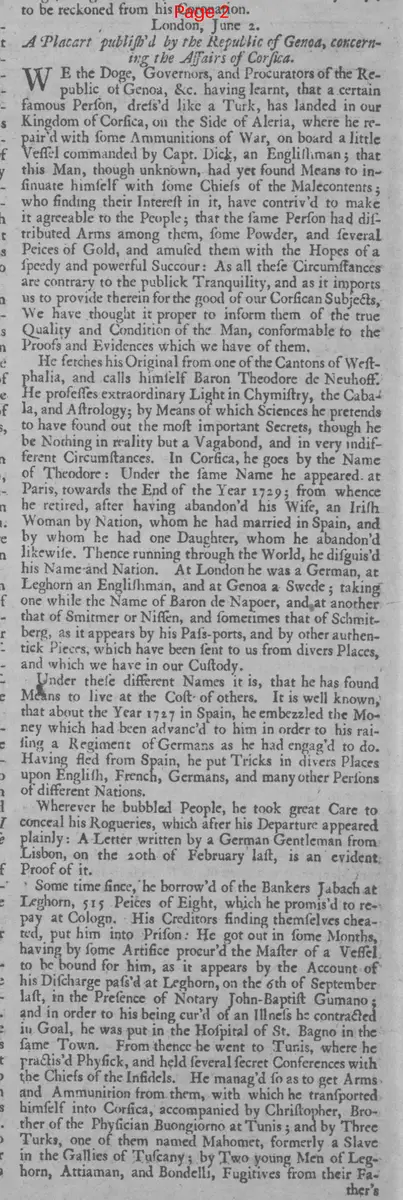
London, June 2.
A Placart publish'd by the Republic of Genoa, concerning the Affairs of Corsica.
WE the Doge, Governors, and Procurators of the Republic of Genoa, &c. having learnt, that a certain famous Person, dress'd like a Turk, has landed in our Kingdom of Corsica, on the Side of Aleria, where he repair'd with some Ammunitions of War, on board a little Vessel commanded by Capt. Dick, an Englishman; that this Man, though unknown, had yet found Means to insinuate himself with some Chiefs of the Malecontents; who finding their Interest in it, have contriv'd to make it agreeable to the People; that the same Person had distributed Arms among them, some Powder, and several Pieces of Gold, and amused them with the Hopes of a speedy and powerful Succour: As all these Circumstances are contrary to the publick Tranquility, and as it imports us to provide therein for the good of our Corsican Subjects, We have thought it proper to inform them of the true Quality and Condition of the Man, conformable to the Proofs and Evidences which we have of them.
He fetches his Original from one of the Cantons of Westphalia, and calls himself Baron Theodore de Neuhoff. He professes extraordinary Light in Chymistry, the Cabala, and Astrology; by Means of which Sciences he pretends to have found out the most important Secrets, though he be Nothing in reality but a Vagabond, and in very indifferent Circumstances. In Corsica, he goes by the Name of Theodore: Under the same Name he appeared at Paris, towards the End of the Year 1729; from whence he retired, after having abandon'd his Wife, an Irish Woman by Nation, whom he had married in Spain, and by whom he had one Daughter, whom he abandon'd likewise. Thence running through the World, he disguis'd his Name and Nation. At London he was a German, at Leghorn an Englishman, and at Genoa a Swede; taking one while the Name of Baron de Napoer, and at another that of Smitmer or Nissen, and sometimes that of Schmitberg, as it appears by his Pass-ports, and by other authentick Pieces, which have been sent to us from divers Places, and which we have in our Custody.
Under these different Names it is, that he has found Means to live at the Cost of others. It is well known, that about the Year 1727 in Spain, he embezzled the Money which had been advanc'd to him in order to his raising a Regiment of Germans as he had engag'd to do. Having fled from Spain, he put Tricks in divers Places upon English, French, Germans, and many other Persons of different Nations.
Wherever he bubbled People, he took great Care to conceal his Rogueries, which after his Departure appeared plainly: A Letter written by a German Gentleman from Lisbon, on the 20th of February last, is an evident Proof of it.
Some time since, he borrow'd of the Bankers Jabach at Leghorn, 515 Pieces of Eight, which he promis'd to repay at Cologn. His Creditors finding themselves cheated, put him into Prison: He got out in some Months, having by some Artifice procur'd the Master of a Vessel to be bound for him, as it appears by the Account of his Discharge pass'd at Leghorn, on the 6th of September last, in the Presence of Notary John-Baptist Gumano: and in order to his being cur'd of an Illness he contracted in Goal, he was put in the Hospital of St. Bagno in the same Town. From thence he went to Tunis, where he practis'd Physick, and held several secret Conferences with the Chiefs of the Infidels. He manag'd so as to get Arms and Ammunition from them, with which he transported himself into Corsica, accompanied by Christopher, Brother of the Physician Buongiorno at Tunis; and by Three Turks, one of them named Mahomet, formerly a Slave in the Gallies of Tuscany; by Two young Men of Leghorn, Attiaman, and Bondelli, Fugitives from their Fa-
their House; and by a Priest of Porto Ferrajo, whom the Missionary Fathers of Tunis thought fit to send at a Distance for good Reasons.
In Consequence of what is said above, and forasmuch as this Man has dared to thrust himself into the Government of Corsica, and turn aside our Subjects maliciously from the Fidelity which they owe to their natural Sovereign; since besides, it may be feared that a Man whose Conduct and Maxims are too depraved, may create great Trouble among our Subjects; we have judged it convenient to publish the aforesaid Account, and to declare, as we do declare by this Placart, that the aforesaid pretended Baron de Neuhoff, actual Author of new Insurrections, Seducer of the People, Disturber of the public Tranquility, is guilty of High Treason and Rebellion, and as such, deserving of all the Punishments prescribed by our Laws, forbidding all Persons whatever to have any Correspondence or Commerce with him; and declaring worthy of the same Punishments, guilty of Rebellion, and Disturbers of the public Repose, all those who shall lend him any Succour or Assistance, or who shall follow him, in order to increase the Revolt, and trouble the Quiet of our People. Done in our Royal Palace, the 9th of May. Signed, Giuseppe Maria.
Three more Ships without Colours are arrived at Corsica with Troops, and vast Quantities of Arms and Ammunition. The Title of Viceroy, which the Baron at first took upon himself, implied his acting under some Principal, and all Eyes were turned toward Spain; but the supreme Royalty which he has now assumed, has thrown the World into a new Surprize, and an Impatience to have the Springs of so extraordinary an Event discovered.
What sub-type of article is it?
Rebellion Or Revolt
Political
What keywords are associated?
Genoa Placart
Neuhoff Impostor
Corsican Revolt
Arms Shipments
Theodore King
What entities or persons were involved?
Baron Theodore De Neuhoff
Doge Giuseppe Maria
Where did it happen?
Corsica
Foreign News Details
Primary Location
Corsica
Event Date
9th Of May
Key Persons
Baron Theodore De Neuhoff
Doge Giuseppe Maria
Outcome
neuhoff declared guilty of high treason and rebellion; subjects forbidden to assist him; further ships with troops and arms arrive at corsica.