Thank you for visiting SNEWPapers!
Sign up free
The New Hampshire Gazette Editorial January 14, 1763
Portsmouth, Rockingham, New Hampshire
What is this article about?
Observes that Empress Maria Theresa continues war against Prussia despite losing Russia and Sweden as allies, finding men and money at home, unlike her earlier pleas for British aid; argues British humanity is played upon.
Quality green show the numbers
Measured from the scan
— how cleanly the OCR engine read the characters
- Mean ink quality
- 97.0% The length-weighted average confidence across the OCR lines — the mean of exactly the per-line scores whose tails the two figures below report. Typical is 99%.
- Illegible ink
- 0.0% Text sitting in OCR-detected lines that scored below 80% confidence — very shaky reads. Weighted by line length, so one long bad line counts for more than a short one.
- Uncertain ink
- 0.0% Text in lines that scored 80–90% — somewhat shaky reads.
- Matches source
- 93.04% How closely the served text matches the raw OCR of the same boxes, letter by letter, after collapsing spacing and case. This measures agreement, not correctness: the OCR is often wrong and the extractor corrects it, so 100% does not mean perfect, and a low figure usually means poor scan text was rewritten rather than that text was lost (length vs source shows loss).
- Length vs source
- 99.81% Below 100% means text was dropped from the OCR; above means text was added to make it read.
Assembled by the extraction model
— whether the stitched-together text holds up; catches layout and segmentation errors, which the scores above cannot see
- Transcription confidence
- 94.0% (typical 96%) How cleanly the extractor could assemble what it was given. Low here with clean ink scores points at layout analysis — the characters were read correctly but grouped or ordered wrongly.
- Comprehension
- 88.0% Whether the piece reads coherently start to finish. Can stay high while transcription confidence drops, when only part of the component is affected.
Clipping
Full Text
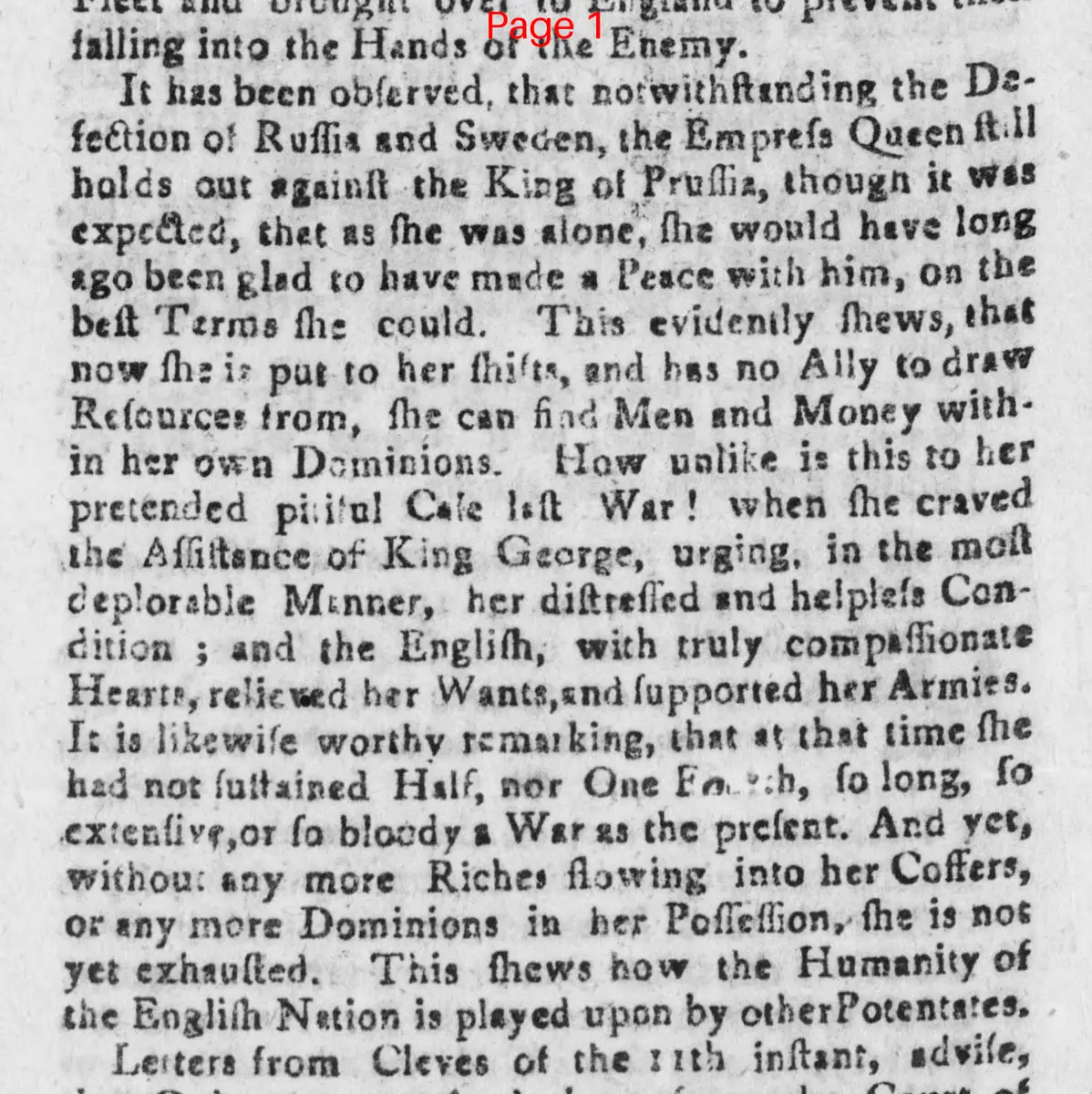
It has been observed, that notwithstanding the Defection of Russia and Sweden, the Empress Queen still holds out against the King of Prussia, though it was expected, that as she was alone, she would have long ago been glad to have made a Peace with him, on the best Terms she could. This evidently shews, that now she is put to her shifts, and has no Ally to draw Resources from, she can find Men and Money within her own Dominions. How unlike is this to her pretended pitiful Case last War! when she craved the Assistance of King George, urging, in the most deplorable Manner, her distressed and helpless Condition; and the English, with truly compassionate Hearts, relieved her Wants, and supported her Armies. It is likewise worthy remarking, that at that time she had not sustained Half, nor One Fourth, so long, so extensive, or so bloody a War as the present. And yet, without any more Riches flowing into her Coffers, or any more Dominions in her Possession, she is not yet exhausted. This shews how the Humanity of the English Nation is played upon by other Potentates.
What sub-type of article is it?
Foreign Affairs
War Or Peace
What keywords are associated?
Empress Queen
Maria Theresa
King Of Prussia
Seven Years' War
British Aid
Russia And Sweden
What entities or persons were involved?
Empress Queen (Maria Theresa)
King Of Prussia (Frederick Ii)
King George
Russia
Sweden
Editorial Details
Primary Topic
Maria Theresa's Continued Resistance To Prussia And Her Earlier Appeals For British Support
Stance / Tone
Critical, Ironic; Resentment At Exploited British Generosity
Key Figures
Empress Queen (Maria Theresa)
King Of Prussia (Frederick Ii)
King George
Russia
Sweden
Key Arguments
- Despite the defection of Russia and Sweden, the Empress Queen still holds out against Prussia
- She can find men and money within her own dominions when put to her shifts
- Her earlier distressed and helpless case, which drew British aid, was exaggerated
- The Humanity of the English Nation is played upon by other Potentates