Thank you for visiting SNEWPapers!
Sign up free
The New Hampshire Gazette And Historical Chronicle Foreign News May 11, 1770
Portsmouth, Rockingham, New Hampshire
What is this article about?
A Portsmouth letter recounts Captain O'Hara's death: while fixing the British flag on an old fort, a misunderstanding made his tender's crew fire on the Moors, killing nearly twenty; O'Hara was captured and died of fever within a week.
Quality green show the numbers
Measured from the scan
— how cleanly the OCR engine read the characters
- Mean ink quality
- 99.0% The length-weighted average confidence across the OCR lines — the mean of exactly the per-line scores whose tails the two figures below report. Typical is 99%.
- Illegible ink
- 0.0% Text sitting in OCR-detected lines that scored below 80% confidence — very shaky reads. Weighted by line length, so one long bad line counts for more than a short one.
- Uncertain ink
- 0.0% Text in lines that scored 80–90% — somewhat shaky reads.
- Matches source
- 96.93% How closely the served text matches the raw OCR of the same boxes, letter by letter, after collapsing spacing and case. This measures agreement, not correctness: the OCR is often wrong and the extractor corrects it, so 100% does not mean perfect, and a low figure usually means poor scan text was rewritten rather than that text was lost (length vs source shows loss).
- Length vs source
- 99.5% Below 100% means text was dropped from the OCR; above means text was added to make it read.
Assembled by the extraction model
— whether the stitched-together text holds up; catches layout and segmentation errors, which the scores above cannot see
- Transcription confidence
- 98.0% (typical 96%) How cleanly the extractor could assemble what it was given. Low here with clean ink scores points at layout analysis — the characters were read correctly but grouped or ordered wrongly.
- Comprehension
- 95.0% Whether the piece reads coherently start to finish. Can stay high while transcription confidence drops, when only part of the component is affected.
Clipping
Full Text
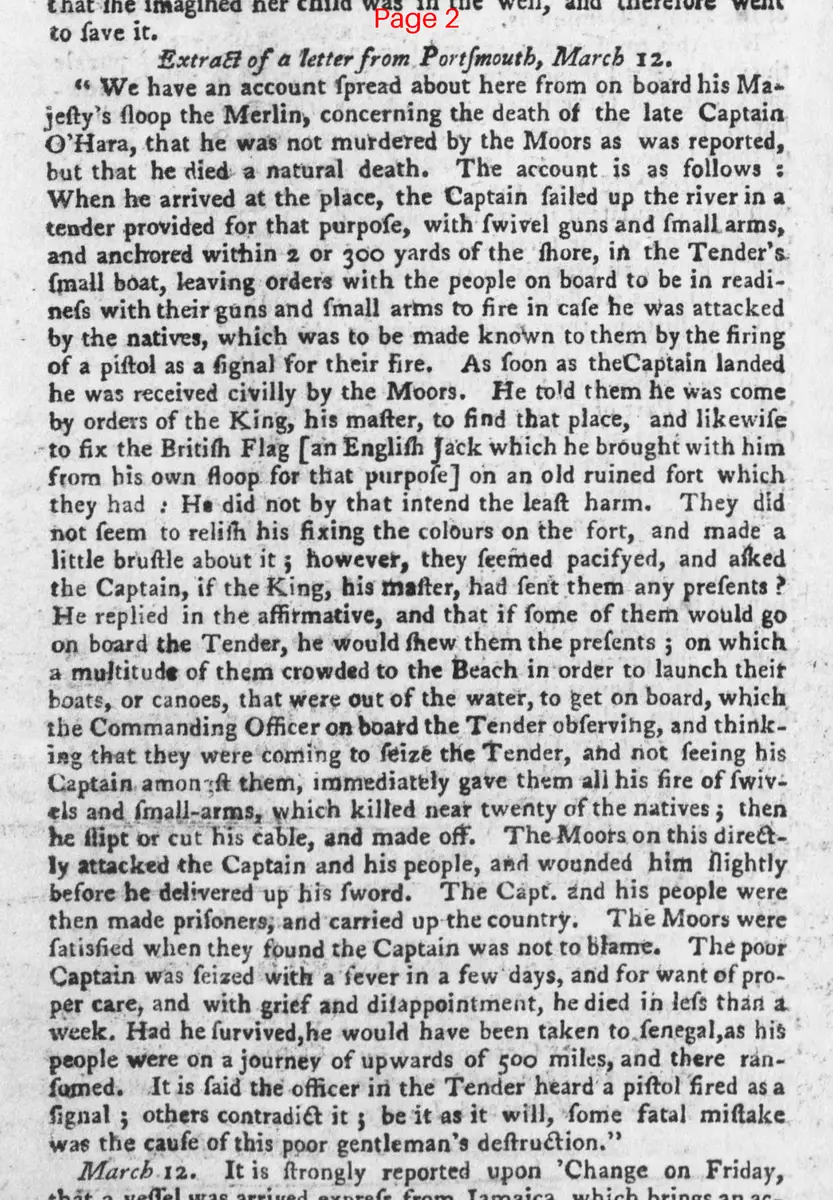
Extract of a letter from Portsmouth, March 12.
"We have an account spread about here from on board his Majesty's sloop the Merlin, concerning the death of the late Captain O'Hara, that he was not murdered by the Moors as was reported, but that he died a natural death. The account is as follows: When he arrived at the place, the Captain sailed up the river in a tender provided for that purpose, with swivel guns and small arms, and anchored within 2 or 300 yards of the shore, in the Tender's small boat, leaving orders with the people on board to be in readiness with their guns and small arms to fire in case he was attacked by the natives, which was to be made known to them by the firing of a pistol as a signal for their fire. As soon as the Captain landed he was received civilly by the Moors. He told them he was come by orders of the King, his master, to find that place, and likewise to fix the British Flag [an English Jack which he brought with him from his own sloop for that purpose] on an old ruined fort which they had: He did not by that intend the least harm. They did not seem to relish his fixing the colours on the fort, and made a little bustle about it; however, they seemed pacified, and asked the Captain, if the King, his master, had sent them any presents? He replied in the affirmative, and that if some of them would go on board the Tender, he would show them the presents; on which a multitude of them crowded to the Beach in order to launch their boats, or canoes, that were out of the water, to get on board, which the Commanding Officer on board the Tender observing, and thinking that they were coming to seize the Tender, and not seeing his Captain amongst them, immediately gave them all his fire of swivels and small-arms, which killed near twenty of the natives; then he slipped or cut his cable, and made off. The Moors on this directly attacked the Captain and his people, and wounded him slightly before he delivered up his sword. The Capt. and his people were then made prisoners, and carried up the country. The Moors were satisfied when they found the Captain was not to blame. The poor Captain was seized with a fever in a few days, and for want of proper care, and with grief and disappointment, he died in less than a week. Had he survived, he would have been taken to Senegal, as his people were on a journey of upwards of 900 miles, and there ransomed. It is said the officer in the Tender heard a pistol fired as a signal; others contradict it; be it as it will, some fatal mistake was the cause of this poor gentleman's destruction."
What sub-type of article is it?
Naval Affairs
Colonial Affairs
What keywords are associated?
Captain O'hara
Death Moors
Senegal
British Flag Fort
What entities or persons were involved?
Captain O'hara
Where did it happen?
Senegal
Foreign News Details
Primary Location
Senegal
Event Date
March 12
Key Persons
Captain O'hara
Outcome
nearly twenty natives killed; captain o'hara taken prisoner and died of fever within a week.