Thanks for visiting SNEWPapers!
Sign up free today to connect your AI tools to the Library of Congress' newspaper collection.
The New Hampshire Gazette And Historical Chronicle Letter to Editor July 15, 1768
Portsmouth, Rockingham, New Hampshire
What is this article about?
A Cambridge letter to the printers of July 1768, signed J. Winthrop, describing how a violent thunderstorm struck Hollis Hall while buildings fitted with pointed lightning rods, including Harvard Hall, escaped — confirming Benjamin Franklin's theory of electricity and the protective value of pointed conductors.
Quality green show the numbers
Measured from the scan
— how cleanly the OCR engine read the characters
- Mean ink quality
- 99.0% The length-weighted average confidence across the OCR lines — the mean of exactly the per-line scores whose tails the two figures below report. Typical is 99%.
- Illegible ink
- 0.0% Text sitting in OCR-detected lines that scored below 80% confidence — very shaky reads. Weighted by line length, so one long bad line counts for more than a short one.
- Uncertain ink
- 0.0% Text in lines that scored 80–90% — somewhat shaky reads.
- Matches source
- 96.53% How closely the served text matches the raw OCR of the same boxes, letter by letter, after collapsing spacing and case. This measures agreement, not correctness: the OCR is often wrong and the extractor corrects it, so 100% does not mean perfect, and a low figure usually means poor scan text was rewritten rather than that text was lost (length vs source shows loss).
- Length vs source
- 99.84% Below 100% means text was dropped from the OCR; above means text was added to make it read.
Assembled by the extraction model
— whether the stitched-together text holds up; catches layout and segmentation errors, which the scores above cannot see
- Transcription confidence
- 97.0% (typical 96%) How cleanly the extractor could assemble what it was given. Low here with clean ink scores points at layout analysis — the characters were read correctly but grouped or ordered wrongly.
- Comprehension
- 95.0% Whether the piece reads coherently start to finish. Can stay high while transcription confidence drops, when only part of the component is affected.
Clipping
Full Text
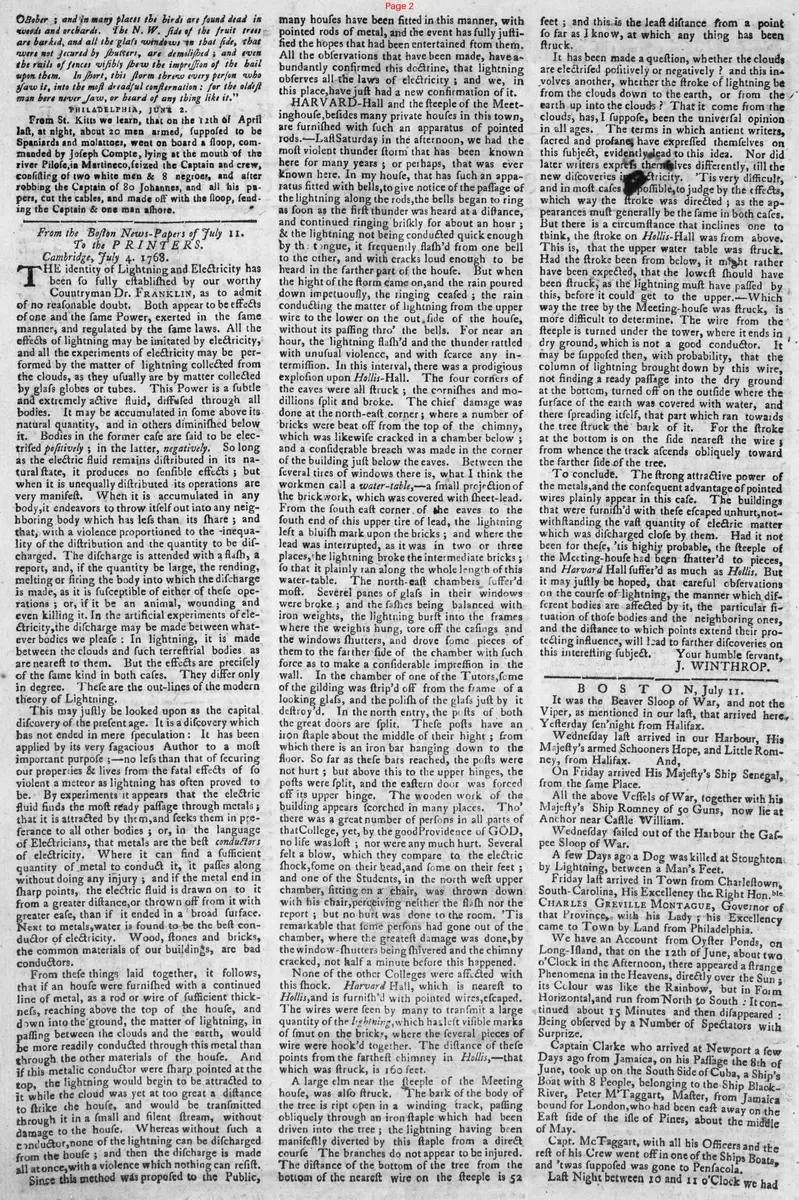
From the Boston News-Papers of July 11.
To the PRINTERS.
Cambridge, July 4. 1768.
been so fully established by our worthy Countryman Dr. FRANKLIN, as to admit of no reasonable doubt. Both appear to be effects of one and the same Power, exerted in the same manner, and regulated by the same laws. All the effects of lightning may be imitated by electricity, and all the experiments of electricity may be performed by the matter of lightning collected from the clouds, as they usually are by matter collected by glass globes or tubes. This Power is a subtle and extremely active fluid, diffused through all bodies. It may be accumulated in some above its natural quantity, and in others diminished below it. Bodies in the former case are said to be electrified positively; in the latter, negatively. So long as the electric fluid remains distributed in its natural state, it produces no sensible effects; but when it is unequally distributed its operations are very manifest. When it is accumulated in any body, it endeavors to throw itself out into any neighboring body which has less than its share; and that, with a violence proportioned to the inequality of the distribution and the quantity to be discharged. The discharge is attended with a flash, a report, and, if the quantity be large, the rending, melting or firing the body into which the discharge is made, as it is susceptible of either of these operations; or, if it be an animal, wounding and even killing it. In the artificial experiments of electricity, the discharge may be made between whatever bodies we please: In lightning, it is made between the clouds and such terrestrial bodies, as are nearest to them. But the effects are precisely of the same kind in both cases. They differ only in degree. These are the out-lines of the modern theory of Lightning.
This may justly be looked upon as the capital discovery of the present age. It is a discovery which has not ended in mere speculation: It has been applied by its very sagacious Author to a most important purpose;—no less than that of securing our properties & lives from the fatal effects of so violent a meteor as lightning has often proved to be. By experiments it appears that the electric fluid finds the most ready passage through metals; that it is attracted by them, and seeks them in preference to all other bodies; or, in the language of Electricians, that metals are the best conductors of electricity. Where it can find a sufficient quantity of metal to conduct it, it passes along without doing any injury; and if the metal end in sharp points, the electric fluid is drawn on to it from a greater distance, or thrown off from it with greater ease, than if it ended in a broad surface. Next to metals, water is found to be the best conductor of electricity. Wood, stones and bricks, the common materials of our buildings, are bad conductors.
From these things laid together, it follows, that if a house were furnished with a continued line of metal, as a rod or wire of sufficient thickness, reaching above the top of the house, and down into the ground, the matter of lightning, in passing between the clouds and the earth, would be more readily conducted through this metal than through the other materials of the house. And if this metallic conductor were sharp pointed at the top, the lightning would begin to be attracted to it while the cloud was yet at too great a distance to strike the house, and would be transmitted through it in a small and silent stream, without damage to the house. Whereas without such a conductor, none of the lightning can be discharged from the house; and then the discharge is made all at once, with a violence which nothing can resist.
Since this method was proposed to the Public, many houses have been fitted in this manner, with pointed rods of metal, and the event has fully justified the hopes that had been entertained from them. All the observations that have been made, have abundantly confirmed this doctrine, that lightning observes all the laws of electricity; and we, in this place, have just had a new confirmation of it.
HARVARD-Hall and the steeple of the Meeting-house, besides many private houses in this town, are furnished with such an apparatus of pointed rods.—Last Saturday in the afternoon, we had the most violent thunder storm that has been known here for many years; or perhaps, that was ever known here. In my house, that has such an apparatus fitted with bells, to give notice of the passage of the lightning along the rods, the bells began to ring as soon as the first thunder was heard at a distance, and continued ringing briskly for about an hour; & the lightning not being conducted quick enough by the tongue, it frequently flash'd from one bell to the other, and with cracks loud enough to be heard in the farther part of the house. But when the height of the storm came on, and the rain poured down impetuously, the ringing ceased; the rain conducting the matter of lightning from the upper wire to the lower on the outside of the house, without its passing thro' the bells. For near an hour, the lightning flash'd and the thunder rattled with unusual violence, and with scarce any intermission. In this interval, there was a prodigious explosion upon Hollis-Hall. The four corners of the eaves were all struck; the cornishes and modillions split and broke. The chief damage was done at the north-east corner; where a number of bricks were beat off from the top of the chimney, which was likewise cracked in a chamber below; and a considerable breach was made in the corner of the building just below the eaves. Between the several tires of windows there is, what I think the workmen call a water-table, a small projection of the brickwork, which was covered with sheet-lead. From the south east corner, of the eaves to the south end of this upper tire of lead, the lightning left a bluish mark upon the bricks; and where the lead was interrupted, as it was in two or three places, the lightning broke the intermediate bricks; so that it plainly ran along the whole length of this water-table. The north-east chambers suffer'd most. Several panes of glass in their windows were broke; and the sashes being balanced with iron weights, the lightning burst into the frames where the weights hung, tore off the casings and the window shutters, and drove some pieces of them to the farther side of the chamber with such force as to make a considerable impression in the wall. In the chamber of one of the Tutors, some of the gilding was strip'd off from the frame of a looking glass, and the polish of the glass just by it destroy'd. In the north entry, the posts of both the great doors are split. These posts have an iron staple about the middle of their height; from which there is an iron bar hanging down to the floor. So far as these bars reached, the posts were not hurt; but above this to the upper hinges, the posts were split, and the eastern door was forced off its upper hinge. The wooden work of the building appears scorched in many places. Tho' there was a great number of persons in all parts of that College, yet, by the good Providence of GOD, no life was lost; nor were any much hurt. Several felt a blow, which they compare to the electric shock, some on their head, and some on their feet; and one of the Students, in the north west upper chamber, sitting on a chair, was thrown down with his chair, perceiving neither the flash nor the report; but no hurt was done to the room, 'Tis remarkable that some persons had gone out of the chamber, where the greatest damage was done, by the window-shutters being shivered and the chimney cracked, not half a minute before this happened.
None of the other Colleges were affected with this shock. Harvard Hall, which is nearest to Hollis, and is furnish'd with pointed wires, escaped. The wires were seen by many to transmit a large quantity of the lightning, which has left visible marks of smut on the bricks, where the several pieces of wire were hook'd together. The distance of these points from the farthest chimney in Hollis,—that which was struck, is 160 feet.
A large elm near the steeple of the Meeting-house, was also struck. The bark of the body of the tree is ript open in a winding track, passing obliquely through an iron staple which had been driven into the tree; the lightning having been manifestly diverted by this staple from a direct course. The branches do not appear to be injured. The distance of the bottom of the tree from the bottom of the nearest wire on the steeple is 52 feet; and this is the least distance from a point, so far as I know, at which any thing has been struck.
It has been made a question, whether the clouds are electrified positively or negatively? and this involves another, whether the stroke of lightning be from the clouds down to the earth, or from the earth up into the clouds? That it come from the clouds, has, I suppose, been the universal opinion in all ages. The terms in which ancient writers, sacred and profane, have expressed themselves on this subject, evidently lead to this idea. Nor did later writers express themselves differently, till the new discoveries in electricity. 'Tis very difficult, and in most cases impossible, to judge by the effects, which way the stroke was directed; as the appearances must generally be the same in both cases. But there is a circumstance that inclines one to think, the stroke on Hollis-Hall was from above. This is, that the upper water table was struck. Had the stroke been from below, it might rather have been expected, that the lowest should have been struck, as the lightning must have passed by this, before it could get to the upper.—Which way the tree by the Meeting-house was struck, is more difficult to determine. The wire from the steeple is turned under the tower, where it ends in dry ground, which is not a good conductor. It may be supposed then, with probability, that the column of lightning brought down by this wire, not finding a ready passage into the dry ground at the bottom, turned off on the outside where the surface of the earth was covered with water, and there spreading itself, that part which ran towards the tree struck the bark of it. For the stroke at the bottom is on the side nearest the wire; from whence the track ascends obliquely toward the farther side of the tree.
To conclude. The strong attractive power of the metals, and the consequent advantage of pointed wires plainly appear in this case. The buildings that were furnish'd with these escaped unhurt, notwithstanding the vast quantity of electric matter which was discharged close by them. Had it not been for these, 'tis highly probable, the steeple of the Meeting-house had been shattered to pieces, and Harvard Hall suffer'd as much as Hollis. But it may justly be hoped, that careful observations on the course of lightning, the manner which different bodies are affected by it, the particular situation of those bodies and the neighboring ones, and the distance to which points extend their protecting influence, will lead to farther discoveries on this interesting subject.
Your humble servant,
J. WINTHROP.
What sub-type of article is it?
Informative
Historical
What themes does it touch?
Science Nature
What keywords are associated?
Lightning
Electricity
Franklin's Theory
Lightning Rods
Hollis Hall
Harvard Hall
Thunderstorm
What entities or persons were involved?
The Printers
J. Winthrop
Letter to Editor Details
Author
J. Winthrop
Recipient
The Printers
Main Argument
The recent storm at Cambridge confirms Franklin's theory that lightning follows the laws of electricity and that pointed metal rods protect buildings from lightning damage.
Notable Details
- Bells attached to the rod rang during the storm
- Hollis Hall suffered damage at the corners, chimneys, windows and doors
- Harvard Hall, fitted with pointed wires, escaped unhurt
- An elm tree near the Meeting-house steeple was struck, with the lightning diverted by an iron staple
- Author considers whether the stroke came from cloud to earth or earth to cloud