Thank you for visiting SNEWPapers!
Sign up free
Fowle's New Hampshire Gazette And General Advertiser Editorial March 11, 1785
Portsmouth, Rockingham, New Hampshire
What is this article about?
An editorial proposing a tax on old maids and bachelors, drawing an analogy to Caesar's rewards for citizens with many children.
Quality green show the numbers
Measured from the scan
— how cleanly the OCR engine read the characters
- Mean ink quality
- 99.0% The length-weighted average confidence across the OCR lines — the mean of exactly the per-line scores whose tails the two figures below report. Typical is 99%.
- Illegible ink
- 0.0% Text sitting in OCR-detected lines that scored below 80% confidence — very shaky reads. Weighted by line length, so one long bad line counts for more than a short one.
- Uncertain ink
- 0.0% Text in lines that scored 80–90% — somewhat shaky reads.
- Matches source
- 96.95% How closely the served text matches the raw OCR of the same boxes, letter by letter, after collapsing spacing and case. This measures agreement, not correctness: the OCR is often wrong and the extractor corrects it, so 100% does not mean perfect, and a low figure usually means poor scan text was rewritten rather than that text was lost (length vs source shows loss).
- Length vs source
- 98.83% Below 100% means text was dropped from the OCR; above means text was added to make it read.
Assembled by the extraction model
— whether the stitched-together text holds up; catches layout and segmentation errors, which the scores above cannot see
- Transcription confidence
- 97.0% (typical 96%) How cleanly the extractor could assemble what it was given. Low here with clean ink scores points at layout analysis — the characters were read correctly but grouped or ordered wrongly.
- Comprehension
- 90.0% Whether the piece reads coherently start to finish. Can stay high while transcription confidence drops, when only part of the component is affected.
Clipping
Full Text
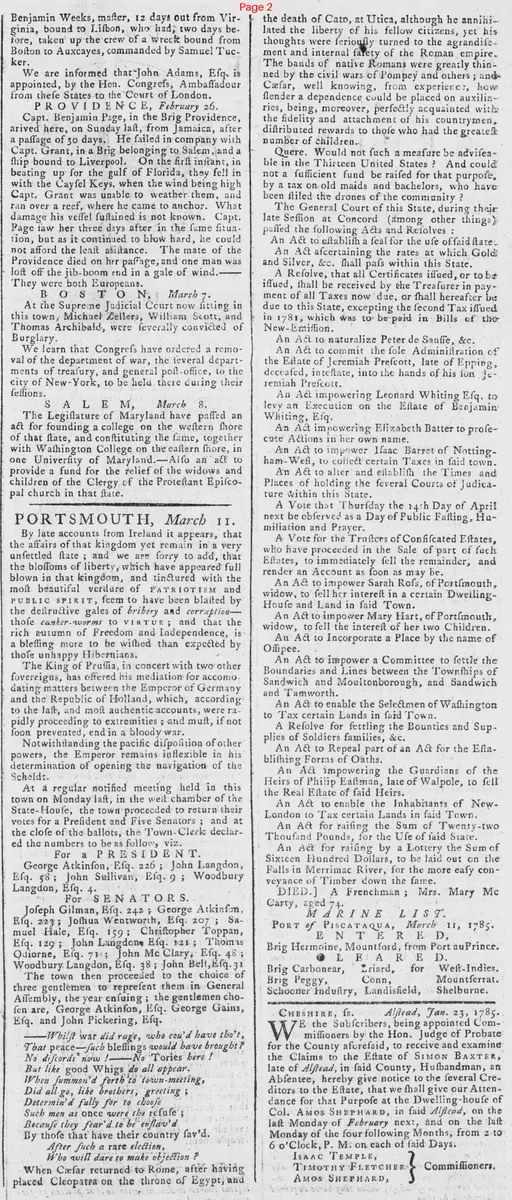
When Cæsar returned to Rome, after having placed Cleopatra on the throne of Egypt, and the death of Cato, at Utica, although he annihilated the liberty of his fellow citizens, yet his thoughts were seriously turned to the aggrandizement and internal safety of the Roman empire. The bands of native Romans were greatly thinned by the civil wars of Pompey and others; and Cæsar, well knowing, from experience, how slender a dependence could be placed on auxiliaries, being, moreover, perfectly acquainted with the fidelity and attachment of his countrymen, distributed rewards to those who had the greatest number of children.
Quere. Would not such a measure be advisable in the Thirteen United States? And could not a sufficient fund be raised for that purpose, by a tax on old maids and bachelors, who have been styled the drones of the community?
What sub-type of article is it?
Taxation
What keywords are associated?
Tax On Bachelors
Population Encouragement
Caesar Analogy
What entities or persons were involved?
Caesar
Thirteen United States
Editorial Details
Primary Topic
Proposal To Tax Bachelors And Old Maids To Encourage Population Growth
Stance / Tone
Suggestive, Mildly Satirical
Key Figures
Caesar
Thirteen United States
Key Arguments
- Caesar rewarded those with many children.
- Such a measure could be advisable in the United States.
- A fund could be raised by taxing old maids and bachelors.