Thanks for visiting SNEWPapers!
Sign up free today to connect your AI tools to the Library of Congress' newspaper collection.
The Massachusetts Spy, Or, Thomas's Boston Journal Letter to Editor January 14, 1773
Boston, Suffolk, Massachusetts
What is this article about?
A reader letter to the Massachusetts Spy narrating the ecclesiastical proceedings that led to the dismissal of Rev. Aaron Hutchinson as pastor of the church at Grafton, detailing repeated confessions and council findings of falsehood, and questioning the honour of his dismission.
Quality green show the numbers
Measured from the scan
— how cleanly the OCR engine read the characters
- Mean ink quality
- 98.0% The length-weighted average confidence across the OCR lines — the mean of exactly the per-line scores whose tails the two figures below report. Typical is 99%.
- Illegible ink
- 0.0% Text sitting in OCR-detected lines that scored below 80% confidence — very shaky reads. Weighted by line length, so one long bad line counts for more than a short one.
- Uncertain ink
- 0.0% Text in lines that scored 80–90% — somewhat shaky reads.
- Matches source
- 94.01% How closely the served text matches the raw OCR of the same boxes, letter by letter, after collapsing spacing and case. This measures agreement, not correctness: the OCR is often wrong and the extractor corrects it, so 100% does not mean perfect, and a low figure usually means poor scan text was rewritten rather than that text was lost (length vs source shows loss).
- Length vs source
- 98.38% Below 100% means text was dropped from the OCR; above means text was added to make it read.
Assembled by the extraction model
— whether the stitched-together text holds up; catches layout and segmentation errors, which the scores above cannot see
- Transcription confidence
- 94.0% (typical 96%) How cleanly the extractor could assemble what it was given. Low here with clean ink scores points at layout analysis — the characters were read correctly but grouped or ordered wrongly.
- Comprehension
- 95.0% Whether the piece reads coherently start to finish. Can stay high while transcription confidence drops, when only part of the component is affected.
Clipping
Full Text
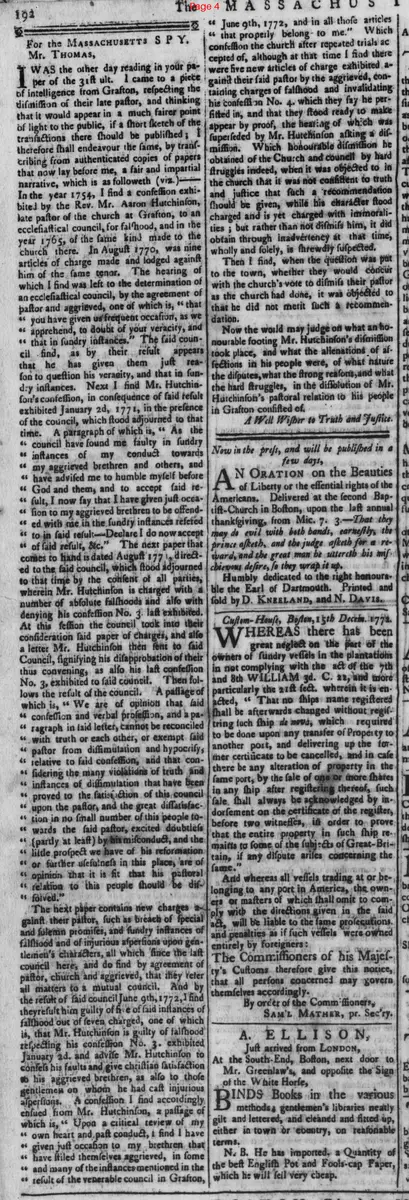
For the Massachusetts Spy.
Mr. THOMAS,
I was the other day reading in your paper of the 6th ult. I came to a piece of intelligence from Grafton, respecting the dismission of their late pastor, and thinking that it would appear in a much fairer point of light to the public, if a short sketch of the transactions there should be published; therefore shall endeavour the same, by transcribing from authenticated copies of papers that now lay before me, a fair and impartial narrative, which is as followeth (viz.)
In the year 1754, I find a confession exhibited by the Rev. Mr. Aaron Hutchinson, late pastor of the church at Grafton, to an ecclesiastical council, for falsehood, and in the year 1765, of the same kind made to the church there. In August 1770, were nine articles of charge made and lodged against him of the same tenor. The hearing of which I find was left to the determination of an ecclesiastical council, by the agreement of pastor and aggrieved, one of which is, "that you have given us frequent occasion, as we apprehend, to doubt of your veracity, and that in sundry instances." The said council find, as by their result appears, that he has given them just reason to question his veracity, and that in sundry instances.
Next I find Mr. Hutchinson's confession, in consequence of said result, exhibited January 2d, 1771, in the presence of the council, which stood adjourned to that time. A paragraph of which is, "As the council have found me faulty in sundry instances of my conduct towards my aggrieved brethren and others, and have advised me to humble myself before God and them, and to accept said result, I now say that I have given just occasion to my aggrieved brethren to be offended with me in the sundry instances referred to in said result. Declare I do now accept of said result, &c."
The next paper that comes to hand is dated August 1771, directed to the said council, which stood adjourned to that time by the consent of all parties, wherein Mr. Hutchinson is charged with a number of absolute falsehoods and also with denying his confession No. 3 last exhibited.
At this session the council took into their consideration said paper of charges, and also a letter Mr. Hutchinson then sent to said council, signifying his disapprobation of their thus convening, as also his last confession No. 3, exhibited to said council. Then follows the result of the council. A passage of which is, "We are of opinion that said confession and verbal profession, and a paragraph in said letter, cannot be reconciled with truth or each other, or exempt said pastor from dissimulation and hypocrisy relative to said confession, and that considering the many violations of truth and instances of dissimulation that have been proved to the satisfaction of this council upon the pastor, and the great dissatisfaction in no small number of this people towards the said pastor, excited doubtless (partly at least) by his misconduct, and the little prospect we have of his reformation or further usefulness in this place, are of opinion that it is fit that his pastoral relation to this people should be dissolved."
The next paper contains new charges against their pastor, such as breach of special and solemn promises, and sundry instances of falsehood and of injurious aspersions upon gentlemen's characters, all which since the last council here, and do find by agreement of pastor, church and aggrieved, that they refer all matters to a mutual council. And by the result of said council June 9th, 1772, I find they result him guilty of five of said instances of falsehood out of seven charged, one of which is, that Mr. Hutchinson is guilty of falsehood respecting his confession No. 3 exhibited January 2d. and advise Mr. Hutchinson to confess his faults and give Christian satisfaction to his aggrieved brethren, as also to those gentlemen on whom he had cast injurious aspersions.
A confession I find accordingly ensued from Mr. Hutchinson, a passage of which is, "Upon a critical review of my own heart and past conduct, I find I have given just occasion to my brethren that have styled themselves aggrieved, in some and many of the instances mentioned in the result of the venerable council in Grafton, June 9th, 1772, and in all those articles that properly belong to me." Which confession the church after repeated trials accepted of, although at that time I find there were five new articles of charge exhibited against their said pastor by the aggrieved, containing charges of falsehood and invalidating his confession No. 4, which they say he persisted in, and that they stood ready to make appear by proof, the hearing of which was superseded by Mr. Hutchinson asking a dismission. Which honourable dismission he obtained of the Church and council by hard struggles indeed, when it was objected to in the church that it was not consistent to truth and justice that such a recommendation should be given, while his character stood charged and is yet charged with immoralities; but rather than not dismiss him, it did obtain through inadvertency at that time, wholly and solely, is shrewdly suspected.
Then I find, when the question was put to the town, whether they would concur with the church's vote to dismiss their pastor as the church had done, it was objected to that he did not merit such a recommendation.
Now the world may judge on what an honourable footing Mr. Hutchinson's dismission took place, and what the alienations of affections in his people were, of what nature the disputes, what the strong reasons, and what the hard struggles, in the dissolution of Mr. Hutchinson's pastoral relation to his people in Grafton consisted of.
A Well Wisher to Truth and Justice.
What sub-type of article is it?
Informative
Historical
Persuasive
What themes does it touch?
Religion
Morality
What keywords are associated?
Rev. Aaron Hutchinson
Grafton Church
Ecclesiastical Council
Pastor Dismissal
Falsehood Confession
Massachusetts Spy
What entities or persons were involved?
Mr. Thomas
A Well Wisher To Truth And Justice
Letter to Editor Details
Author
A Well Wisher To Truth And Justice
Recipient
Mr. Thomas
Main Argument
The council results show Rev. Hutchinson repeatedly confessed to falsehood and dissimulation, and his dismission was obtained only through hard struggles and inadvertency, so it was not honourable.
Notable Details
- Chronicles proceedings from 1754 through 1772
- Multiple confessions (No. 3, No. 4) and charges of falsehood
- Council result of June 9, 1772 found him guilty of five of seven charged instances of falsehood
- Church accepted a confession after repeated trials while five new charges remained
- Question raised in town whether to concur with the church's vote to dismiss