Thank you for visiting SNEWPapers!
Sign up free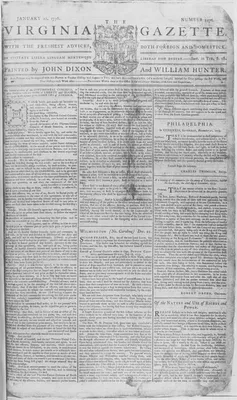
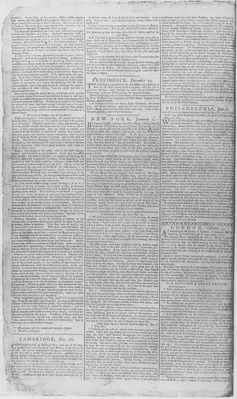
The Virginia Gazette Literary January 20, 1776
Richmond, Richmond, Virginia
What is this article about?
A philosophical essay on the true use of riches and power: both are goods when wielded by the virtuous for others' happiness, and tyranny arises when sovereignty is divorced from the good of the community.
Quality green show the numbers
Measured from the scan
— how cleanly the OCR engine read the characters
- Mean ink quality
- 99.0% The length-weighted average confidence across the OCR lines — the mean of exactly the per-line scores whose tails the two figures below report. Typical is 99%.
- Illegible ink
- 0.0% Text sitting in OCR-detected lines that scored below 80% confidence — very shaky reads. Weighted by line length, so one long bad line counts for more than a short one.
- Uncertain ink
- 0.0% Text in lines that scored 80–90% — somewhat shaky reads.
- Matches source
- 96.08% How closely the served text matches the raw OCR of the same boxes, letter by letter, after collapsing spacing and case. This measures agreement, not correctness: the OCR is often wrong and the extractor corrects it, so 100% does not mean perfect, and a low figure usually means poor scan text was rewritten rather than that text was lost (length vs source shows loss). Across pages, this is the worst fragment.
- Length vs source
- 99.32% Below 100% means text was dropped from the OCR; above means text was added to make it read.
Assembled by the extraction model
— whether the stitched-together text holds up; catches layout and segmentation errors, which the scores above cannot see
- Transcription confidence
- 94.0% (typical 96%) How cleanly the extractor could assemble what it was given. Low here with clean ink scores points at layout analysis — the characters were read correctly but grouped or ordered wrongly.
- Comprehension
- 95.0% Whether the piece reads coherently start to finish. Can stay high while transcription confidence drops, when only part of the component is affected.
Clippings
1 of 2
Full Text
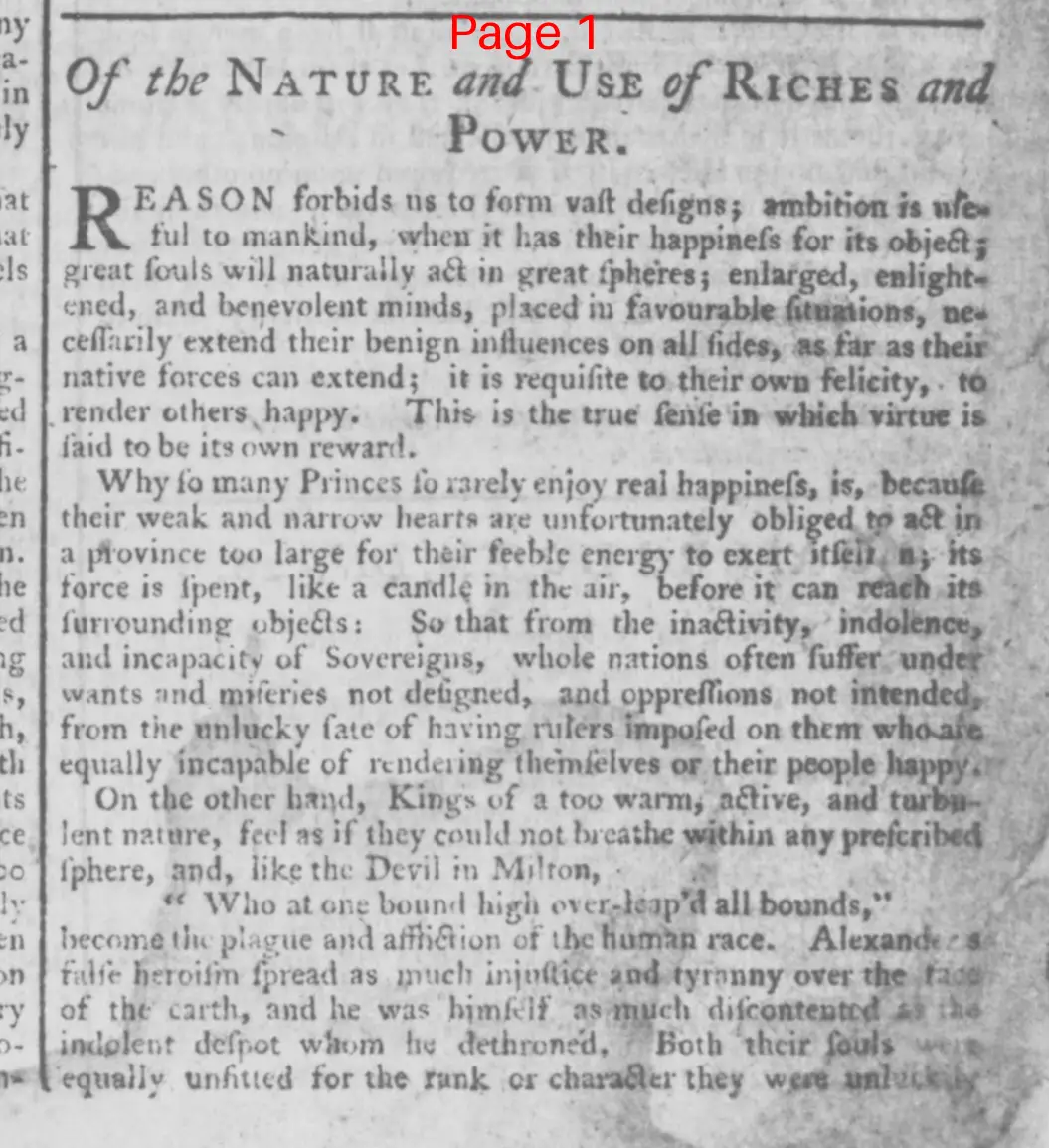
Of the Nature and Use of Riches and POWER.
REASON forbids us to form vast designs; ambition is useful to mankind, when it has their happiness for its object; great souls will naturally act in great spheres; enlarged, enlightened, and benevolent minds, placed in favourable situations, necessarily extend their benign influences on all sides, as far as their native forces can extend; it is requisite to their own felicity, to render others happy. This is the true sense in which virtue is said to be its own reward.
Why so many Princes so rarely enjoy real happiness, is, because their weak and narrow hearts are unfortunately obliged to act in a province too large for their feeble energy to exert itself; its force is spent, like a candle in the air, before it can reach its surrounding objects: So that from the inactivity, indolence, and incapacity of Sovereigns, whole nations often suffer under wants and miseries not designed, and oppressions not intended, from the unlucky fate of having rulers imposed on them who are equally incapable of rendering themselves or their people happy.
On the other hand, Kings of a too warm, active, and turbulent nature, feel as if they could not breathe within any prescribed sphere, and, like the Devil in Milton,
"Who at one bound high over-leap'd all bounds,"
become the plague and affliction of the human race. Alexander's false heroism spread as much injustice and tyranny over the face of the earth, and he was himself as much discontented as the indolent despot whom he dethroned. Both their souls were equally unfitted for the rank or character they were unluckily
placed in. Seneca says, of this warrior, Aestuat infelix angusto limite mundi; post Darium et Indos pauper et Alexander; inventus est qui concupisceret ALIQUID POST OMNIA. One would be apt to imagine, that sovereignty naturally ran into extremes, we so seldom meet with other Kings than Storks or Logs.
The happiness of mankind can result only from a concordance between our situations and desires. Universal monarchy itself is no enjoyment to the possessor, if he knows not how to conduct it towards his own happiness; it is a real evil, if it renders himself unhappy; and a detestable abuse of it, if it makes others so. The greatest Princes are not generally so unhappy, nor their subjects unfortunate, but because they first possess every means of good, without making use of them; or because they know only how to misapply them.
A wise man on a throne, provided he be not so great a fool as Solomon*, must be the happiest mortal breathing. A Monarch of the greatest power is incapable of procuring superior organs, or different sensations from the meanest of his subjects; the only advantages he can boast, arise from the grandeur, the variety, the multiplicity of the objects which occupy his faculties; and which, giving a continual action to his mind, prevent it from stagnating, and becoming a burthen to itself. If his soul be great and virtuous, for in such a station it must be both to render the possessor happy, he must feel his ambition fully compleated, in the consciousness of having his own desires corresponding with the wishes of his subjects; and in the right he has to challenge the admiration and esteem of other nations, from the respect and love he merits from his own.
Such are the conquests which Nature and Reason have pointed out to those whom Providence hath destined to empire; and these objects are sufficiently great to satisfy the most lively imagination, and most extensive ambition. Potentates are never to be deemed the happiest of men, but from having it in their power to create the felicity of a greater number of others; and by these means, meriting the only elogy which can render incense to a noble or a liberal mind:
"All praise is foreign, but of true desert."
These advantages of sovereign power, are enjoyed also by all those ministers, or favourites, who possess any share in the government of nations, Therefore grandeur, rank, and honours, are desirable objects to those who know how to turn them to the account of their own happiness; they are useless to others, not blessed with the faculties or capacity of making them accrue to their own profit; but become a double misfortune, when in pursuit of them we forfeit our own happiness, and sacrifice that of others. And those are strangely infatuated, who pay a deference or respect to men who employ the superiority of talents or fortune to their detriment, which has a claim to honour only when we share the fruits of it.
Riches, superfluous to the miser, who is but their anxious gaoler; and destructive to the profligate, whom they but afflict with diseases, weariness and disgust; are capable of supplying the virtuous man with numberless accessions to his happiness; it is madness or folly to desire opulence, without a proper sense and determined purpose to make a right use of it. Money is but the representative sign of good; to realize it, we must employ it as the means of rendering good to others. Gold, by the arbitrary value fixed upon it among men, is capable of procuring us all the outward advantages of life; but the internal enjoyment of it must arise from a more liberal application of it, than any idle vanity or sensual gratification can possibly afford us.
To have wealth without being capable of using it, is to be in possession of the key of a palace too weighty to lift; to squander it, is to throw the key into the river; and to abuse it, is to knock ourselves down with it. But treasures, in the hands of a person of sense and virtue, are never any manner of incumbrance to him: If he has a great and noble soul, they will be but the counters of his benevolence; and he will relieve himself from the oppression of their weight, by portioning it upon many shoulders. He will be abstemious in his pleasures, in order to enjoy them; he will know that money cannot recruit an exhausted soul, faculties enfeebled by excess, or a body enervated to premature old age; he will know that luxury dries up the very source of pleasure, and that all the riches of the Indies cannot restore a decayed sense.
Nothing, therefore, can be so ridiculous or absurd, as the declamations of gloomy philosophers against the desire of power, grandeur, riches, or pleasure. They have been all abused, and so have health and strength. Why don't such wise heads add these articles, also, to their catalogue of evils? and then the vir sapiens of the Stoics would be a compleat old Beggarman indeed.
Those forbidden objects are desirable by us, when our condition in life will suffer us to pretend to them, and that we have sense and virtue enough to turn them to our real advantage: Reason has no right either to condemn or despise them, when we endeavour after such emoluments, without invading the properties of others; and they rise into objects of the highest esteem, when they are administered toward the happiness of mankind and ourselves.
Pleasure is a good, and it is natural to desire it. Money is the symbol of most of the goods of life: It becomes a real one itself. In the hands of those who know how to render it so. Power is one of the greatest goods, in the possession of men endowed by nature and education with souls sufficiently great, noble, and resolute, to extend their benignant influences over whole nations, which are conquered by benefits, and made subjects in their wills. Such, and such only, have a claim to empire; the right of one man to command another, can be founded only in the happiness or advantage he is able to confer on him. Without such a title, to assume dominion is an act of violence, an usurpation, a manifest tyranny: Reason or justice admit no other pretence for sovereignty, but the good of the community. Nature never made so partial a distinction as a throne; and the people can never be supposed to have conferred such power and dignity, upon any other terms but their own safety and happiness.
What an ignorant superstition, then, must it be in men to look upon Kings in any other light than this! Let them boast their jus divinum as much as their parasites please, they will hardly presume to carry this title higher than it is claimed in religion; and our duty and devotion to Heaven itself are required upon no other conditions, but the past benefits received from nature, and those future ones promised by the gospel. The King of Kings exacts our obedience to his laws for our own advantage only; and shall man, proud man, dressed in a little brief authority†," dare to challenge a more disinterested homage?
Who declared all to be vanity and vexation of spirit.
+ Measure for Measure.
What sub-type of article is it?
Essay
What themes does it touch?
Moral Virtue
Political
Commerce Trade
What keywords are associated?
Riches
Power
Kingship
Virtue
Happiness
Tyranny
Literary Details
Title
Of The Nature And Use Of Riches And Power.
Subject
On The Right Use Of Wealth And Sovereign Power
Form / Style
Philosophical Prose Essay With Classical And Scriptural References
Key Lines
Who At One Bound High Over Leap'd All Bounds
All Praise Is Foreign, But Of True Desert.
Money Is But The Representative Sign Of Good; To Realize It, We Must Employ It As The Means Of Rendering Good To Others.