Thanks for visiting SNEWPapers!
Sign up free today to connect your AI tools to the Library of Congress' newspaper collection.
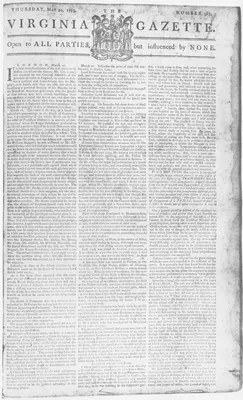
The Virginia Gazette Foreign News May 20, 1773
Williamsburg, Virginia
What is this article about?
In the Commons debate on the bill for relief of Protestant Dissenters, Burke spoke for toleration and against penal laws; after debate until near eight, the bill passed by a considerable majority.
Quality green show the numbers
Measured from the scan
— how cleanly the OCR engine read the characters
- Mean ink quality
- 99.0% The length-weighted average confidence across the OCR lines — the mean of exactly the per-line scores whose tails the two figures below report. Typical is 99%.
- Illegible ink
- 0.0% Text sitting in OCR-detected lines that scored below 80% confidence — very shaky reads. Weighted by line length, so one long bad line counts for more than a short one.
- Uncertain ink
- 0.0% Text in lines that scored 80–90% — somewhat shaky reads.
- Matches source
- 96.36% How closely the served text matches the raw OCR of the same boxes, letter by letter, after collapsing spacing and case. This measures agreement, not correctness: the OCR is often wrong and the extractor corrects it, so 100% does not mean perfect, and a low figure usually means poor scan text was rewritten rather than that text was lost (length vs source shows loss).
- Length vs source
- 99.35% Below 100% means text was dropped from the OCR; above means text was added to make it read.
Assembled by the extraction model
— whether the stitched-together text holds up; catches layout and segmentation errors, which the scores above cannot see
- Transcription confidence
- 98.0% (typical 96%) How cleanly the extractor could assemble what it was given. Low here with clean ink scores points at layout analysis — the characters were read correctly but grouped or ordered wrongly.
- Comprehension
- 95.0% Whether the piece reads coherently start to finish. Can stay high while transcription confidence drops, when only part of the component is affected.
Clipping
Full Text
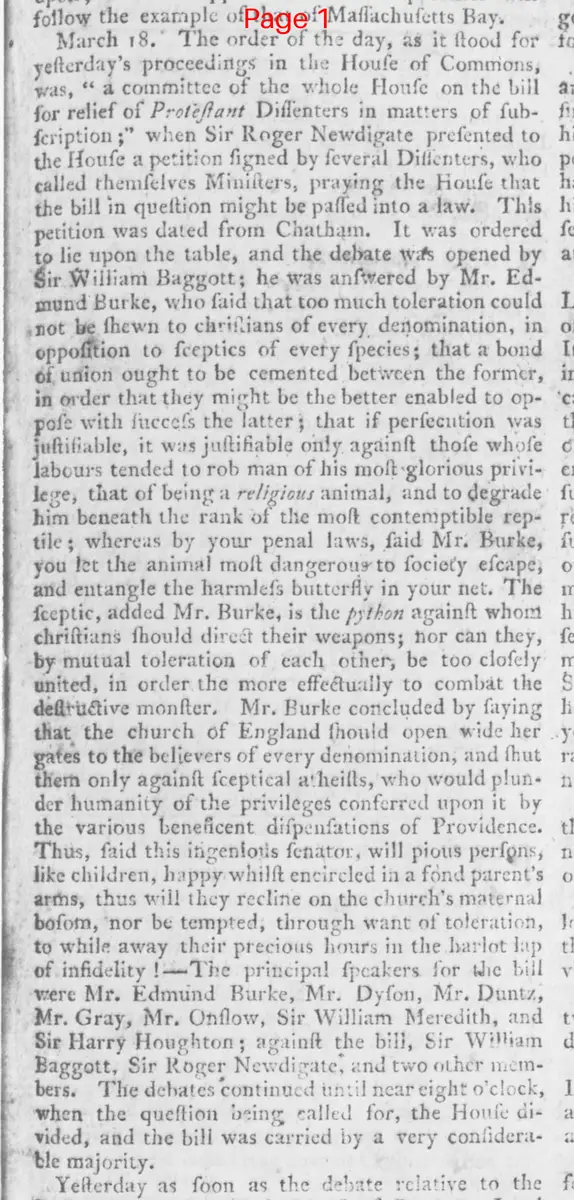
March 18. The order of the day, as it stood for yesterday's proceedings in the House of Commons, was, "a committee of the whole House on the bill for relief of Protestant Dissenters in matters of subscription;" when Sir Roger Newdigate presented to the House a petition signed by several Dissenters, who called themselves Ministers, praying the House that the bill in question might be passed into a law. This petition was dated from Chatham. It was ordered to lie upon the table, and the debate was opened by Sir William Baggott; he was answered by Mr. Edmund Burke, who said that too much toleration could not be shown to christians of every denomination, in opposition to sceptics of every species; that a bond of union ought to be cemented between the former, in order that they might be the better enabled to oppose with success the latter; that if persecution was justifiable, it was justifiable only against those whose labours tended to rob man of his most glorious privilege, that of being a religious animal, and to degrade him beneath the rank of the most contemptible reptile; whereas by your penal laws, said Mr. Burke, you let the animal most dangerous to society escape, and entangle the harmless butterfly in your net. The sceptic, added Mr. Burke, is the python against whom christians should direct their weapons; nor can they, by mutual toleration of each other, be too closely united, in order the more effectually to combat the destructive monster. Mr. Burke concluded by saying that the church of England should open wide her gates to the believers of every denomination; and shut them only against sceptical atheists, who would plunder humanity of the privileges conferred upon it by the various beneficent dispensations of Providence. Thus, said this ingenious senator, will pious persons, like children, happy whilst encircled in a fond parent's arms, thus will they recline on the church's maternal bosom, nor be tempted; through want of toleration, to while away their precious hours in the harlot's lap of infidelity!—The principal speakers for the bill were Mr. Edmund Burke, Mr. Dyson, Mr. Duntz, Mr. Gray, Mr. Onslow, Sir William Meredith, and Sir Harry Houghton; against the bill, Sir William Baggott, Sir Roger Newdigate, and two other members. The debates continued until near eight o'clock, when the question being called for, the House divided, and the bill was carried by a very considerable majority.
What sub-type of article is it?
Political
Religious Affairs
What keywords are associated?
House Of Commons
Dissenters Bill
Edmund Burke
Toleration
What entities or persons were involved?
Sir Roger Newdigate
Sir William Baggott
Edmund Burke
Mr. Dyson
Mr. Duntz
Mr. Gray
Mr. Onslow
Sir William Meredith
Sir Harry Houghton
Where did it happen?
London
Foreign News Details
Primary Location
London
Event Date
March 18
Key Persons
Sir Roger Newdigate
Sir William Baggott
Edmund Burke
Mr. Dyson
Mr. Duntz
Mr. Gray
Mr. Onslow
Sir William Meredith
Sir Harry Houghton
Outcome
bill carried by a considerable majority