Thanks for visiting SNEWPapers!
Sign up free today to connect your AI tools to the Library of Congress' newspaper collection.
The New Hampshire Gazette Letter to Editor July 8, 1757
Portsmouth, Rockingham, New Hampshire
What is this article about?
A reader forwards an extract from Benjamin Franklin's Letters on Electricity warning that taking shelter under a tree during a thunderstorm is dangerous, following a reported death by lightning under a tree.
Quality green show the numbers
Measured from the scan
— how cleanly the OCR engine read the characters
- Mean ink quality
- 98.0% The length-weighted average confidence across the OCR lines — the mean of exactly the per-line scores whose tails the two figures below report. Typical is 99%.
- Illegible ink
- 0.0% Text sitting in OCR-detected lines that scored below 80% confidence — very shaky reads. Weighted by line length, so one long bad line counts for more than a short one.
- Uncertain ink
- 1.0% Text in lines that scored 80–90% — somewhat shaky reads.
- Matches source
- 96.23% How closely the served text matches the raw OCR of the same boxes, letter by letter, after collapsing spacing and case. This measures agreement, not correctness: the OCR is often wrong and the extractor corrects it, so 100% does not mean perfect, and a low figure usually means poor scan text was rewritten rather than that text was lost (length vs source shows loss).
- Length vs source
- 98.16% Below 100% means text was dropped from the OCR; above means text was added to make it read.
Assembled by the extraction model
— whether the stitched-together text holds up; catches layout and segmentation errors, which the scores above cannot see
- Transcription confidence
- 95.0% (typical 96%) How cleanly the extractor could assemble what it was given. Low here with clean ink scores points at layout analysis — the characters were read correctly but grouped or ordered wrongly.
- Comprehension
- 95.0% Whether the piece reads coherently start to finish. Can stay high while transcription confidence drops, when only part of the component is affected.
Clipping
Full Text
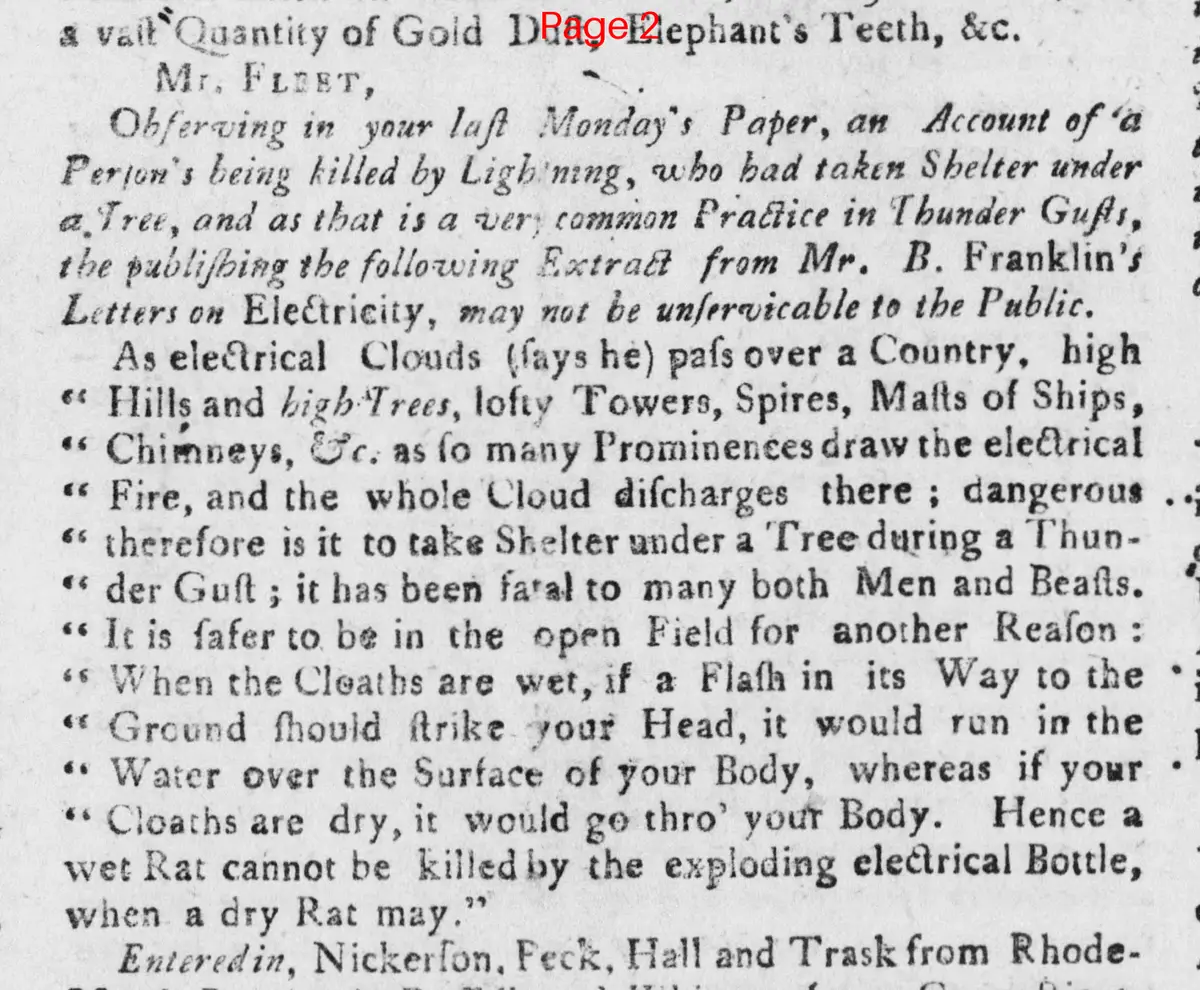
Mr. FLEET,
Observing in your last Monday's Paper, an Account of a Person's being killed by Lightning, who had taken Shelter under a Tree, and as that is a very common Practice in Thunder Gusts, the publishing the following Extract from Mr. B. Franklin's Letters on Electricity, may not be unserviceable to the Public.
"As electrical Clouds (says he) pass over a Country, high Hills and high Trees, lofty Towers, Spires, Mafts of Ships, Chimneys, &c. as so many Prominences draw the electrical Fire, and the whole Cloud discharges there; dangerous therefore is it to take Shelter under a Tree during a Thunder Gust; it has been fatal to many both Men and Beasts. It is safer to be in the open Field for another Reason: When the Cloaths are wet, if a Flash in its Way to the Ground should strike your Head, it would run in the Water over the Surface of your Body, whereas if your Cloaths are dry, it would go thro' your Body. Hence a wet Rat cannot be killed by the exploding electrical Bottle, when a dry Rat may."
What sub-type of article is it?
Informative
What themes does it touch?
Science Nature
What keywords are associated?
Lightning Safety
Thunderstorm Shelter
Benjamin Franklin
Electricity Dangers
What entities or persons were involved?
Mr. Fleet
Anonymous
Letter to Editor Details
Author
Anonymous
Recipient
Mr. Fleet
Main Argument
Recommends the public heed Franklin's warning that trees attract lightning and that sheltering under one during a thunderstorm is dangerous.
Notable Details
- Benjamin Franklin's Letters on Electricity
- wet clothes conduct lightning over the body
- wet rat vs dry rat experiment