Thanks for visiting SNEWPapers!
Sign up free today to connect your AI tools to the Library of Congress' newspaper collection.
The Virginia Gazette Foreign News May 6, 1737
Richmond, Richmond, Virginia
What is this article about?
From London: at Common Pleas, Mrs. Elizabeth Brockhurst's action against John Dinely for necessaries supplied to his eloped wife fails after a five-hour trial; the next day Dinely is acquitted of subornation of perjury and plans to sue the prosecutor.
Quality green show the numbers
Measured from the scan
— how cleanly the OCR engine read the characters
- Mean ink quality
- 99.0% The length-weighted average confidence across the OCR lines — the mean of exactly the per-line scores whose tails the two figures below report. Typical is 99%.
- Illegible ink
- 0.0% Text sitting in OCR-detected lines that scored below 80% confidence — very shaky reads. Weighted by line length, so one long bad line counts for more than a short one.
- Uncertain ink
- 0.0% Text in lines that scored 80–90% — somewhat shaky reads.
- Matches source
- 97.25% How closely the served text matches the raw OCR of the same boxes, letter by letter, after collapsing spacing and case. This measures agreement, not correctness: the OCR is often wrong and the extractor corrects it, so 100% does not mean perfect, and a low figure usually means poor scan text was rewritten rather than that text was lost (length vs source shows loss).
- Length vs source
- 99.48% Below 100% means text was dropped from the OCR; above means text was added to make it read.
Assembled by the extraction model
— whether the stitched-together text holds up; catches layout and segmentation errors, which the scores above cannot see
- Transcription confidence
- 99.0% (typical 96%) How cleanly the extractor could assemble what it was given. Low here with clean ink scores points at layout analysis — the characters were read correctly but grouped or ordered wrongly.
- Comprehension
- 90.0% Whether the piece reads coherently start to finish. Can stay high while transcription confidence drops, when only part of the component is affected.
Clipping
Full Text
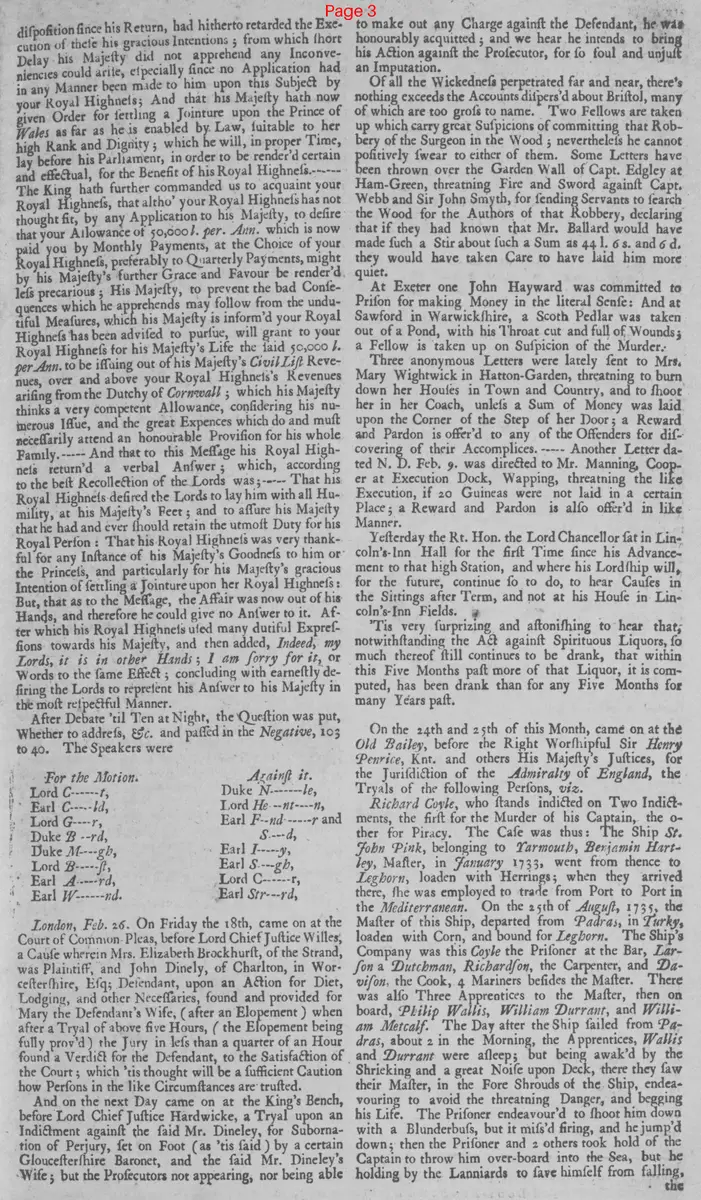
London, Feb. 26. On Friday the 18th, came on at the Court of Common-Pleas, before Lord Chief Justice Willes, a Cause wherein Mrs. Elizabeth Brockhurst, of the Strand, was Plaintiff, and John Dinely, of Charlton, in Worcestershire, Esq; Defendant, upon an Action for Diet, Lodging, and other Necessaries, found and provided for Mary the Defendant's Wife, (after an Elopement) when after a Tryal of above five Hours, (the Elopement being fully prov'd) the Jury in less than a quarter of an Hour found a Verdict for the Defendant, to the Satisfaction of the Court; which 'tis thought will be a sufficient Caution how Persons in the like Circumstances are trusted.
And on the next Day came on at the King's Bench, before Lord Chief Justice Hardwicke, a Tryal upon an Indictment against the said Mr. Dineley, for Subornation of Perjury, set on Foot (as 'tis said) by a certain Gloucestershire Baronet, and the said Mr. Dineley's Wife; but the Prosecutors not appearing, nor being able to make out any Charge against the Defendant, he was honourably acquitted; and we hear he intends to bring his Action against the Prosecutor, for so foul and unjust an Imputation.
What sub-type of article is it?
Crime
Human Interest
What keywords are associated?
London Court Trial
Elopement
Subornation Of Perjury
Common Pleas
King's Bench
What entities or persons were involved?
Mrs. Elizabeth Brockhurst
John Dinely
Lord Chief Justice Willes
Lord Chief Justice Hardwicke
Mary Dinely
Where did it happen?
London
Foreign News Details
Primary Location
London
Event Date
February 18 (Reported Feb. 26)
Key Persons
Mrs. Elizabeth Brockhurst
John Dinely
Lord Chief Justice Willes
Lord Chief Justice Hardwicke
Mary Dinely
Outcome
verdict for defendant in the necessaries action; dinely acquitted of subornation of perjury.