Thank you for visiting SNEWPapers!
Sign up free
The Patowmac Guardian, And Berkeley Advertiser Letter to Editor September 30, 1793
Martinsburg, Berkeley, West Virginia
What is this article about?
Benjamin Rush writes to the College of Physicians of Philadelphia with further observations on the yellow fever epidemic, reporting success with repeated bleeding and urging boldness with the lancet alongside mercury and jalap.
Quality green show the numbers
Measured from the scan
— how cleanly the OCR engine read the characters
- Mean ink quality
- 99.0% The length-weighted average confidence across the OCR lines — the mean of exactly the per-line scores whose tails the two figures below report. Typical is 99%.
- Illegible ink
- 0.0% Text sitting in OCR-detected lines that scored below 80% confidence — very shaky reads. Weighted by line length, so one long bad line counts for more than a short one.
- Uncertain ink
- 0.0% Text in lines that scored 80–90% — somewhat shaky reads.
- Matches source
- 95.5% How closely the served text matches the raw OCR of the same boxes, letter by letter, after collapsing spacing and case. This measures agreement, not correctness: the OCR is often wrong and the extractor corrects it, so 100% does not mean perfect, and a low figure usually means poor scan text was rewritten rather than that text was lost (length vs source shows loss).
- Length vs source
- 99.32% Below 100% means text was dropped from the OCR; above means text was added to make it read.
Assembled by the extraction model
— whether the stitched-together text holds up; catches layout and segmentation errors, which the scores above cannot see
- Transcription confidence
- 97.0% (typical 96%) How cleanly the extractor could assemble what it was given. Low here with clean ink scores points at layout analysis — the characters were read correctly but grouped or ordered wrongly.
- Comprehension
- 90.0% Whether the piece reads coherently start to finish. Can stay high while transcription confidence drops, when only part of the component is affected.
Clipping
Full Text
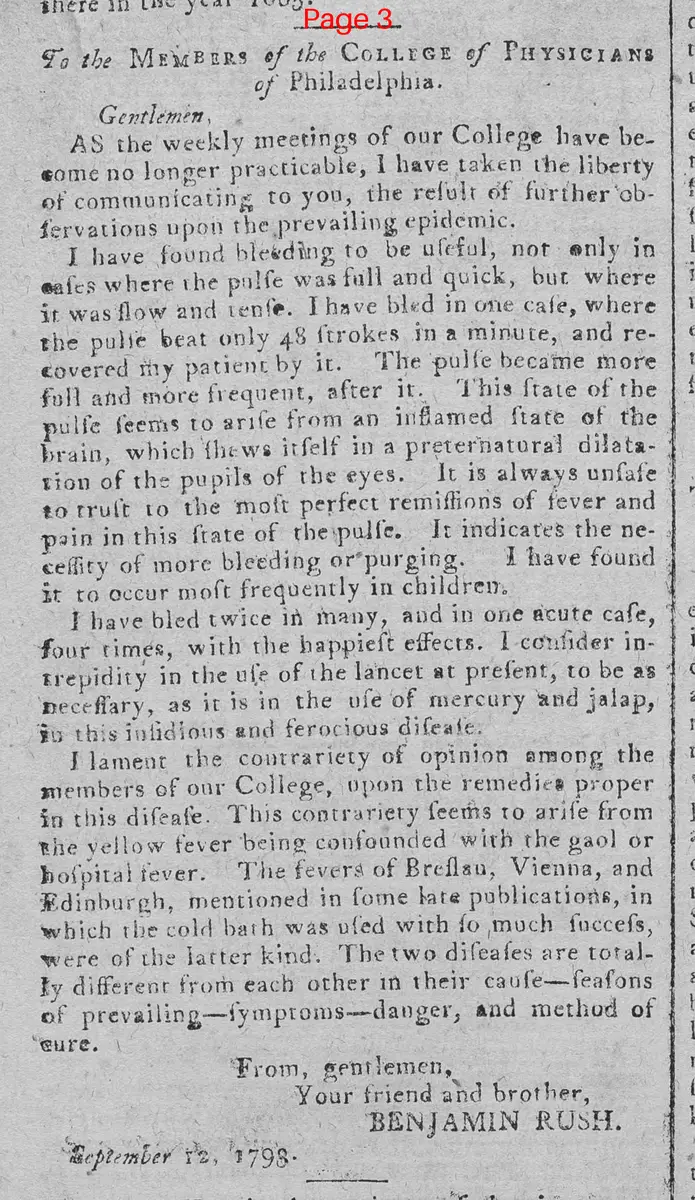
To the MEMBERS of the COLLEGE of PHYSICIANS of Philadelphia.
Gentlemen
AS the weekly meetings of our College have become no longer practicable, I have taken the liberty of communicating to you, the result of further observations upon the prevailing epidemic.
I have found bleeding to be useful, not only in cases where the pulse was full and quick, but where it was slow and tense. I have bled in one case, where the pulse beat only 48 strokes in a minute, and recovered my patient by it. The pulse became more full and more frequent, after it. This state of the pulse seems to arise from an inflamed state of the brain, which shows itself in a preternatural dilatation of the pupils of the eyes. It is always unsafe to trust to the most perfect remissions of fever and pain in this state of the pulse. It indicates the necessity of more bleeding or purging. I have found it to occur most frequently in children.
I have bled twice in many, and in one acute case, four times, with the happiest effects. I consider intrepidity in the use of the lancet at present, to be as necessary, as it is in the use of mercury and jalap, in this insidious and ferocious disease.
I lament the contrariety of opinion among the members of our College, upon the remedies proper in this disease. This contrariety seems to arise from the yellow fever being confounded with the gaol or hospital fever. The fevers of Breslau, Vienna, and Edinburgh, mentioned in some late publications, in which the cold bath was used with so much success, were of the latter kind. The two diseases are totally different from each other in their cause-seasons of prevailing-symptoms-danger, and method of cure.
From, gentlemen,
Your friend and brother.
BENJAMIN RUSH.
September 12, 1793.
What sub-type of article is it?
Informative
Persuasive
What themes does it touch?
Health Medicine
What keywords are associated?
Yellow Fever
Blood Letting
Lancet
College Of Physicians
Philadelphia 1793
What entities or persons were involved?
The Members Of The College Of Physicians Of Philadelphia
Benjamin Rush
Letter to Editor Details
Author
Benjamin Rush
Recipient
The Members Of The College Of Physicians Of Philadelphia
Main Argument
Reports further clinical observations supporting vigorous bleeding as well as mercury and jalap in yellow fever, and distinguishes the epidemic from gaol or hospital fever to resolve disagreements among the College.
Notable Details
- bled a patient with pulse of 48 beats per minute
- bled twice in many cases and four times in one acute case
- inflamed brain shown by dilated pupils
- contrasts fevers of Breslau, Vienna, Edinburgh