Thanks for visiting SNEWPapers!
Sign up free today to connect your AI tools to the Library of Congress' newspaper collection.
The Virginia Gazette Editorial November 11, 1773
Richmond, Richmond, Virginia
What is this article about?
An open letter to the Virginia legislature urging it to rename the House of Burgesses 'Parliament' and assert its exclusive legislative power, arguing that the British Parliament has no right to tax the colonies and that colonial obedience is owed only to the King.
Quality green show the numbers
Measured from the scan
— how cleanly the OCR engine read the characters
- Mean ink quality
- 99.0% The length-weighted average confidence across the OCR lines — the mean of exactly the per-line scores whose tails the two figures below report. Typical is 99%.
- Illegible ink
- 0.0% Text sitting in OCR-detected lines that scored below 80% confidence — very shaky reads. Weighted by line length, so one long bad line counts for more than a short one.
- Uncertain ink
- 0.0% Text in lines that scored 80–90% — somewhat shaky reads.
- Matches source
- 96.62% How closely the served text matches the raw OCR of the same boxes, letter by letter, after collapsing spacing and case. This measures agreement, not correctness: the OCR is often wrong and the extractor corrects it, so 100% does not mean perfect, and a low figure usually means poor scan text was rewritten rather than that text was lost (length vs source shows loss).
- Length vs source
- 99.59% Below 100% means text was dropped from the OCR; above means text was added to make it read.
Assembled by the extraction model
— whether the stitched-together text holds up; catches layout and segmentation errors, which the scores above cannot see
- Transcription confidence
- 97.0% (typical 96%) How cleanly the extractor could assemble what it was given. Low here with clean ink scores points at layout analysis — the characters were read correctly but grouped or ordered wrongly.
- Comprehension
- 95.0% Whether the piece reads coherently start to finish. Can stay high while transcription confidence drops, when only part of the component is affected.
Clipping
Full Text
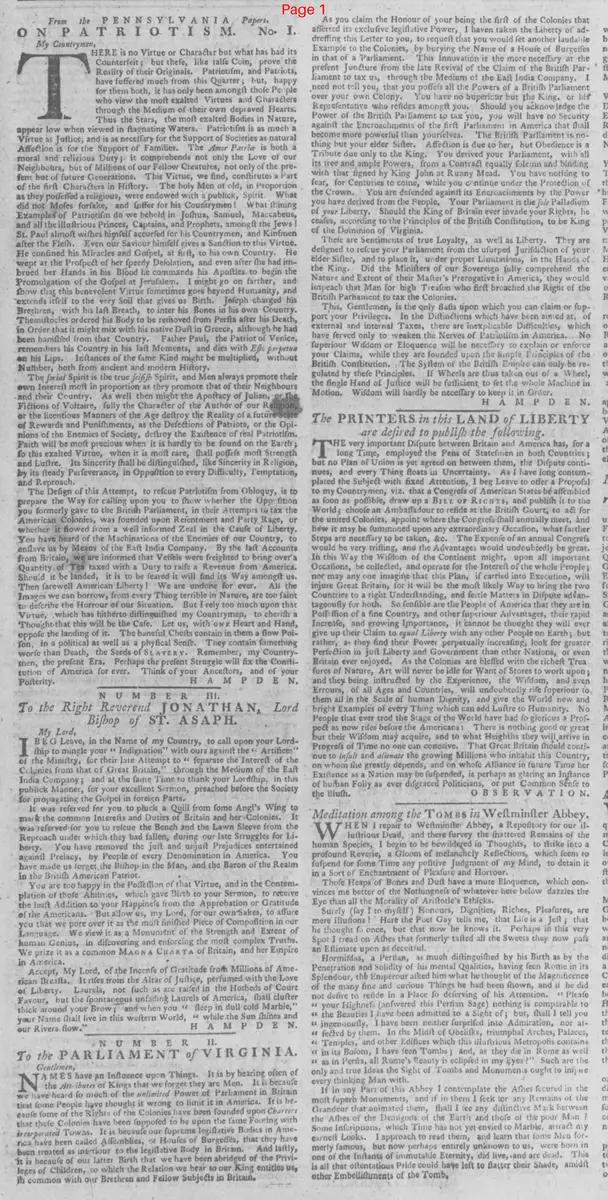
NUMBER II.
To the PARLIAMENT of VIRGINIA.
Gentlemen,
NAMES have an Influence upon Things. It is by hearing often of the Attributes of Kings that we forget they are Men. It is because we have heard so much of the unlimited Power of Parliament in Britain that some People have thought it wrong to limit it in America. It is because some of the Rights of the Colonies have been founded upon Charters that these Colonies have been supposed to be upon the same Footing with incorporate Towns. It is because our supreme legislative Bodies in America have been called Assemblies, or Houses of Burgesses, that they have been treated as inferior to the legislative Body in Britain. And lastly, it is because of our latter Birth that we have been abridged of the Privileges of Children, to which the Relation we bear to our King entitles us, in common with our Brethren and Fellow Subjects in Britain.
As you claim the Honour of your being the first of the Colonies that asserted its exclusive legislative Power, I have taken the Liberty of addressing this Letter to you, to request that you would set another laudable Example to the Colonies, by burying the Name of a House of Burgesses in that of a Parliament. This Innovation is the more necessary at the present Juncture from the late Revival of the Claim of the British Parliament to tax us, through the Medium of the East India Company. I need not tell you, that you possess all the Powers of a British Parliament over your own Colony. You have no Superior but the King, or his Representative who resides amongst you. Should you acknowledge the Power of the British Parliament to tax you, you will have no Security against the Encroachments of the first Parliament in America that shall become more powerful than yourselves. The British Parliament is nothing but your elder Sister. Affection is due to her, but Obedience is a Tribute due only to the King. You derived your Parliament, with all its free and ample Powers, from a Contract equally solemn and binding with that signed by King John at Runny Mead. You have nothing to fear, for Centuries to come, while you continue under the Protection of the Crown. You are defended against its Encroachments by the Power you have derived from the People. Your Parliament is the sole Palladium of your Liberty. Should the King of Britain ever invade your Rights, he ceases, according to the Principles of the British Constitution, to be King of the Dominion of Virginia.
These are Sentiments of true Loyalty, as well as Liberty. They are designed to rescue your Parliament from the usurped Jurisdiction of your elder Sister, and to place it, under proper Limitations, in the Hands of the King. Did the Ministers of our Sovereign fully comprehend the Nature and Extent of their Master's Prerogative in America, they would impeach that Man for high Treason who first broached the Right of the British Parliament to tax the Colonies.
This, Gentlemen, is the only Basis upon which you can claim or support your Privileges. In the Distinctions which have been aimed at, of external and internal Taxes, there are inexplicable Difficulties, which have served only to weaken the Nerves of Patriotism in America. No superior Wisdom or Eloquence will be necessary to explain or enforce your Claims, while they are founded upon the simple Principles of the British Constitution. The System of the British Empire can only be regulated by these Principles. If Wheels are thus taken out of a Wheel, the single Hand of Justice will be sufficient, to set the whole Machine in Motion. Wisdom will hardly be necessary to keep it in Order.
HAMPDEN.
What sub-type of article is it?
Constitutional
Partisan Politics
Economic Policy
What keywords are associated?
Colonial Rights
Legislative Power
British Parliament Taxation
House Of Burgesses
Virginia Parliament
Constitutional Principles
What entities or persons were involved?
Parliament Of Virginia
British Parliament
King Of Britain
East India Company
Editorial Details
Primary Topic
Assertion Of Virginia's Exclusive Legislative Power And Opposition To The British Parliament's Claim To Tax The Colonies
Stance / Tone
Argumentative And Loyalist In Framing; Firmly Opposed To British Parliamentary Taxation, Urging Colonial Self Assertion Under The Crown
Key Figures
Parliament Of Virginia
British Parliament
King Of Britain
East India Company
Key Arguments
- Names influence perceptions; 'House of Burgesses' invites treatment as inferior to the British Parliament
- Virginia possesses all the powers of a British Parliament over its own colony, with no superior but the King
- Obedience is owed only to the King; the British Parliament is but an elder sister, deserving affection not submission
- The colonial Parliament rests on a contract as solemn as Magna Carta and is the sole palladium of liberty
- The distinction of external and internal taxes is inexplicable and weakens American patriotism
- Colonial rights should rest on the simple principles of the British constitution