Thanks for visiting SNEWPapers!
Sign up free today to connect your AI tools to the Library of Congress' newspaper collection.
The New Hampshire Gazette And Historical Chronicle Letter to Editor March 31, 1763
Portsmouth, Rockingham, New Hampshire
What is this article about?
A reader letter to the printer proposing that farmers reduce their livestock, turn part of their mowing land to pasture, and grow wheat instead of Indian corn in order to lower labor costs and improve yields, especially given post-war price and currency scarcity.
Quality green show the numbers
Measured from the scan
— how cleanly the OCR engine read the characters
- Mean ink quality
- 99.0% The length-weighted average confidence across the OCR lines — the mean of exactly the per-line scores whose tails the two figures below report. Typical is 99%.
- Illegible ink
- 0.0% Text sitting in OCR-detected lines that scored below 80% confidence — very shaky reads. Weighted by line length, so one long bad line counts for more than a short one.
- Uncertain ink
- 0.0% Text in lines that scored 80–90% — somewhat shaky reads.
- Matches source
- 96.51% How closely the served text matches the raw OCR of the same boxes, letter by letter, after collapsing spacing and case. This measures agreement, not correctness: the OCR is often wrong and the extractor corrects it, so 100% does not mean perfect, and a low figure usually means poor scan text was rewritten rather than that text was lost (length vs source shows loss). Across pages, this is the worst fragment.
- Length vs source
- 99.24% Below 100% means text was dropped from the OCR; above means text was added to make it read.
Assembled by the extraction model
— whether the stitched-together text holds up; catches layout and segmentation errors, which the scores above cannot see
- Transcription confidence
- 93.0% (typical 96%) How cleanly the extractor could assemble what it was given. Low here with clean ink scores points at layout analysis — the characters were read correctly but grouped or ordered wrongly.
- Comprehension
- 95.0% Whether the piece reads coherently start to finish. Can stay high while transcription confidence drops, when only part of the component is affected.
Clippings
1 of 2
Full Text
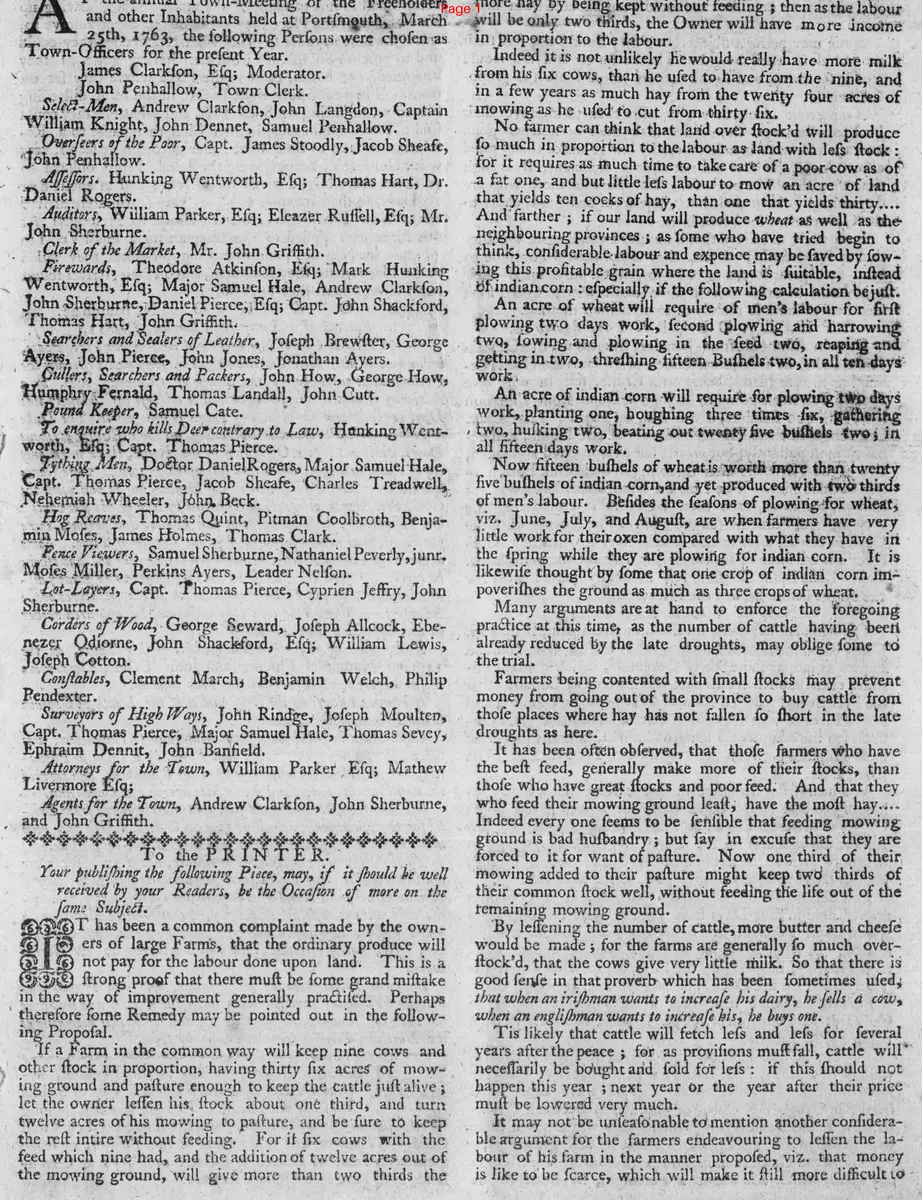
To the PRINTER.
Your publishing the following Piece, may, if it should be well received by your Readers, be the Occasion of more on the same Subject.
It has been a common complaint made by the owners of large Farms, that the ordinary produce will not pay for the labour done upon land. This is a strong proof that there must be some grand mistake in the way of improvement generally practised. Perhaps therefore some Remedy may be pointed out in the following Proposal.
If a Farm in the common way will keep nine cows and other stock in proportion, having thirty six acres of mowing ground and pasture enough to keep the cattle just alive; let the owner lessen his stock about one third, and turn twelve acres of his mowing to pasture, and be sure to keep the rest entire without feeding. For if six cows with the feed which nine had, and the addition of twelve acres out of the mowing ground, will give more than two thirds. The Owner will have more income in proportion to the labour.
Indeed it is not unlikely he would really have more milk from his six cows, than he used to have from the nine, and in a few years as much hay from the twenty four acres of mowing as he used to cut from thirty-six.
No farmer can think that land over-stocked will produce so much in proportion to the labour as land with less stock: for it requires as much time to take care of a poor cow as of a fat one, and but little less labour to mow an acre of land that yields ten cocks of hay, than one that yields thirty. And farther; if our land will produce wheat as well as the neighbouring provinces; as some who have tried begin to think, considerable labour and expence may be saved by sowing this profitable grain where the land is suitable, instead of Indian corn: especially if the following calculation be just.
An acre of wheat will require of men's labour for first plowing two days work, second plowing and harrowing two, sowing and plowing in the feed two, reaping and getting in two, threshing fifteen Bushels two, in all ten days work.
An acre of Indian corn will require for plowing two days work, planting one, hoeing three times six, gathering two, husking two, beating out twenty five bushels two; in all fifteen days work.
Now fifteen bushels of wheat is worth more than twenty five bushels of Indian corn, and yet produced with two thirds of men's labour. Besides the seasons of plowing for wheat, viz. June, July, and August, are when farmers have very little work for their oxen compared with what they have in the spring while they are plowing for Indian corn. It is likewise thought by some that one crop of Indian corn impoverishes the ground as much as three crops of wheat.
Many arguments are at hand to enforce the foregoing practice at this time, as the number of cattle having been already reduced by the late droughts, may oblige some to the trial.
Farmers being contented with small stocks may prevent money from going out of the province to buy cattle from those places where hay has not fallen so short in the late droughts as here.
It has been often observed, that those farmers who have the best feed, generally make more of their stocks, than those who have great stocks and poor feed. And that they who feed their mowing ground least, have the most hay. Indeed every one seems to be sensible that feeding mowing ground is bad husbandry; but say in excuse that they are forced to it for want of pasture. Now one third of their mowing added to their pasture might keep two thirds of their common stock well, without feeding the life out of the remaining mowing ground.
By lessening the number of cattle, more butter and cheese would be made; for the farms are generally so much over-stocked, that the cows give very little milk. So that there is good sense in that proverb which has been sometimes used, that when an Irishman wants to increase his dairy, he sells a cow, when an Englishman wants to increase his, he buys one.
'Tis likely that cattle will fetch less and less for several years after the peace; for as provisions must fall, cattle will necessarily be bought and sold for less: if this should not happen this year; next year or the year after their price must be lowered very much.
It may not be unseasonable to mention another considerable argument for the farmers endeavouring to lessen the labour of his farm in the manner proposed, viz. that money is like to be scarce, which will make it still more difficult to
pay for such labour as turns to little profit. The scarcity of money may be argued from hence, that the bills that are a tender in law must all be called in about three years hence, and the province can make no more money that any one can be forced to take; so that silver and gold must be our currency whether we will or no: and as there is very little silver or gold in the province at this time, it will require several years before we shall be able to export lumber, &c., enough to pay for the rum, tea, coffee, bread corn and other foreign commodities we use in such amazing quantities of late; and to bring home a balance of silver and gold sufficient for a currency.
There is no want of land in this part of the World: the great difficulty is to contrive means to raise the largest quantity of necessaries with the least labour of men, whether it takes more or less land; as hands are not so plenty as land; which is the thing here chiefly aimed at. But whether the farmer desires a good crop of wheat or hay with little labour, it is absolutely necessary he should keep his land from being fed.
Some may perhaps object that if they should not feed their ground close, their neighbours in the spring and fall would feed it for them, and so the owners would lose the proposed benefit.
To prevent which, they who desire thus to improve their land to advantage, should first make their own fence good and then force their neighbours by law to make theirs good also: And if the laws are not already sufficient, it is high time they should be made so. Therefore let those who are determined to keep their land close from being fed, apply to the Government for better laws.
I am ready to believe that if numbers would agree together thus to improve their farms, they who should continue to keep such great stocks as to be forced to prey upon their neighbours in order to keep their cattle alive, would soon feel their mistake so plainly as to alter their method.
What sub-type of article is it?
Persuasive
Informative
What themes does it touch?
Agriculture
Economic Policy
What keywords are associated?
Farm Improvement
Livestock Reduction
Wheat Vs Indian Corn
Agricultural Labour
Currency Scarcity
Dairy Farming
What entities or persons were involved?
The Printer
Letter to Editor Details
Recipient
The Printer
Main Argument
Farmers overstock their land; by reducing stock about one third, converting some mowing to pasture, and sowing wheat instead of Indian corn, they can raise more produce with less labor and better preserve their land, especially as money becomes scarce.
Notable Details
- calculation: wheat needs 10 days labor per acre vs 15 for Indian corn
- wheat worth more than corn though produced with two thirds the labor
- one crop of Indian corn impoverishes ground as much as three of wheat
- proverb about Irishman selling a cow and Englishman buying one
- scarcity of currency and need for silver and gold