Thank you for visiting SNEWPapers!
Sign up free
The Massachusetts Spy, Or, Thomas's Boston Journal Letter to Editor June 3, 1773
Boston, Suffolk, Massachusetts
Cautionary note: Historical slavery-era petition using period racial terminology ('Negroes') and discussing enslavement.
What is this article about?
An enslaved committee in Boston circulates a petition for freedom to the towns of Massachusetts, offering to work to purchase their liberty and eventually resettle on the coast of Africa.
Quality green show the numbers
Measured from the scan
— how cleanly the OCR engine read the characters
- Mean ink quality
- 98.0% The length-weighted average confidence across the OCR lines — the mean of exactly the per-line scores whose tails the two figures below report. Typical is 99%.
- Illegible ink
- 0.0% Text sitting in OCR-detected lines that scored below 80% confidence — very shaky reads. Weighted by line length, so one long bad line counts for more than a short one.
- Uncertain ink
- 2.9% Text in lines that scored 80–90% — somewhat shaky reads.
- Matches source
- 95.21% How closely the served text matches the raw OCR of the same boxes, letter by letter, after collapsing spacing and case. This measures agreement, not correctness: the OCR is often wrong and the extractor corrects it, so 100% does not mean perfect, and a low figure usually means poor scan text was rewritten rather than that text was lost (length vs source shows loss).
- Length vs source
- 100.49% Below 100% means text was dropped from the OCR; above means text was added to make it read.
Assembled by the extraction model
— whether the stitched-together text holds up; catches layout and segmentation errors, which the scores above cannot see
- Transcription confidence
- 92.0% (typical 96%) How cleanly the extractor could assemble what it was given. Low here with clean ink scores points at layout analysis — the characters were read correctly but grouped or ordered wrongly.
- Comprehension
- 85.0% Whether the piece reads coherently start to finish. Can stay high while transcription confidence drops, when only part of the component is affected.
Clipping
Full Text
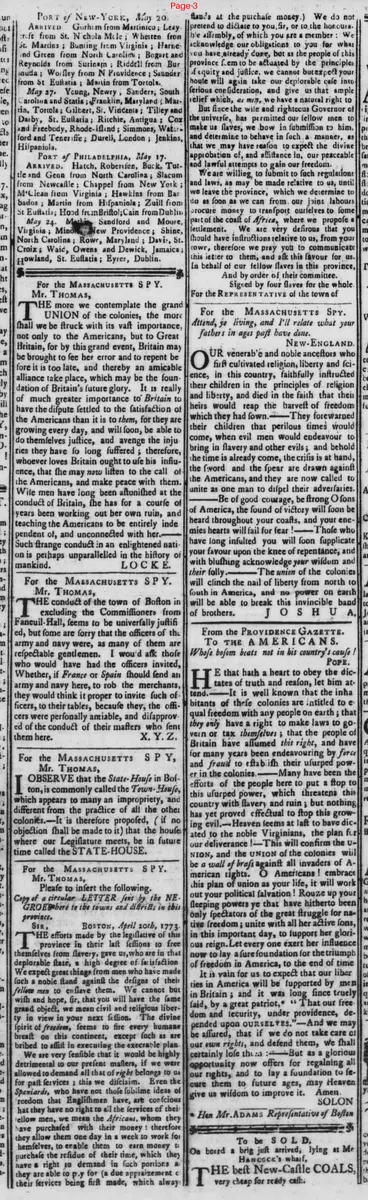
For the Massachusetts Spy.
Mr. Thomas,
Please to insert the following.
Copy of a circular LETTER sent by the NEGROES here to the towns and districts in this province.
SIR, Boston, April 20th, 1773.
The province in their last sessions to free themselves from slavery, gave us, who are in that deplorable state, a high degree of satisfaction. We expect great things from men who have made such a noble stand against the designs of their fellow men to enslave them. We cannot but wish and hope, sir, that you will have the same grand object, we mean civil and religious liberty in view in your next session. The divine spirit of freedom, seems to fire every humane breast on this continent, except such as are bribed to assist in executing the execrable plan.
We are very sensible that it would be highly detrimental to our present masters, if we were allowed to demand all that of right belongs to us for past services; this we disclaim. Even the Spaniards, who have not those sublime ideas of freedom that Englishmen have, are conscious that they have no right to all the services of their fellow men, we mean the Africans, whom they have purchased with their money: therefore they allow them one day in a week to work for themselves, to enable them to earn money to purchase the residue of their time, which they have a right to demand in such portions as they are able to pay for (a due appraisement of their services being first made, which always stands at the purchase money.)
We do not pretend to dictate to you, sir, or to the honourable assembly, of which you are a member: We acknowledge our obligations to you for what you have already done, but as the people of this province seem to be actuated by the principles of equity and justice, we cannot but expect your house will again take our deplorable case into serious consideration, and give us that ample relief which, as men, we have a natural right to.
But since the wise and righteous Governor of the universe, has permitted our fellow men to make us slaves, we bow in submission to him, and determine to behave in such a manner, as that we may have reason to expect the divine approbation of, and assistance in, our peaceable and lawful attempts to gain our freedom.
We are willing to submit to such regulations and laws, as may be made relative to us, until we leave the province, which we determine to do as soon as we can from our joint labours procure money to transport ourselves to some part of the coast of Africa, where we propose a settlement. We are very desirous that you should have instructions relative to us, from your town, therefore we pray you to communicate this letter to them, and ask this favour for us.
In behalf of our fellow slaves in this province, And by order of their committee.
Signed by four slaves for the whole.
For the Representative of the town of
What sub-type of article is it?
Open Letter
Persuasive
Emotional
What themes does it touch?
Slavery Abolition
Constitutional Rights
What keywords are associated?
Slavery Petition
Massachusetts Slaves
Freedom Appeal
African Settlement
Colonial Liberty
What entities or persons were involved?
Mr. Thomas (Printer); The Representative Of The Town
Four Slaves For The Whole (Unnamed)
Letter to Editor Details
Author
Four Slaves For The Whole (Unnamed)
Recipient
Mr. Thomas (Printer); The Representative Of The Town
Main Argument
Enslaved people of Massachusetts appeal to the province's towns and assembly for freedom, offering to purchase their liberty and eventually settle in Africa.
Notable Details
- Spanish custom of allowing slaves one day per week to work for themselves
- plan to purchase the residue of their time
- proposed settlement on the coast of Africa
- signed by four slaves for the whole