Thank you for visiting SNEWPapers!
Sign up free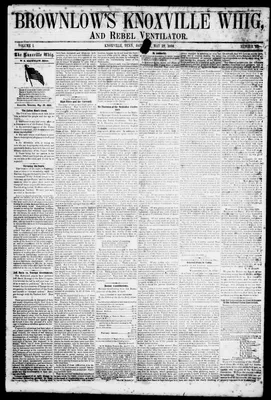
Brownlow's Knoxville Whig, And Rebel Ventilator Editorial May 28, 1864
Knoxville, Knox, Tennessee
Cautionary note: Civil War-era racial stereotyping of freedmen and mandatory white supervision
What is this article about?
Editorial endorsing Gen. Tuttle's order at Natchez requiring freedmen ('contrabands') to be employed by responsible white persons and barring them from the city unless employed, saying Knoxville needs a similar order.
Quality green show the numbers
Measured from the scan
— how cleanly the OCR engine read the characters
- Mean ink quality
- 98.0% The length-weighted average confidence across the OCR lines — the mean of exactly the per-line scores whose tails the two figures below report. Typical is 99%.
- Illegible ink
- 0.0% Text sitting in OCR-detected lines that scored below 80% confidence — very shaky reads. Weighted by line length, so one long bad line counts for more than a short one.
- Uncertain ink
- 0.0% Text in lines that scored 80–90% — somewhat shaky reads.
- Matches source
- 97.94% How closely the served text matches the raw OCR of the same boxes, letter by letter, after collapsing spacing and case. This measures agreement, not correctness: the OCR is often wrong and the extractor corrects it, so 100% does not mean perfect, and a low figure usually means poor scan text was rewritten rather than that text was lost (length vs source shows loss).
- Length vs source
- 98.71% Below 100% means text was dropped from the OCR; above means text was added to make it read.
Assembled by the extraction model
— whether the stitched-together text holds up; catches layout and segmentation errors, which the scores above cannot see
- Transcription confidence
- 94.0% (typical 96%) How cleanly the extractor could assemble what it was given. Low here with clean ink scores points at layout analysis — the characters were read correctly but grouped or ordered wrongly.
- Comprehension
- 88.0% Whether the piece reads coherently start to finish. Can stay high while transcription confidence drops, when only part of the component is affected.
Clipping
Full Text
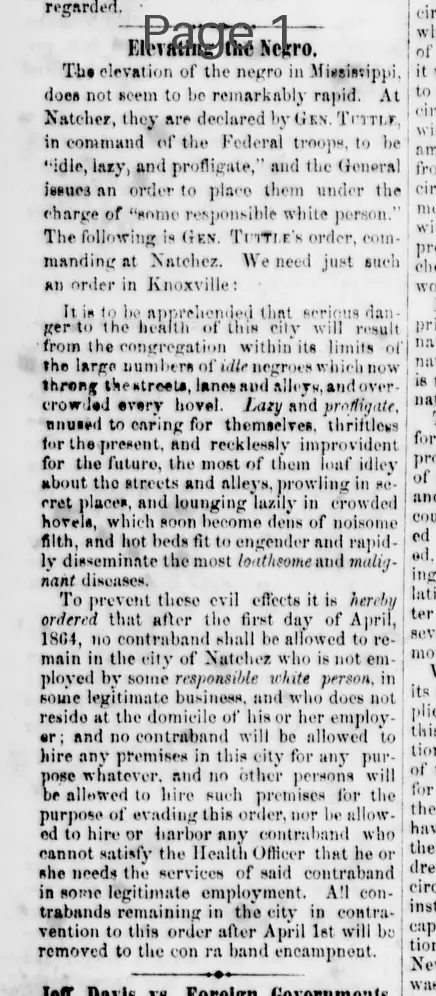
Elevating the Negro.
The elevation of the negro in Mississippi does not seem to be remarkably rapid. At Natchez, they are declared by Gen. Tuttle, in command of the Federal troops, to be "idle, lazy, and profligate," and the General issues an order to place them under the charge of "some responsible white person." The following is Gen. Tuttle's order, commanding at Natchez. We need just such an order in Knoxville:
It is to be apprehended that serious danger to the health of this city will result from the congregation within its limits of the large numbers of idle negroes which now throng the streets, lanes and alleys, and overcrowd every hovel. Lazy and profligate, unused to caring for themselves, thriftless for the present, and recklessly improvident for the future, the most of them loaf idly about the streets and alleys, prowling in secret places, and lounging lazily in crowded hovels, which soon become dens of noisome filth, and hot beds fit to engender and rapidly disseminate the most loathsome and malignant diseases.
To prevent these evil effects it is hereby ordered that after the first day of April, 1864, no contraband shall be allowed to remain in the city of Natchez who is not employed by some responsible white person, in some legitimate business, and who does not reside at the domicile of his or her employer; and no contraband will be allowed to hire any premises in this city for any purpose whatever, and no other persons will be allowed to hire such premises for the purpose of evading this order, nor be allowed to hire or harbor any contraband who cannot satisfy the Health Officer that he or she needs the services of said contraband in some legitimate employment. All contrabands remaining in the city in contravention to this order after April 1st will be removed to the contraband encampment.
What sub-type of article is it?
Slavery Abolition
Labor
Social Reform
What keywords are associated?
Freedmen
Contrabands
Natchez
General Tuttle
Civil War Occupation
Emancipation
What entities or persons were involved?
Gen. Tuttle
Freedmen/Contrabands
Natchez
Knoxville
Editorial Details
Primary Topic
Regulation Of Freedmen In Natchez During Federal Occupation
Stance / Tone
Approving Of The Order, Paternalistic And Racially Disparaging
Key Figures
Gen. Tuttle
Freedmen/Contrabands
Natchez
Knoxville
Key Arguments
- freedmen in Natchez are described as idle, lazy, and profligate
- they must be employed by responsible white persons
- unemployed contrabands should be removed to the contraband encampment
- Knoxville needs a similar order