Thanks for visiting SNEWPapers!
Sign up free today to connect your AI tools to the Library of Congress' newspaper collection.
The New Hampshire Gazette And Historical Chronicle Letter to Editor December 2, 1763
Portsmouth, Rockingham, New Hampshire
What is this article about?
A reader responds to a report that the French made St. Lucia a free port, arguing that the northern colonies only have provisions and should be allowed to barter them for French and Spanish sugars, which would benefit English trade and manufacturing.
Quality green show the numbers
Measured from the scan
— how cleanly the OCR engine read the characters
- Mean ink quality
- 99.0% The length-weighted average confidence across the OCR lines — the mean of exactly the per-line scores whose tails the two figures below report. Typical is 99%.
- Illegible ink
- 0.0% Text sitting in OCR-detected lines that scored below 80% confidence — very shaky reads. Weighted by line length, so one long bad line counts for more than a short one.
- Uncertain ink
- 0.0% Text in lines that scored 80–90% — somewhat shaky reads.
- Matches source
- 96.46% How closely the served text matches the raw OCR of the same boxes, letter by letter, after collapsing spacing and case. This measures agreement, not correctness: the OCR is often wrong and the extractor corrects it, so 100% does not mean perfect, and a low figure usually means poor scan text was rewritten rather than that text was lost (length vs source shows loss).
- Length vs source
- 99.46% Below 100% means text was dropped from the OCR; above means text was added to make it read.
Assembled by the extraction model
— whether the stitched-together text holds up; catches layout and segmentation errors, which the scores above cannot see
- Transcription confidence
- 98.0% (typical 96%) How cleanly the extractor could assemble what it was given. Low here with clean ink scores points at layout analysis — the characters were read correctly but grouped or ordered wrongly.
- Comprehension
- 92.0% Whether the piece reads coherently start to finish. Can stay high while transcription confidence drops, when only part of the component is affected.
Clipping
Full Text
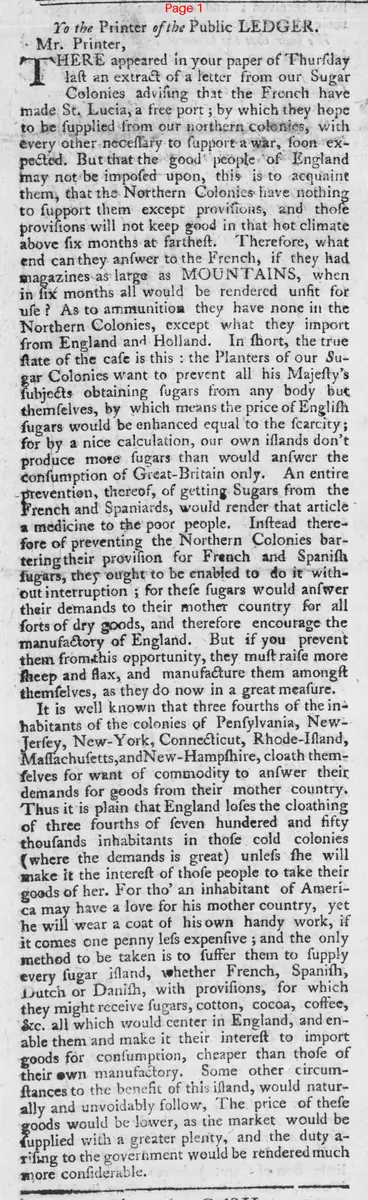
To the Printer of the Public LEDGER.
Mr. Printer,
THERE appeared in your paper of Thursday last an extract of a letter from our Sugar Colonies advising that the French have made St. Lucia, a free port; by which they hope to be supplied from our northern colonies, with every other necessary to support a war, soon expected. But that the good people of England may not be imposed upon, this is to acquaint them, that the Northern Colonies have nothing to support them except provisions, and those provisions will not keep good in that hot climate above six months at farthest. Therefore, what end can they answer to the French, if they had magazines as large as MOUNTAINS, when in six months all would be rendered unfit for use? As to ammunition they have none in the Northern Colonies, except what they import from England and Holland. In short, the true state of the case is this: the Planters of our Sugar Colonies want to prevent all his Majesty's subjects obtaining sugars from any body but themselves, by which means the price of English sugars would be enhanced equal to the scarcity; for by a nice calculation, our own islands don't produce more sugars than would answer the consumption of Great-Britain only. An entire prevention, thereof, of getting Sugars from the French and Spaniards, would render that article a medicine to the poor people. Instead therefore of preventing the Northern Colonies bartering their provision for French and Spanish sugars, they ought to be enabled to do it without interruption; for these sugars would answer their demands to their mother country for all sorts of dry goods, and therefore encourage the manufactory of England. But if you prevent them from this opportunity, they must raise more sheep and flax, and manufacture them amongst themselves, as they do now in a great measure.
It is well known that three fourths of the inhabitants of the colonies of Pennsylvania, New-Jersey, New-York, Connecticut, Rhode-Island, Massachusetts, and New-Hampshire, clothe themselves for want of commodity to answer their demands for goods from their mother country. Thus it is plain that England loses the clothing of three fourths of seven hundred and fifty thousands inhabitants in those cold colonies (where the demands is great) unless she will make it the interest of those people to take their goods of her. For though an inhabitant of America may have a love for his mother country, yet he will wear a coat of his own handy work, if it comes one penny less expensive; and the only method to be taken is to suffer them to supply every sugar island, whether French, Spanish, Dutch or Danish, with provisions, for which they might receive sugars, cotton, cocoa, coffee, &c. all which would center in England, and enable them and make it their interest to import goods for consumption, cheaper than those of their own manufactory. Some other circumstances to the benefit of this island, would naturally and unavoidably follow. The price of these goods would be lower, as the market would be supplied with a greater plenty, and the duty arising to the government would be rendered much more considerable.
What sub-type of article is it?
Persuasive
Informative
What themes does it touch?
Commerce Trade
Economic Policy
What keywords are associated?
Sugar Trade
Free Port
Colonies
Economic Policy
Trade Restrictions
What entities or persons were involved?
The Printer Of The Public Ledger
Letter to Editor Details
Recipient
The Printer Of The Public Ledger
Main Argument
The northern colonies should be allowed to trade provisions with French and Spanish sugar islands, as this would benefit England by lowering prices and increasing duties.
Notable Details
- mentions St. Lucia free port
- lists northern colonies
- calculates population of 750,000
- discusses clothing production