Thanks for visiting SNEWPapers!
Sign up free today to connect your AI tools to the Library of Congress' newspaper collection.
Jenks's Portland Gazette Domestic News March 15, 1802
Portland, Cumberland, Maine
What is this article about?
Dispatches from Washington report on the ongoing congressional debate over the judiciary bill, with speeches by Bayard, Griswold, Nicholson, Dennis, and others, including a dispute over Dennis's remarks about Munroe and Milledge's charge that President Washington violated the Constitution.
Quality green show the numbers
Measured from the scan
— how cleanly the OCR engine read the characters
- Mean ink quality
- 97.0% The length-weighted average confidence across the OCR lines — the mean of exactly the per-line scores whose tails the two figures below report. Typical is 99%.
- Illegible ink
- 0.0% Text sitting in OCR-detected lines that scored below 80% confidence — very shaky reads. Weighted by line length, so one long bad line counts for more than a short one.
- Uncertain ink
- 0.8% Text in lines that scored 80–90% — somewhat shaky reads.
- Matches source
- 94.14% How closely the served text matches the raw OCR of the same boxes, letter by letter, after collapsing spacing and case. This measures agreement, not correctness: the OCR is often wrong and the extractor corrects it, so 100% does not mean perfect, and a low figure usually means poor scan text was rewritten rather than that text was lost (length vs source shows loss).
- Length vs source
- 99.46% Below 100% means text was dropped from the OCR; above means text was added to make it read.
Assembled by the extraction model
— whether the stitched-together text holds up; catches layout and segmentation errors, which the scores above cannot see
- Transcription confidence
- 94.0% (typical 96%) How cleanly the extractor could assemble what it was given. Low here with clean ink scores points at layout analysis — the characters were read correctly but grouped or ordered wrongly.
- Comprehension
- 95.0% Whether the piece reads coherently start to finish. Can stay high while transcription confidence drops, when only part of the component is affected.
Clipping
Full Text
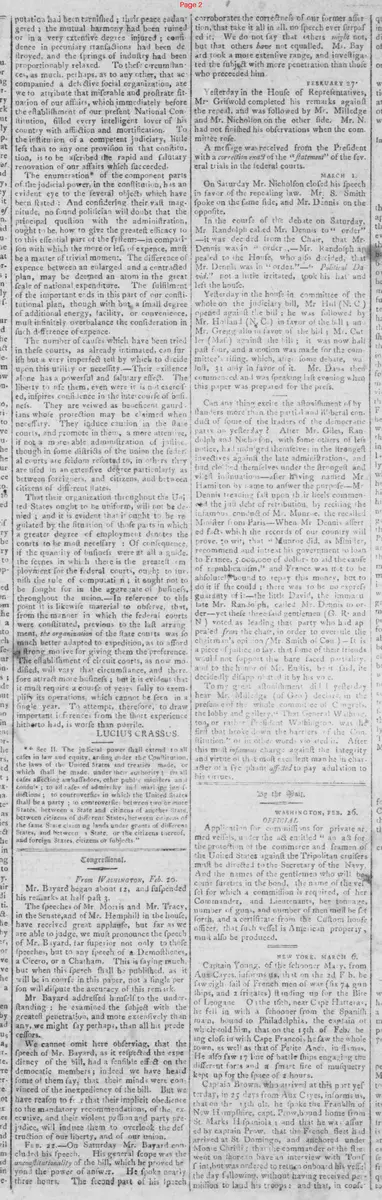
From Washington, Feb. 20.
Mr. Bayard began about 12, and suspended his remarks at half past 3. The speeches of Mr. Morris and Mr. Tracy, in the Senate, and of Mr. Hemphill in the house, have received great applause, but as far as we are able to judge, we must pronounce the speech of Mr. Bayard, far superior not only to those speeches, but to any speech of a Demosthenes, a Cicero, or a Chatham. This is saying much, but when this speech shall be published, as it will be in course in this paper, not a single person will dispute the accuracy of this remark.
Mr. Bayard addressed himself to the understanding: he examined the subject with the greatest penetration, and more extensively than any, we might say perhaps, than all his predecessors.
We cannot omit here observing, that the speech of Mr. Bayard, as it respected the expediency of the bill, had a sensible effect on the democratic members; indeed we have heard some of them say, that their minds were convinced of the inexpediency of the bill. But we have reason to fear that their implicit obedience to the mandatory recommendations, of the executive, and their violent passion and party prejudice, will induce them to overlook the destruction of our liberty, and of our union.
Feb. 22.-On Saturday Mr. Bayard concluded his speech. His general scope was the unconstitutionality of the bill, which he proved beyond the power of answer. He spoke nearly three hours. The second part of his speech corroborates the correctness of our former assertion, that take it all in all, no speech ever surpassed it. We do not say that others might not, but that others have not equalled. Mr. Bayard took a more extensive range, and investigated the subject with more penetration than those who preceded him.
FEBRUARY 27
Yesterday in the House of Representatives, Mr. Griswold completed his remarks against the repeal, and was followed by Mr. Milledge and Mr. Nicholson on the other side. Mr. N. had not finished his observations when the committee rose.
A message was received from the President with a correction exact of the 'statement' of the several trials in the federal courts.
MARCH 1.
On Saturday Mr. Nicholson closed his speech in favor of the repealing law. Mr. S. Smith spoke on the same side, and Mr. Dennis on the opposite.
In the course of the debate on Saturday, Mr. Randolph called Mr. Dennis to 'order'—it was decided from the Chair, that Mr. Dennis was in 'order'—Mr. Randolph appealed to the House, who also decided, that Mr. Dennis was in 'order.'-'Political David,' not a little irritated, took his hat and left the house.
Yesterday in the house in committee of the whole on the judiciary bill, Mr. Hull (N.C.) opened against the bill; he was followed by Mr. Holland (N.C.) in favor of the bill; and Mr. Gregg also in favor of the bill; Mr. Cutler (Mass.) against the bill; it was now half past four, and a motion was made for the committee's rising, which, after some debate, was lost, 31 only in favor of it. Mr. Dana then commenced and was speaking last evening when this paper was prepared for the press.
Can any thing excite the astonishment of by-standers more than the partial and illiberal conduct of some of the leaders of the democratic party on yesterday? After Mr. Giles, Randolph and Nicholson, with some others of less notice, had indulged themselves in the strongest invectives against the late administrations, and had clothed themselves under the strongest and vilest insinuations—after having named Mr. Hamilton by name to answer the purpose—Mr. Dennis treading fast upon their heels commenced the just debt of retribution, by reciting the infamous conduct of Mr. Munroe, the recalled Minister from Paris-When Mr. Dennis asserted facts which the records of our country will prove, to wit, that 'Munroe did, as Minister, recommend and entreat his government to loan to France, 5,000,000 of dollars, to aid the cause of republicanism,' and France was not to be absolutely bound to repay this money, but to do it if she could; there was to be no express guaranty of it-the little David, the immaculate Mr. Randolph, called Mr. Dennis to order-yet these three said gentlemen (G. R. and N) voted as leading that party who had appealed from the chair, in order to over-rule the chairman's opinion (Mr. Smith of Con.)- It is a piece of justice to say, that some of their friends would not support this bare faced partiality. and to the honor of Mr. Eustis, be it said, he decidedly disapproved it by his vote.
To my great astonishment did I yesterday hear Mr. Milledge (of Geo.) declare, in the presence of the whole committee of Congress, the lobby and gallery, 'That General Washington, or rather President Washington, was the first that broke down the barriers of the Constitution.' or in other words violated it. After this most infamous charge against the integrity and virtue of that most excellent man he in character of a sycophant affected to pay adulation to his virtues.
What sub-type of article is it?
Politics
Legal Or Court
What keywords are associated?
Judiciary Bill
Congressional Debate
House Of Representatives
Senate
Bayard Speech
Repeal
What entities or persons were involved?
Mr. Bayard
Mr. Randolph
Mr. Dennis
Mr. Nicholson
Mr. Milledge
Mr. Griswold
Mr. Giles
Mr. Munroe
Mr. Eustis
Mr. Hamilton
President Washington
Where did it happen?
Washington
Domestic News Details
Primary Location
Washington
Event Date
February 20 To March 1
Key Persons
Mr. Bayard
Mr. Randolph
Mr. Dennis
Mr. Nicholson
Mr. Milledge
Mr. Griswold
Mr. Giles
Mr. Munroe
Mr. Eustis
Mr. Hamilton
President Washington
Outcome
no vote reported; the debate continued. incidents included randolph's call to order against dennis and milledge's charge that washington violated the constitution.