Thanks for visiting SNEWPapers!
Sign up free today to connect your AI tools to the Library of Congress' newspaper collection.
Daily Globe Filler November 26, 1882
Saint Paul, Ramsey, Minnesota
What is this article about?
An essay on the 'Dance of Death,' allegorical representations of death's universal power dating from the fourteenth century, tracing its origins and dramatic form.
Quality green show the numbers
Measured from the scan
— how cleanly the OCR engine read the characters
- Mean ink quality
- 99.0% The length-weighted average confidence across the OCR lines — the mean of exactly the per-line scores whose tails the two figures below report. Typical is 99%.
- Illegible ink
- 0.0% Text sitting in OCR-detected lines that scored below 80% confidence — very shaky reads. Weighted by line length, so one long bad line counts for more than a short one.
- Uncertain ink
- 0.0% Text in lines that scored 80–90% — somewhat shaky reads.
- Matches source
- 98.66% How closely the served text matches the raw OCR of the same boxes, letter by letter, after collapsing spacing and case. This measures agreement, not correctness: the OCR is often wrong and the extractor corrects it, so 100% does not mean perfect, and a low figure usually means poor scan text was rewritten rather than that text was lost (length vs source shows loss).
- Length vs source
- 99.01% Below 100% means text was dropped from the OCR; above means text was added to make it read.
Assembled by the extraction model
— whether the stitched-together text holds up; catches layout and segmentation errors, which the scores above cannot see
- Transcription confidence
- 96.0% (typical 96%) How cleanly the extractor could assemble what it was given. Low here with clean ink scores points at layout analysis — the characters were read correctly but grouped or ordered wrongly.
- Comprehension
- 95.0% Whether the piece reads coherently start to finish. Can stay high while transcription confidence drops, when only part of the component is affected.
Clipping
Full Text
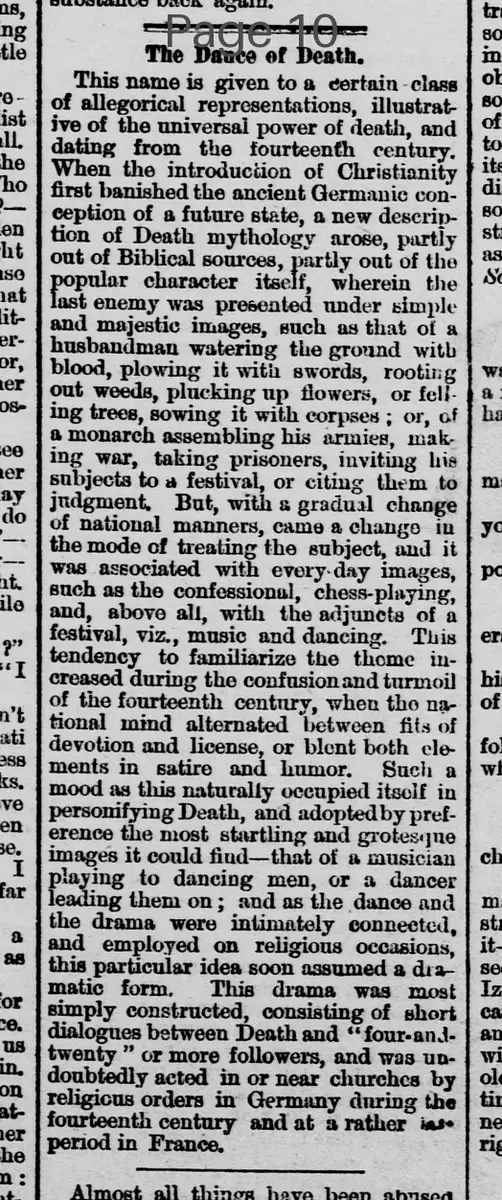
The Dance of Death.
This name is given to a certain class of allegorical representations, illustrative of the universal power of death, and dating from the fourteenth century. When the introduction of Christianity first banished the ancient Germanic conception of a future state, a new description of Death mythology arose, partly out of Biblical sources, partly out of the popular character itself, wherein the last enemy was presented under simple and majestic images, such as that of a husbandman watering the ground with blood, plowing it with swords, rooting out weeds, plucking up flowers, or felling trees, sowing it with corpses; or, of a monarch assembling his armies, making war, taking prisoners, inviting his subjects to a festival, or citing them to judgment. But, with a gradual change of national manners, came a change in the mode of treating the subject, and it was associated with every-day images, such as the confessional, chess-playing, and, above all, with the adjuncts of a festival, viz., music and dancing. This tendency to familiarize the theme increased during the confusion and turmoil of the fourteenth century, when the national mind alternated between fits of devotion and license, or blent both elements in satire and humor. Such a mood as this naturally occupied itself in personifying Death, and adopted by preference the most startling and grotesque images it could find—that of a musician playing to dancing men, or a dancer leading them on; and as the dance and the drama were intimately connected, and employed on religious occasions, this particular idea soon assumed a dramatic form. This drama was most simply constructed, consisting of short dialogues between Death and "four-and-twenty" or more followers, and was undoubtedly acted in or near churches by religious orders in Germany during the fourteenth century and at a rather later period in France.
What sub-type of article is it?
Curiosity
What keywords are associated?
Dance Of Death
Allegory
Fourteenth Century
Death
Filler Details
Topic
The Dance Of Death In Art And Drama