Thank you for visiting SNEWPapers!
Sign up free
The Virginia Gazette Letter to Editor January 6, 1776
Richmond, Richmond, Virginia
What is this article about?
A letter from General Lee to General Burgoyne urging him to prevent American independence by having Britain rescind its oppressive acts, arguing that Americans seek only their rights and self-taxation, and warning that continued oppression will force separation.
Quality green show the numbers
Measured from the scan
— how cleanly the OCR engine read the characters
- Mean ink quality
- 96.0% The length-weighted average confidence across the OCR lines — the mean of exactly the per-line scores whose tails the two figures below report. Typical is 99%.
- Illegible ink
- 0.0% Text sitting in OCR-detected lines that scored below 80% confidence — very shaky reads. Weighted by line length, so one long bad line counts for more than a short one.
- Uncertain ink
- 3.9% Text in lines that scored 80–90% — somewhat shaky reads.
- Matches source
- 94.58% How closely the served text matches the raw OCR of the same boxes, letter by letter, after collapsing spacing and case. This measures agreement, not correctness: the OCR is often wrong and the extractor corrects it, so 100% does not mean perfect, and a low figure usually means poor scan text was rewritten rather than that text was lost (length vs source shows loss).
- Length vs source
- 100.31% Below 100% means text was dropped from the OCR; above means text was added to make it read.
Assembled by the extraction model
— whether the stitched-together text holds up; catches layout and segmentation errors, which the scores above cannot see
- Transcription confidence
- 93.0% (typical 96%) How cleanly the extractor could assemble what it was given. Low here with clean ink scores points at layout analysis — the characters were read correctly but grouped or ordered wrongly.
- Comprehension
- 95.0% Whether the piece reads coherently start to finish. Can stay high while transcription confidence drops, when only part of the component is affected.
Clipping
Full Text
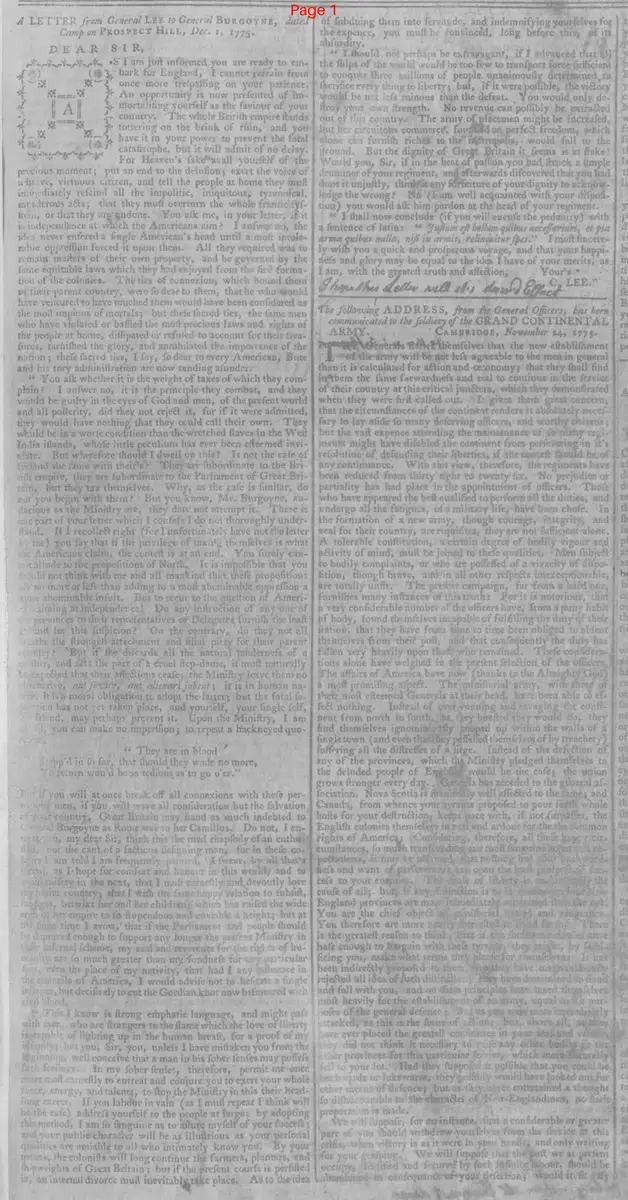
A LETTER from General LEE to General BURGOYNE, dated
Camp on Prospect Hill, Dec. 1, 1775.
DEAR SIR,
I am just informed you are ready to embark for England, I cannot refrain from once more trespassing on your patience. An opportunity is now presented of immortalizing yourself as the saviour of your country. The whole British empire stands tottering on the brink of ruin, and you have it in your power to prevent the fatal catastrophe, but it will admit of no delay. For Heaven's sake avail yourself of the precious moment; put an end to the delusion; exert the voice of a brave, virtuous citizen, and tell the people at home they must immediately rescind all the impolitic, iniquitous, tyrannical, murderous acts; that they must overturn the whole frantic system, or that they are undone. You ask me, in your letter, if it is independence at which the Americans aim? I answer no, the idea never entered a single American's head until a most intolerable oppression forced it upon them. All they required was to remain masters of their own property, and be governed by the same equitable laws which they had enjoyed from the first formation of the colonies. The ties of connexion, which bound them to their parent country, were so dear to them, that he who would have ventured to have touched them would have been considered as the most impious of mortals; but these sacred ties, the same men who have violated or baffled the most precious laws and rights of the people at home, dissipated or refused to account for their treasures, tarnished the glory, and annihilated the importance of the nation; these sacred ties, I say, so dear to every American, Bute and his tory administration are now rending asunder.
"You ask whether it is the weight of taxes of which they complain? I answer no, it is the principle they combat, and they would be guilty in the eyes of God and men, of the present world and all posterity, did they not reject it, for if it were admitted, they would have nothing that they could call their own. They would be in a worse condition than the wretched slaves in the West India islands, whose little peculium has ever been esteemed inviolate. But wherefore should I dwell on this? Is not the case of Ireland the same with theirs? They are subordinate to the British empire, they are subordinate to the Parliament of Great Britain, but they tax themselves. Why, as the case is similar, do you not begin with them? But you know, Mr. Burgoyne, audacious as the Ministry are, they dare not attempt it. There is one part of your letter which I confess I do not thoroughly understand. If I recollect right (for unfortunately I have not the letter by me) you say that if the privilege of taxing themselves is what the Americans claim, the contest is at an end. You surely cannot allude to the propositions of North. It is impossible that you should not think with me and all mankind that these propositions are no more or less than adding to a most abominable oppression a more abominable insult. But to recur to the question of America aiming at independence! Do any instructions of any one of the provinces to their representatives or Delegates furnish the least ground for this suspicion? On the contrary do they not all breathe the strongest attachment and filial piety for their parent country? But if she discards all the natural tenderness of a mother, and acts the part of a cruel step-dame, it must naturally be expected that their affections cease; the Ministry leave them no alternative, aut servire, aut alienari jubent; it is in human nature, it is a moral obligation to adopt the latter: but the fatal separation has not yet taken place, and yourself, your single self, my friend, may perhaps prevent it. Upon the Ministry, I am sorry, you can make no impression; to repeat a hackneyed quotation,
"They are in blood
Stepp'd in so far, that should they wade no more,
To return would be as tedious as to go o'er."
But if you will at once break off all connexions with these pernicious men, if you will waive all consideration but the salvation of your country, Great Britain may stand as much indebted to General Burgoyne as Rome was to her Camillus. Do not, I entreat you, my dear Sir, think this the mad rhapsody of an enthusiast, nor the cant of a factious designing man, for in these colours I am told I am frequently painted. I swear, by all that's sacred, as I hope for comfort and honour in this world, and to avoid misery in the next, that I most earnestly and devoutly love my native country; that I wish the same happy relation to subsist, for ages, betwixt her and her children which has raised the wide arch of her empire to so stupendous and enviable a height; but at the same time I avow, that if the Parliament and people should be depraved enough to support any longer the present Ministry in their infernal scheme, my zeal and reverence for the rights of humanity are so much greater than my fondness for my particular country, even the place of my nativity, that had I any influence in the councils of America, I would advise not to hesitate a single instant, but decisively to cut the Gordian knot now besmeared with civil blood.
"This I know is strong emphatic language, and might pass with men, who are strangers to the flame which the love of liberty is capable of lighting up in the human breast, for a proof of my sanity; but you, Sir, you, unless I have mistaken you from the beginning, will conceive that a man in his sober senses may possess such feelings. In my sober senses, therefore, permit me once more most earnestly to entreat and conjure you to exert your whole force, energy, and talents, to stop the Ministry in this their headlong career. If you labour in vain (as I must repeat I think will be the case) address yourself to the people at large; by adopting this method, I am so sanguine as to assure myself of your success; and your public character will be as illustrious as your personal qualities are amiable to all who intimately know you. By your means, the colonists will long continue the farmers, planters, and shipwrights of Great Britain; but if the present course is persisted in, an internal divorce must inevitably take place. As to the idea of subduing them into servitude, and indemnifying yourselves for the expense, you must be convinced, long before this, of its absurdity.
"I should not perhaps be extravagant, if I advanced that all the ships of the world would be too few to transport force sufficient to conquer three millions of people unanimously determined to sacrifice every thing to liberty; but, if it were possible, the victory would be not less ruinous than the defeat. You would only destroy your own strength. No revenue can possibly be extracted out of this country. The army of placemen might be increased, but her circuitous commerce, founded on perfect freedom, which alone can furnish riches to the metropolis, would fall to the ground. But the dignity of Great Britain it seems is at stake! Would you, Sir, if in the heat of passion you had struck a simple drummer of your regiment, and afterwards discovered that you had done it unjustly, think any forfeiture of your dignity to acknowledge the wrong? No (I am well acquainted with your disposition) you would ask him pardon at the head of your regiment.
"I shall now conclude (if you will excuse the pedantry) with a sentence of Latin: "Justum est bellum quibus necessarium, et pia arma quibus nulla, nisi in armis, relinquitur spes." I most sincerely wish you a quick and prosperous voyage, and that your happiness and glory may be equal to the idea I have of your merits, as I am, with the greatest truth and affection, Yours—
What sub-type of article is it?
Persuasive
Political
What themes does it touch?
Constitutional Rights
Politics
What keywords are associated?
American Independence
Taxation
General Burgoyne
Colonial Rights
Liberty
What entities or persons were involved?
General Burgoyne
General Lee
Letter to Editor Details
Author
General Lee
Recipient
General Burgoyne
Main Argument
Urges Burgoyne to use his influence to have Britain rescind its oppressive acts and avoid a separation; asserts Americans do not aim at independence but at being governed by equitable laws and retaining self-taxation.
Notable Details
- Quotes Macbeth
- Mentions Bute and the Tory administration
- Draws an analogy with Ireland
- Cites a Latin maxim on just war