Thanks for visiting SNEWPapers!
Sign up free today to connect your AI tools to the Library of Congress' newspaper collection.
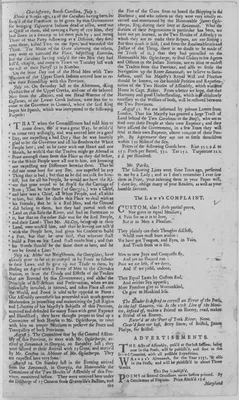
The Virginia Gazette Poem October 15, 1736
Richmond, Richmond, Virginia
What is this article about?
A lady's complaint against the double standard of custom, arguing that love is a pain for women and a pleasure for men, and calling for equal laws.
Quality green show the numbers
Measured from the scan
— how cleanly the OCR engine read the characters
- Mean ink quality
- 99.0% The length-weighted average confidence across the OCR lines — the mean of exactly the per-line scores whose tails the two figures below report. Typical is 99%.
- Illegible ink
- 0.0% Text sitting in OCR-detected lines that scored below 80% confidence — very shaky reads. Weighted by line length, so one long bad line counts for more than a short one.
- Uncertain ink
- 0.0% Text in lines that scored 80–90% — somewhat shaky reads.
- Matches source
- 97.35% How closely the served text matches the raw OCR of the same boxes, letter by letter, after collapsing spacing and case. This measures agreement, not correctness: the OCR is often wrong and the extractor corrects it, so 100% does not mean perfect, and a low figure usually means poor scan text was rewritten rather than that text was lost (length vs source shows loss).
- Length vs source
- 99.59% Below 100% means text was dropped from the OCR; above means text was added to make it read.
Assembled by the extraction model
— whether the stitched-together text holds up; catches layout and segmentation errors, which the scores above cannot see
- Transcription confidence
- 97.0% (typical 96%) How cleanly the extractor could assemble what it was given. Low here with clean ink scores points at layout analysis — the characters were read correctly but grouped or ordered wrongly.
- Comprehension
- 90.0% Whether the piece reads coherently start to finish. Can stay high while transcription confidence drops, when only part of the component is affected.
Clipping
Full Text
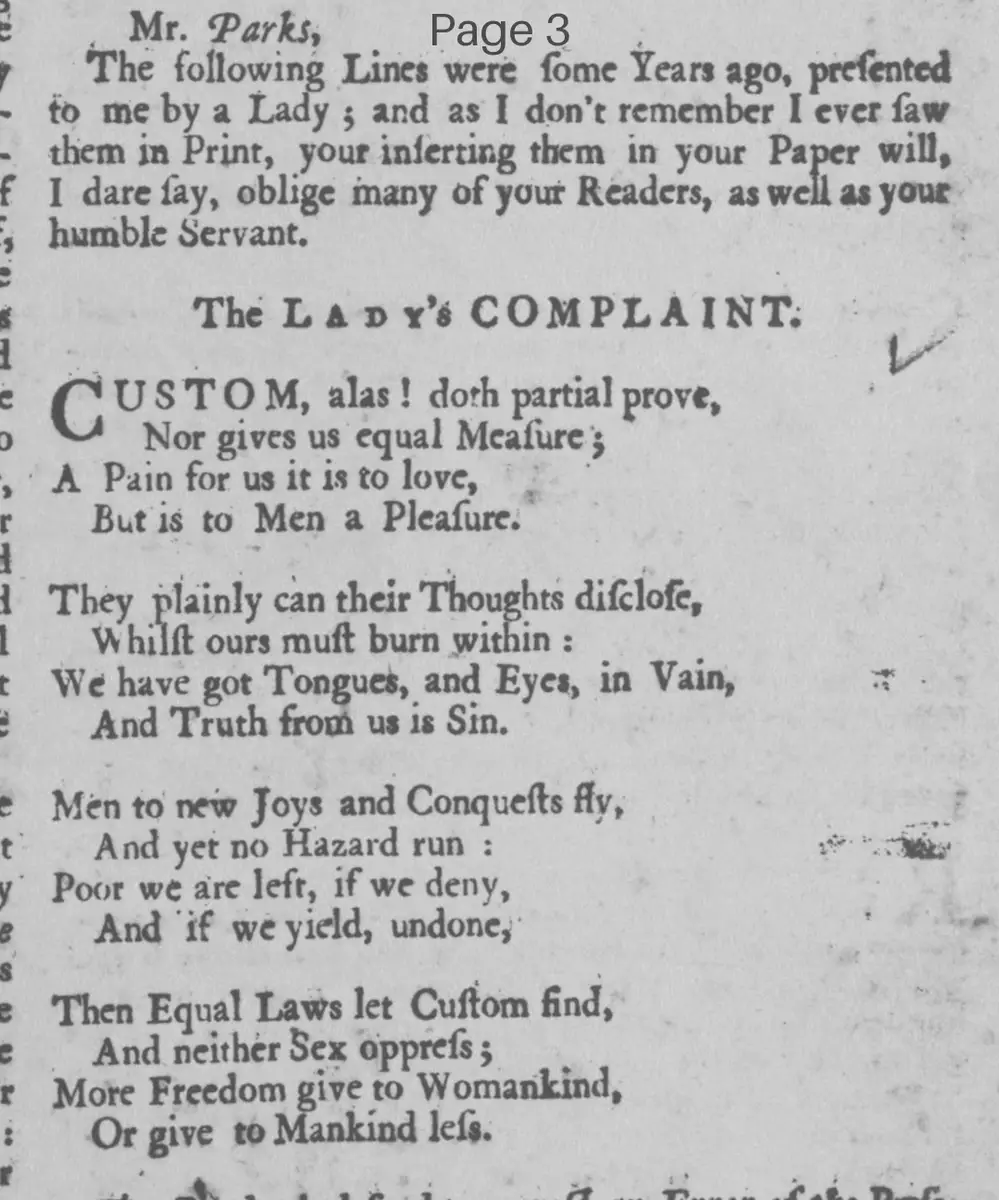
The following Lines were some Years ago, presented to me by a Lady; and as I don't remember I ever saw them in Print, your inserting them in your Paper will, I dare say, oblige many of your Readers, as well as your humble Servant.
The LADY's COMPLAINT.
Custom, alas! doth partial prove,
Nor gives us equal Measure;
A Pain for us it is to love,
But is to Men a Pleasure.
They plainly can their Thoughts disclose,
Whilst ours must burn within:
We have got Tongues, and Eyes, in Vain,
And Truth from us is Sin.
Men to new Joys and Conquests fly,
And yet no Hazard run:
Poor we are left, if we deny,
And if we yield, undone.
Then Equal Laws let Custom find,
And neither Sex oppress;
More Freedom give to Womankind,
Or give to Mankind less.
What sub-type of article is it?
Lyric
Satire
What themes does it touch?
Satire Society
Liberty Independence
What keywords are associated?
Lady's Complaint
Double Standard
Women's Freedom
Custom
Poem Details
Title
The Lady's Complaint.
Subject
The Unequal Customs Of Love Between The Sexes
Form / Style
Rhymed Quatrains
Key Lines
Custom, Alas! Doth Partial Prove,
Nor Gives Us Equal Measure;
More Freedom Give To Womankind,
Or Give To Mankind Less.