Thank you for visiting SNEWPapers!
Sign up free
The New Hampshire Gazette And Historical Chronicle Domestic News March 9, 1764
Portsmouth, Rockingham, New Hampshire
What is this article about?
Letter from Philadelphia describes alarm over armed Paxton rioters marching on the city; the Governor called out citizens, the Assembly passed a riot act, and after several days of alarms the Paxtonians dispersed and peace was restored.
Quality green show the numbers
Measured from the scan
— how cleanly the OCR engine read the characters
- Mean ink quality
- 98.0% The length-weighted average confidence across the OCR lines — the mean of exactly the per-line scores whose tails the two figures below report. Typical is 99%.
- Illegible ink
- 0.0% Text sitting in OCR-detected lines that scored below 80% confidence — very shaky reads. Weighted by line length, so one long bad line counts for more than a short one.
- Uncertain ink
- 0.0% Text in lines that scored 80–90% — somewhat shaky reads.
- Matches source
- 96.35% How closely the served text matches the raw OCR of the same boxes, letter by letter, after collapsing spacing and case. This measures agreement, not correctness: the OCR is often wrong and the extractor corrects it, so 100% does not mean perfect, and a low figure usually means poor scan text was rewritten rather than that text was lost (length vs source shows loss).
- Length vs source
- 99.54% Below 100% means text was dropped from the OCR; above means text was added to make it read.
Assembled by the extraction model
— whether the stitched-together text holds up; catches layout and segmentation errors, which the scores above cannot see
- Transcription confidence
- 93.0% (typical 96%) How cleanly the extractor could assemble what it was given. Low here with clean ink scores points at layout analysis — the characters were read correctly but grouped or ordered wrongly.
- Comprehension
- 95.0% Whether the piece reads coherently start to finish. Can stay high while transcription confidence drops, when only part of the component is affected.
Clipping
Full Text
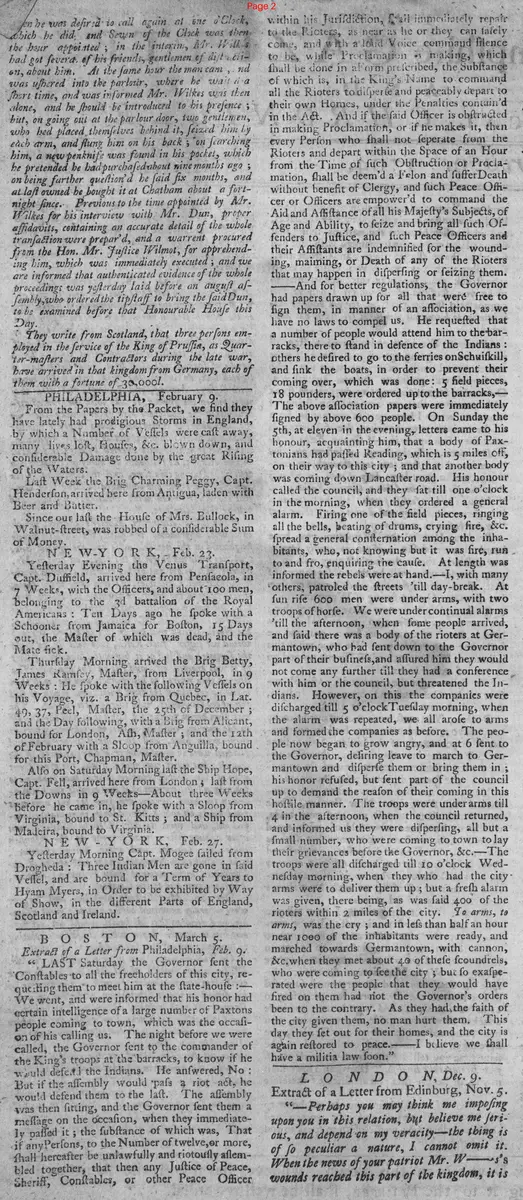
BOSTON, March 5.
Extract of a Letter from Philadelphia, Feb. 9.
"Last Saturday the Governor sent the constables to all the freeholders of this city, requesting them to meet him at the state-house: we went, and were informed that his honor had certain intelligence of a large number of Paxton's people coming to town, which was the occasion of his calling us. The night before we were called, the Governor sent to the commander of the King's troops at the barracks, to know if he would defend the Indians. He answered, No: but if the assembly would pass a riot act, he would defend them to the last. The assembly was then sitting, and the Governor sent them a message on the occasion, when they immediately passed it; the substance of which was, That if any persons, to the number of twelve, or more, shall hereafter be unlawfully and riotously assembled together, that then any Justice of Peace, sheriff, constables, or other peace officer within his jurisdiction, shall immediately repair to the rioters, as near as he or they can safely come, and with a loud voice command silence to be, while proclamation is making, which shall be done in a form prescribed, the substance of which is, in the King's name to command all the rioters to disperse and peaceably depart to their own homes, under the penalties contain'd in the Act. And if the said officer is obstructed in making proclamation, or if he makes it, then every person who shall not separate from the rioters and depart within the space of an hour from the time of such obstruction or proclamation, shall be deem'd a felon and suffer death without benefit of clergy, and such peace officer or officers are empower'd to command the aid and assistance of all his Majesty's subjects, of age and ability, to seize and bring all such offenders to justice, and such peace officers and their assistants are indemnified for the wounding, maiming, or death of any of the rioters that may happen in dispersing or seizing them.
And for better regulations, the Governor had papers drawn up for all that were free to sign them, in manner of an association, as we have no laws to compel us. He requested that a number of people would attend him to the barracks, there to stand in defence of the Indians: others he desired to go to the ferries on Schuylkill, and sink the boats, in order to prevent their coming over, which was done: 5 field pieces, 18 pounders, were ordered up to the barracks. The above association papers were immediately signed by above 600 people. On Sunday the 5th, at eleven in the evening, letters came to his honour, acquainting him, that a body of Paxtonians had passed Reading, which is 5 miles off, on their way to this city; and that another body was coming down Lancaster road. His honour called the council, and they sat till one o'clock in the morning, when they ordered a general alarm. Firing one of the field pieces, ringing all the bells, beating of drums, crying fire, &c. spread a general consternation among the inhabitants, who, not knowing but it was fire, ran to and fro, enquiring the cause. At length was informed the rebels were at hand.—I, with many others, patroled the streets 'till day-break. At sun-rise 600 men were under arms, with two troops of horse. We were under continual alarms 'till the afternoon, when some people arrived, and said there was a body of the rioters at Germantown, who had sent down to the Governor part of their business, and assured him they would not come any further till they had a conference with him or the council, but threatened the Indians. However, on this the companies were discharged till 5 o'clock Tuesday morning, when the alarm was repeated, we all arose to arms and formed the companies as before. The people now began to grow angry, and at 6 sent to the Governor, desiring leave to march to Germantown and disperse them or bring them in; his honor refused, but sent part of the council up to demand the reason of their coming in this hostile manner. The troops were under arms till 4 in the afternoon, when the council returned, and informed us they were dispersing, all but a small number, who were coming to town to lay their grievances before the Governor, &c.—The troops were all discharged till 10 o'clock Wednesday morning, when they who had the city arms were to deliver them up; but a fresh alarm was given, there being, as was said, 400 of the rioters within 2 miles of the city: To arms, to arms, was the cry; and in less than half an hour near 1000 of the inhabitants were ready, and marched towards Germantown, with cannon, &c. when they met about 40 of these scoundrels, who were coming to see the city; but so exasperated were the people that they would have fired on them had not the Governor's orders been to the contrary. As they had the faith of the city given them, no man hurt them. This day they set out for their homes, and the city is again restored to peace.—I believe we shall have a militia law soon."
What sub-type of article is it?
Riot Or Protest
Politics
Military
What keywords are associated?
Paxton Boys
Philadelphia Riot
Riot Act
Militia Alarm
Indians
Where did it happen?
Philadelphia
Domestic News Details
Primary Location
Philadelphia
Event Date
February 9
Outcome
no casualties reported; riot act passed, citizens and militia armed, paxtonians dispersed and returned home, city restored to peace.