Thanks for visiting SNEWPapers!
Sign up free today to connect your AI tools to the Library of Congress' newspaper collection.
The Virginia Gazette Foreign News September 2, 1773
Williamsburg, Virginia
What is this article about?
At a meeting of East India Company proprietors in London, the chairman and directors oppose the East India bill and a government loan bill, recommending General Monckton as commander-in-chief in India over objections, and move to petition Parliament against the measures.
Quality green show the numbers
Measured from the scan
— how cleanly the OCR engine read the characters
- Mean ink quality
- 99.0% The length-weighted average confidence across the OCR lines — the mean of exactly the per-line scores whose tails the two figures below report. Typical is 99%.
- Illegible ink
- 0.0% Text sitting in OCR-detected lines that scored below 80% confidence — very shaky reads. Weighted by line length, so one long bad line counts for more than a short one.
- Uncertain ink
- 0.0% Text in lines that scored 80–90% — somewhat shaky reads.
- Matches source
- 96.97% How closely the served text matches the raw OCR of the same boxes, letter by letter, after collapsing spacing and case. This measures agreement, not correctness: the OCR is often wrong and the extractor corrects it, so 100% does not mean perfect, and a low figure usually means poor scan text was rewritten rather than that text was lost (length vs source shows loss).
- Length vs source
- 99.23% Below 100% means text was dropped from the OCR; above means text was added to make it read.
Assembled by the extraction model
— whether the stitched-together text holds up; catches layout and segmentation errors, which the scores above cannot see
- Transcription confidence
- 95.0% (typical 96%) How cleanly the extractor could assemble what it was given. Low here with clean ink scores points at layout analysis — the characters were read correctly but grouped or ordered wrongly.
- Comprehension
- 95.0% Whether the piece reads coherently start to finish. Can stay high while transcription confidence drops, when only part of the component is affected.
Clipping
Full Text
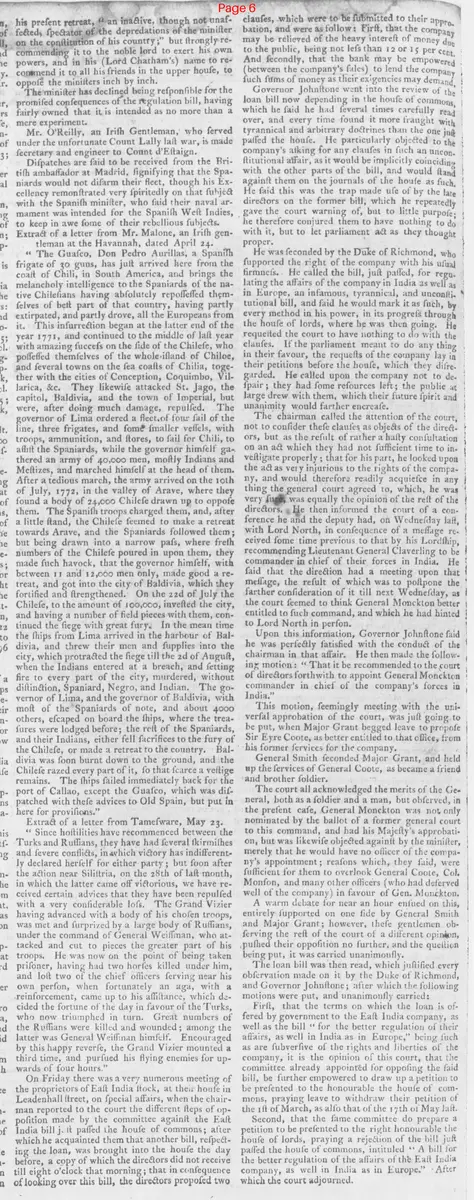
On Friday there was a very numerous meeting of the proprietors of East India stock, at their house in Leadenhall street, on special affairs, when the chairman reported to the court the different steps of opposition made by the committee against the East India bill just passed the house of commons; after which he acquainted them that another bill, respecting the loan, was brought into the house the day before, a copy of which the directors did not receive till eight o'clock that morning; that in consequence of looking over this bill, the directors proposed two clauses, which were to be submitted to their approbation, and were as follow: First, that the company may be relieved of the heavy interest of money due to the public, being not less than 12 or 15 per cent. And secondly, that the bank may be empowered (between the company's sales) to lend the company such sums of money as their exigencies may demand,
Governor Johnstone went into the review of the loan bill now depending in the house of commons, which he said he had several times carefully read over, and every time found it more fraught with tyrannical and arbitrary doctrines than the one just passed the house. He particularly objected to the company's asking for any clauses in such an unconstitutional affair, as it would be implicitly coinciding with the other parts of the bill, and would stand against them on the journals of the house as such. He said this was the trap made use of by the late directors on the former bill, which he repeatedly gave the court warning of, but to little purpose; he therefore conjured them to have nothing to do with it, but to let parliament act as they thought proper.
He was seconded by the Duke of Richmond, who supported the right of the company with his usual firmness. He called the bill, just passed, for regulating the affairs of the company in India as well as in Europe, an infamous, tyrannical, and unconstitutional bill, and said he would mark it as such, by every method in his power, in its progress through the house of lords, where he was then going. He requested the court to have nothing to do with the clauses. If the parliament meant to do any thing in their favour, the requests of the company lay in their petitions before the house, which they disregarded. He called upon the company not to despair; they had some resources left; the public at large drew with them, which their future spirit and unanimity would farther increase.
The chairman called the attention of the court, not to consider these clauses as objects of the directors, but as the result of rather a hasty consultation on an act which they had not sufficient time to investigate properly; that for his part, he looked upon the act as very injurious to the rights of the company, and would therefore readily acquiesce in any thing the general court agreed to, which, he was very sure, was equally the opinion of the rest of the directors. He then informed the court of a conference he and the deputy had, on Wednesday last, with Lord North, in consequence of a message received some time previous to that by his Lordship, recommending Lieutenant General Claverling to be commander in chief of their forces in India. He said that the direction had a meeting upon that message, the result of which was to postpone the farther consideration of it till next Wednesday, as the court seemed to think General Monckton better entitled to such command, and which he had hinted to Lord North in person.
Upon this information, Governor Johnstone said he was perfectly satisfied with the conduct of the chairman in that affair. He then made the following motion: "That it be recommended to the court of directors forthwith to appoint General Monckton commander in chief of the company's forces in India."
This motion, seemingly meeting with the universal approbation of the court, was just going to be put, when Major Grant begged leave to propose Sir Eyre Coote, as better entitled to that office, from his former services for the company.
General Smith seconded Major Grant, and held up the services of General Coote, as became a friend and brother soldier.
The court all acknowledged the merits of the General, both as a soldier and a man, but observed, in the present case, General Monckton was not only nominated by the ballot of a former general court to this command, and had his Majesty's approbation, but was likewise objected against by the minister, merely that he would have no officer of the company's appointment; reasons which, they said, were sufficient for them to overlook General Coote, Col. Monson, and many other officers (who had deserved well of the company) in favour of Gen. Monckton.
A warm debate for near an hour ensued on this, entirely supported on one side by General Smith and Major Grant; however, these gentlemen observing the rest of the court of a different opinion, pushed their opposition no further, and the question being put, it was carried unanimously.
The loan bill was then read, which justified every observation made on it by the Duke of Richmond, and Governor Johnstone; after which the following motions were put, and unanimously carried:
First, that the terms on which the loan is offered by government to the East India company, as well as the bill "for the better regulation of their affairs, as well in India as in Europe," being such as are subversive of the rights and liberties of the company, it is the opinion of this court, that the committee already appointed for opposing the said bill, be further empowered to draw up a petition to be presented to the honourable the house of commons, praying leave to withdraw their petition of the 1st of March, as also that of the 17th of May last.
Second, that the same committee do prepare a petition to be presented to the right honourable the house of lords, praying a rejection of the bill just passed the house of commons, intituled "A bill for the better regulation of the affairs of the East India company, as well in India as in Europe." After which the court adjourned.
What sub-type of article is it?
Political
Economic
What keywords are associated?
East India Company
Loan Bill
General Monckton
Petition
Leadenhall Street
What entities or persons were involved?
Governor Johnstone
Duke Of Richmond
Lord North
General Monckton
General Coote
Major Grant
General Smith
Where did it happen?
London
Foreign News Details
Primary Location
London
Event Date
On Friday
Key Persons
Governor Johnstone
Duke Of Richmond
Lord North
General Monckton
General Coote
Major Grant
General Smith
Outcome
court resolved to petition the commons to withdraw earlier petitions and to petition the lords to reject the bill for regulating east india affairs.