Thank you for visiting SNEWPapers!
Sign up free
Sunbury American Foreign News November 15, 1851
Sunbury, Northumberland, Pennsylvania
What is this article about?
Whale-ship Ann Alexander, Capt. Deblois, was twice attacked and finally sunk by a sperm whale in the South Pacific; the crew was rescued after two boats were destroyed, and all hands were saved by the ship Nantucket.
Quality green show the numbers
Measured from the scan
— how cleanly the OCR engine read the characters
- Mean ink quality
- 99.0% The length-weighted average confidence across the OCR lines — the mean of exactly the per-line scores whose tails the two figures below report. Typical is 99%.
- Illegible ink
- 0.0% Text sitting in OCR-detected lines that scored below 80% confidence — very shaky reads. Weighted by line length, so one long bad line counts for more than a short one.
- Uncertain ink
- 0.0% Text in lines that scored 80–90% — somewhat shaky reads.
- Matches source
- 98.47% How closely the served text matches the raw OCR of the same boxes, letter by letter, after collapsing spacing and case. This measures agreement, not correctness: the OCR is often wrong and the extractor corrects it, so 100% does not mean perfect, and a low figure usually means poor scan text was rewritten rather than that text was lost (length vs source shows loss).
- Length vs source
- 99.28% Below 100% means text was dropped from the OCR; above means text was added to make it read.
Assembled by the extraction model
— whether the stitched-together text holds up; catches layout and segmentation errors, which the scores above cannot see
- Transcription confidence
- 98.0% (typical 96%) How cleanly the extractor could assemble what it was given. Low here with clean ink scores points at layout analysis — the characters were read correctly but grouped or ordered wrongly.
- Comprehension
- 95.0% Whether the piece reads coherently start to finish. Can stay high while transcription confidence drops, when only part of the component is affected.
Clipping
Full Text
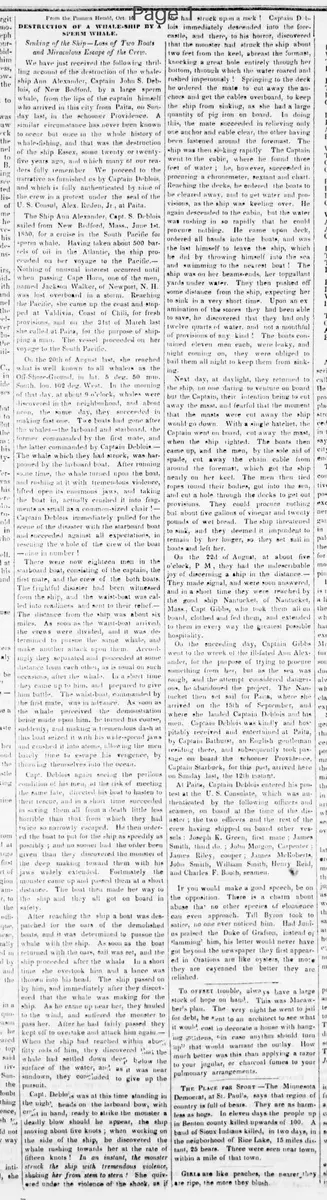
From the Panama Herald, Oct. 16.
DESTRUCTION OF A WHALE-SHIP BY A SPERM WHALE.
Sinking of the Ship—Loss of Two Boats and Miraculous Escape of the Crew.
We have just received the following thrilling account of the destruction of the whale-ship Ann Alexander, Captain John S. Deblois, of New Bedford, by a large sperm whale, from the lips of the captain himself, who arrived in this city from Paita, on Sunday last, in the schooner Providence. A similar circumstance has never been known to occur but once in the whole history of whale-fishing, and that was the destruction of the ship Essex, some twenty or twenty-five years ago, and which many of our readers fully remember. We proceed to the narrative as furnished us by Captain Deblois, and which is fully authenticated by nine of the crew in a protest under the seal of the U. S. Consul, Alex. Ruden, Jr., at Paita.
The Ship Ann Alexander, Capt. S. Deblois, sailed from New Bedford, Mass., June 1st, 1850, for a cruise in the South Pacific for sperm whale. Having taken about 500 barrels of oil in the Atlantic, the ship proceeded on her voyage to the Pacific. Nothing of unusual interest occurred until when passing Cape Horn, one of the men, named Jackson Walker, of Newport, N. H., was lost overboard in a storm. Reaching the Pacific, she came up the coast and stopped at Valdivia, Coast of Chili, for fresh provisions, and on the 31st of March last she called at Paita, for the purpose of shipping a man. The vessel proceeded on her voyage to the South Pacific.
On the 20th of August last, she reached what is well known to all whalers as the Off-Shore-Ground, in lat. 5 deg. 50 min. South, lon. 102 deg. West. In the morning of that day, at about 9 o'clock, whales were discovered in the neighborhood, and about noon, the same day, they succeeded in making fast one. Two boats had gone after the whales—the larboard and starboard, the former commanded by the first mate, and the latter commanded by Captain Deblois. The whale which they had struck, was harpooned by the larboard boat. After running some time, the whale turned upon the boat, and rushing at it with tremendous violence, lifted open its enormous jaws, and taking the boat in, actually crushed it into fragments as small as a common-sized chair! Captain Deblois immediately pulled for the scene of the disaster with the starboard boat and succeeded against all expectations, in rescuing the whole of the crew of the boat—nine in number!
There were now eighteen men in the starboard boat, consisting of the captain, the first mate, and the crew of the both boats. The frightful disaster had been witnessed from the ship, and the waist-boat was called into readiness and sent to their relief. The distance from the ship was about six miles. As soon as the waist-boat arrived, the crews were divided, and it was determined to pursue the same whale, and make another attack upon them. Accordingly they separated and proceeded at some distance from each other, as is usual on such occasions, after the whale. In a short time they came up to him, and prepared to give him battle. The waist-boat, commanded by the first mate, was in advance. As soon as the whale perceived the demonstration being made upon him, he turned his course, suddenly, and making a tremendous dash at this boat seized it with his wide-spread jaws and crushed it into atoms, allowing the men barely time to escape his vengeance, by throwing themselves into the ocean.
Capt. Deblois again seeing the perilous condition of his men, at the risk of meeting the same fate, directed his boat to hasten to their rescue, and in a short time succeeded in saving them all from a death little less horrible than that from which they had twice so narrowly escaped. He then ordered the boat to put for the ship as speedily as possible; and no sooner had the order been given than they discovered the monster of the deep making toward them with his jaws widely extended. Fortunately the monster came up and passed them at a short distance. The boat then made her way to the ship and they all got on board in safety.
After reaching the ship a boat was dispatched for the oars of the demolished boats, and it was determined to pursue the whale with the ship. As soon as the boat returned with the oars, sail was set, and the ship proceeded after the whale. In a short time she overtook him and a lance was thrown into his head. The ship passed on by him, and immediately after they discovered that the whale was making for the ship. As he came up near her, they hauled to the wind, and suffered the monster to pass her. After he had fairly passed they kept off to overtake and attack him again. When the ship had reached within about fifty rods of him, they discovered that the whale had settled down deep below the surface of the water, and as it was near sundown, they concluded to give up the pursuit.
Capt. Deblois was at this time standing in the knight-heads on the larboard bow, with craft in hand, ready to strike the monster a deadly blow should he appear, the ship moving about five knots; when working on the side of the ship, he discovered the whale rushing towards her at the rate of fifteen knots! In an instant, the monster struck the ship with tremendous violence, shaking her from stem to stern! She quivered under the violence of the shock, as if she had struck upon a rock! Captain Deblois immediately descended into the forecastle, and there, to his horror, discovered that the monster had struck the ship about two feet from the keel, abreast the foremast, knocking a great hole entirely through her bottom, through which the water roared and rushed impetuously! Springing to the deck he ordered the mate to cut away the anchors and get the cables overboard, to keep the ship from sinking, as she had a large quantity of pig iron on board. In doing this, the mate succeeded in relieving only one anchor and cable clear, the other having been fastened around the foremast. The ship was then sinking rapidly. The Captain went to the cabin, where he found three feet of water; he, however, succeeded in procuring a chronometer, sextant and chart. Reaching the decks, he ordered the boats to be cleared away, and to get water and provisions, as the ship was keeling over. He again descended to the cabin, but the water was rushing in so rapidly that he could procure nothing. He came upon deck, ordered all hands into the boats, and was the last himself to leave the ship, which he did by throwing himself into the sea and swimming to the nearest boat! The ship was on her beam-ends, her topgallant yards under water. They then pushed off some distance from the ship, expecting her to sink in a very short time. Upon an examination of the stores they had been able to save, he discovered that they had only twelve quarts of water, and not a mouthful of provisions of any kind! The boats contained eleven men each, were leaky, and night coming on, they were obliged to bail them all night to keep them from sinking.
Next day, at daylight, they returned to the ship, no one daring to venture on board but the Captain, their intention being to cut away the mast, and fearful that the moment that the masts were cut away the ship would go down. With a single hatchet, the Captain went on board, cut away the mast, when the ship righted. The boats then came up, and the men, by the sole aid of spade, cut away the chain cable from around the foremast, which got the ship nearly on her keel. The men then tied ropes round their bodies, got into the sea, and cut a hole through the decks to get out provisions. They could procure nothing but about five gallons of vinegar and twenty pounds of wet bread. The ship threatened to sink, and they deemed it imprudent to remain by her longer, so they set sail in boats and left her.
On the 22d of August, at about five o'clock, P. M., they had the indescribable joy of discerning a ship in the distance. They made signal, and were soon answered, and in a short time they were reached by the good ship Nantucket, of Nantucket, Mass., Capt. Gibbs, who took them all on board, clothed and fed them, and extended to them in every way the greatest possible hospitality.
On the succeeding day, Captain Gibbs went to the wreck of the ill-fated Ann Alexander, for the purpose of trying to procure something from her, but as the sea was rough, and the attempt considered dangerous, he abandoned the project. The Nantucket then set sail for Paita, where she arrived on the 15th of September, and where she landed Captain Deblois and his men. Captain Deblois was kindly and hospitably received and entertained at Paita, by Captain Bathurst, an English gentleman residing there, and subsequently took passage on board the schooner Providence, Captain Starbuck, for this port, arrived here on Sunday last, the 12th instant.
At Paita, Captain Deblois entered his protest at the U. S. Consulate, which was authenticated by the following officers and seamen, on board at the time of the disaster; the two officers and the rest of the crew having shipped on board other vessels: Joseph K. Green, first mate; James Smith, third do.; John Morgan, Carpenter; James Riley, cooper; James McRoberts, John Smith, William Smith, Henry Reid, and Charles F. Booth, seamen.
What sub-type of article is it?
Human Interest
Naval Affairs
What keywords are associated?
Whale Attack
Ann Alexander
Sperm Whale
Shipwreck
South Pacific
What entities or persons were involved?
Captain John S. Deblois
Captain Gibbs
Joseph K. Green
Where did it happen?
Off Shore Ground, South Pacific
Foreign News Details
Primary Location
Off Shore Ground, South Pacific
Event Date
20th August Last (1850)
Key Persons
Captain John S. Deblois
Captain Gibbs
Joseph K. Green
Outcome
one seaman lost overboard; two whaleboats destroyed; ship ann alexander sunk; entire crew rescued.