Thanks for visiting SNEWPapers!
Sign up free today to connect your AI tools to the Library of Congress' newspaper collection.
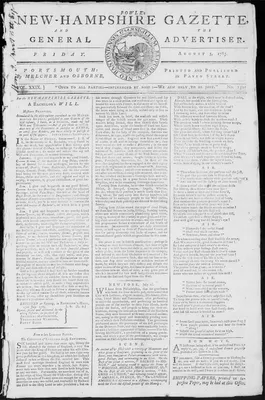
Fowle's New Hampshire Gazette And General Advertiser Editorial August 5, 1785
Portsmouth, Rockingham, New Hampshire
Cautionary note: graphic descriptions of colonial violence (natives blown from guns) and slavery
What is this article about?
A sweeping condemnation of English history from Henry II onward—constant wars, colonial conquest in America, the African slave trade, and atrocities in India—arguing Britain's restless thirst for dominion has left it deeply in debt.
Quality yellow Our extraction tools indicate this piece is a little shaky on the transcription; compare it to the source before quoting. show the numbers
Measured from the scan
— how cleanly the OCR engine read the characters
- Mean ink quality
- 99.0% The length-weighted average confidence across the OCR lines — the mean of exactly the per-line scores whose tails the two figures below report. Typical is 99%.
- Illegible ink
- 0.0% Text sitting in OCR-detected lines that scored below 80% confidence — very shaky reads. Weighted by line length, so one long bad line counts for more than a short one.
- Uncertain ink
- 0.0% Text in lines that scored 80–90% — somewhat shaky reads.
- Matches source
- 96.67% How closely the served text matches the raw OCR of the same boxes, letter by letter, after collapsing spacing and case. This measures agreement, not correctness: the OCR is often wrong and the extractor corrects it, so 100% does not mean perfect, and a low figure usually means poor scan text was rewritten rather than that text was lost (length vs source shows loss).
- Length vs source
- 99.58% Below 100% means text was dropped from the OCR; above means text was added to make it read.
Assembled by the extraction model
— whether the stitched-together text holds up; catches layout and segmentation errors, which the scores above cannot see
- Transcription confidence
- 90.0% (typical 96%) How cleanly the extractor could assemble what it was given. Low here with clean ink scores points at layout analysis — the characters were read correctly but grouped or ordered wrongly.
- Comprehension
- 90.0% Whether the piece reads coherently start to finish. Can stay high while transcription confidence drops, when only part of the component is affected.
Clipping
Full Text
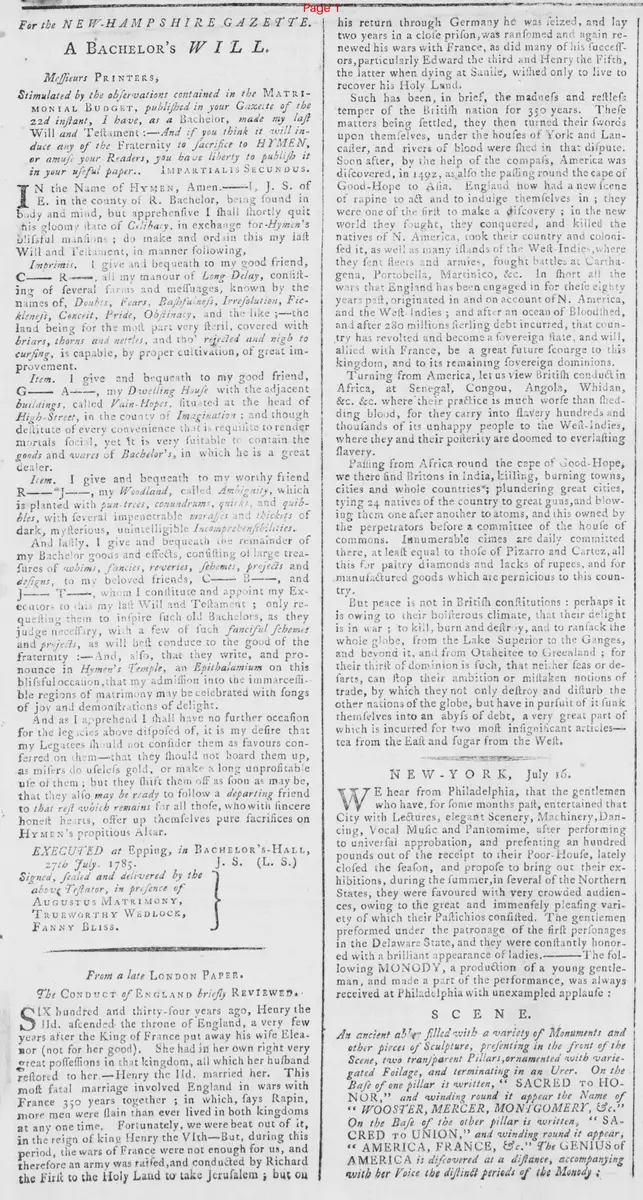
From a late LONDON PAPER.
The CONDUCT of ENGLAND briefly REVIEWED.
Six hundred and thirty-four years ago, Henry the IId ascended the throne of England, a very few years after the King of France put away his wife Eleanour (not for her good). She had in her own right very great possessions in that kingdom, all which her husband restored to her. Henry the IId married her. This most fatal marriage involved England in wars with France 350 years together ; in which, says Rapin, more men were slain than ever lived in both kingdoms at any one time. Fortunately, we were beat out of it, in the reign of king Henry the VIth-But, during this period, the wars of France were not enough for us, and therefore an army was raised, and conducted by Richard the First to the Holy Land to take Jerusalem ; but on his return through Germany he was seized, and lay two years in a close prison, was ransomed and again renewed his wars with France, as did many of his successors, particularly Edward the third and Henry the Fifth, the latter when dying at Sanile, wished only to live to recover his Holy Land.
Such has been, in brief, the madness and restless temper of the British nation for 350 years. These matters being settled, they then turned their swords upon themselves, under the houses of York and Lancaster, and rivers of blood were shed in that dispute. Soon after, by the help of the compass, America was discovered, in 1492, as also the passing round the cape of Good-Hope to Asia. England now had a new scene of rapine to act and to indulge themselves in ; they were one of the first to make a discovery ; in the new world they fought, they conquered, and killed the natives of N. America, took their country and colonised it, as well as many islands of the West-Indies, where they sent fleets and armies, fought battles at Carthagena, Portobello, Martinico, &c. In short all the wars that England has been engaged in for these eighty years past, originated in and on account of N. America, and the West Indies ; and after an ocean of Bloodshed, and after 280 millions sterling debt incurred, that country has revolted and become a sovereign state, and will, allied with France, be a great future scourge to this kingdom, and to its remaining sovereign dominions.
Turning from America, let us view British conduct in Africa, at Senegal, Congou, Angola, Whidan, &c. &c. where their practice is much worse than shedding blood, for they carry into slavery hundreds and thousands of its unhappy people to the West-Indies, where they and their posterity are doomed to everlasting slavery.
Passing from Africa round the cape of Good-Hope, we there find Britons in India, killing, burning towns, cities and whole countries ; plundering great cities, tying 24 natives of the country to great guns, and blowing them one after another to atoms, and this owned by the perpetrators before a committee of the house of commons. Innumerable crimes are daily committed there, at least equal to those of Pizarro and Cortez, all this for paltry diamonds and lacks of rupees, and for manufactured goods which are pernicious to this country.
But peace is not in British constitutions : perhaps it is owing to their boisterous climate, that their delight is in war ; 'to kill, burn and destroy, and to ransack the whole globe, from the Lake Superior to the Ganges, and beyond it, and from Otaheitee to Greenland ; for their thirst of dominion is such, that neither seas or deserts, can stop their ambition or mistaken notions of trade, by which they not only destroy and disturb the other nations of the globe, but have in pursuit of it sunk themselves into an abyss of debt, a very great part of which is incurred for two most insignificant articles—tea from the East and sugar from the West.
What sub-type of article is it?
War Or Peace
Imperialism
Slavery Abolition
What keywords are associated?
British Conduct
Colonial Wars
Slavery
India Atrocities
Imperialism
War Critique
What entities or persons were involved?
Henry Ii
Richard I
Edward Iii
Henry V
Great Britain
France
India
Africa
Editorial Details
Primary Topic
Historical Critique Of British Conduct
Stance / Tone
Condemnatory And Anti British
Key Figures
Henry Ii
Richard I
Edward Iii
Henry V
Great Britain
France
India
Africa
Key Arguments
- England's fatal marriage to Eleanor involved it in 350 years of wars with France
- Britain's restless temper led it to crusades and constant warfare
- British colonial wars in America and the West Indies originated from greed
- Britain carries Africans into slavery in the West Indies
- British atrocities in India rival those of Pizarro and Cortez
- Britain's thirst for dominion has sunk it into an abyss of debt over tea and sugar