Thank you for visiting SNEWPapers!
Sign up free
The Virginia Gazette Foreign News August 16, 1751
Richmond, Richmond, Virginia
What is this article about?
A British bill in the House of Peers proposes replacing the old year beginning March 25 with January 1, omitting eleven nominal days, revising leap-year rules, and adopting new calendar tables and Easter rules, while protecting existing contracts, rents, leases, and ages.
Quality green show the numbers
Measured from the scan
— how cleanly the OCR engine read the characters
- Mean ink quality
- 99.0% The length-weighted average confidence across the OCR lines — the mean of exactly the per-line scores whose tails the two figures below report. Typical is 99%.
- Illegible ink
- 0.0% Text sitting in OCR-detected lines that scored below 80% confidence — very shaky reads. Weighted by line length, so one long bad line counts for more than a short one.
- Uncertain ink
- 0.0% Text in lines that scored 80–90% — somewhat shaky reads.
- Matches source
- 96.85% How closely the served text matches the raw OCR of the same boxes, letter by letter, after collapsing spacing and case. This measures agreement, not correctness: the OCR is often wrong and the extractor corrects it, so 100% does not mean perfect, and a low figure usually means poor scan text was rewritten rather than that text was lost (length vs source shows loss).
- Length vs source
- 99.6% Below 100% means text was dropped from the OCR; above means text was added to make it read.
Assembled by the extraction model
— whether the stitched-together text holds up; catches layout and segmentation errors, which the scores above cannot see
- Transcription confidence
- 96.0% (typical 96%) How cleanly the extractor could assemble what it was given. Low here with clean ink scores points at layout analysis — the characters were read correctly but grouped or ordered wrongly.
- Comprehension
- 95.0% Whether the piece reads coherently start to finish. Can stay high while transcription confidence drops, when only part of the component is affected.
Clipping
Full Text
LONDON,
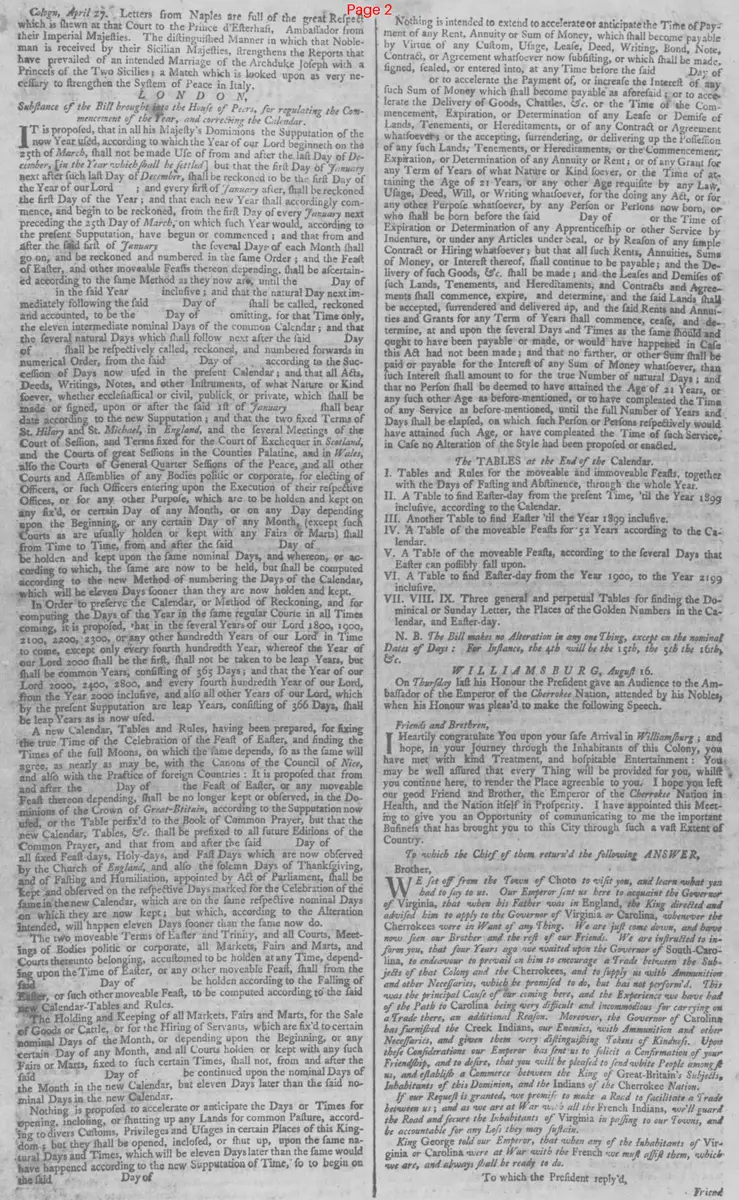
Substance of the Bill brought into the House of Peers, for regulating the Commencement of the Year, and correcting the Calendar.
IT is proposed, that in all his Majesty's Dominions the Supputation of the now Year used, according to which the Year of our Lord beginneth on the 25th of March, shall not be made Use of from and after the last Day of December, [in the Year which shall be settled] but that the first Day of January next after such last Day of December, shall be reckoned to be the first Day of the Year of our Lord ; and every first of January after, shall be reckoned the first Day of the Year; and that each new Year shall accordingly commence, and begin to be reckoned, from the first Day of every January next preceding the 25th Day of March, on which such Year would, according to the present Supputation, have begun or commenced; and that from and after the said first of January the several Days of each Month shall go on, and be reckoned and numbered in the same Order; and the Feast of Easter, and other moveable Feasts thereon depending, shall be ascertained according to the same Method as they now are, until the Day of in the said Year inclusive; and that the natural Day next immediately following the said Day of shall be called, reckoned and accounted, to be the Day of omitting, for that Time only, the eleven intermediate nominal Days of the common Calendar; and that the several natural Days which shall follow next after the said Day of shall be respectively called, reckoned, and numbered forwards in numerical Order, from the said Day of according to the Succession of Days now used in the present Calendar; and that all Acts, Deeds, Writings, Notes, and other Instruments, of what Nature or Kind soever, whether ecclesiastical or civil, publick, or private, which shall be made or signed, upon or after the said 1st of January shall bear date according to the new Supputation; and that the two fixed Terms of St. Hilary and St. Michael, in England, and the several Meetings of the Court of Session, and Terms fixed for the Court of Exchequer in Scotland, and the Courts of great Sessions in the Counties Palatine, and in Wales, also the Courts of General Quarter Sessions of the Peace, and all other Courts and Assemblies of any Bodies politic or corporate, for electing of Officers, or such Officers entering upon the Execution of their respective Offices, or for any other Purpose, which are to be holden and kept on any fix'd, or certain Day of any Month, or on any Day depending upon the Beginning, or any certain Day of any Month, (except such Courts as are usually holden or kept with any Fairs or Marts) shall from Time to Time, from and after the said Day of be holden and kept upon the same nominal Days, and whereon, or according to which, the same are now to be held, but shall be computed according to the new Method of numbering the Days of the Calendar, which will be eleven Days sooner than they are now holden and kept.
In Order to preserve the Calendar, or Method of Reckoning, and for computing the Days of the Year in the same regular Course in all Times coming, it is proposed, that in the several Years of our Lord 1800, 1900, 2100, 2200, 2300, or any other hundredth Years of our Lord in Time to come, except only every fourth hundredth Year, whereof the Year of our Lord 2000 shall be the first, shall not be taken to be leap Years, but shall be common Years, consisting of 365 Days; and that the Year of our Lord 2000, 2400, 2800, and every fourth hundredth Year of our Lord, from the Year 2000 inclusive, and also all other Years of our Lord, which by the present Supputation are leap Years, consisting of 366 Days, shall be leap Years as is now used.
A new Calendar, Tables and Rules, having been prepared, for fixing the true Time of the Celebration of the Feast of Easter, and finding the Times of the full Moons, on which the same depends, so as the same will agree, as nearly as may be, with the Canons of the Council of Nice, and also with the Practice of foreign Countries: It is proposed that from and after the Day of the Feast of Easter, or any moveable Feast thereon depending, shall be no longer kept or observed, in the Dominions of the Crown of Great-Britain, according to the Supputation now used, or the Table prefix'd to the Book of Common Prayer, but that the new Calendar, Tables, &c. shall be prefixed to all future Editions of the Common Prayer, and that from and after the said Day of all fixed Feast-days, Holy-days, and Fast Days which are now observed by the Church of England, and also the solemn Days of Thanksgiving, and of Fasting and Humiliation, appointed by Act of Parliament, shall be kept and observed on the respective Days marked for the Celebration of the same in the new Calendar, which are on the same respective nominal Days on which they are now kept; but which, according to the Alteration intended, will happen eleven Days sooner than the same now do.
The two moveable Terms of Easter and Trinity, and all Courts, Meetings of Bodies politic or corporate, all Markets, Fairs and Marts, and Courts thereunto belonging, accustomed to be holden at any Time, depending upon the Time of Easter, or any other moveable Feast, shall from the said Day of be holden according to the Falling of Easter, or such other moveable Feast, to be computed according to the said new Calendar-Tables and Rules.
The Holding and Keeping of all Markets, Fairs and Marts, for the Sale of Goods or Cattle, or for the Hiring of Servants, which are fix'd to certain nominal Days of the Month, or depending upon the Beginning, or any certain Day of any Month, and all Courts holden or kept with any such Fairs or Marts, fixed to such certain Times, shall not, from and after the said Day of be continued upon the nominal Days of the Month in the new Calendar, but eleven Days later than the said nominal Days in the new Calendar.
Nothing is proposed to accelerate or anticipate the Days or Times for opening, enclosing, or shutting up any Lands for common Pasture, according to divers Customs, Privileges and Usages in certain Places of this Kingdom; but they shall be opened, enclosed, or shut up, upon the same natural Days and Times, which will be eleven Days later than the same would have happened according to the new Supputation of Time, so to begin on the said Day of
Nothing is intended to extend to accelerate or anticipate the Time of Payment of any Rent, Annuity or Sum of Money, which shall become payable by Virtue of any Custom, Usage, Lease, Deed, Writing, Bond, Note, Contract, or Agreement whatsoever now subsisting, or which shall be made, signed, sealed, or entered into, at any Time before the said Day of — or to accelerate the Payment of, or increase the Interest of any such Sum of Money which shall become payable as aforesaid; or to accelerate the Delivery of Goods, Chattles, &c. or the Time of the Commencement, Expiration, or Determination of any Lease or Demise of Lands, Tenements, or Hereditaments, or of any Contract or Agreement whatsoever; or the accepting, surrendering, or delivering up the Possession of any such Lands, Tenements, or Hereditaments, or the Commencement, Expiration, or Determination of any Annuity or Rent; or of any Grant for any Term of Years of what Nature or Kind soever, or the Time of attaining the Age of 21 Years, or any other Age requisite by any Law, Usage, Deed, Will, or Writing whatsoever, for the doing any Act, or for any other Purpose whatsoever, by any Person or Persons now born, or who shall be born before the said Day of — or the Time of Expiration or Determination of any Apprenticeship or other Service by Indenture, or under any Articles under Seal, or by Reason of any simple Contract or Hiring whatsoever; but that all such Rents, Annuities, Sums of Money, or Interest thereof, shall continue to be payable; and the Delivery of such Goods, &c. shall be made; and the Leases and Demises of such Lands, Tenements, and Hereditaments, and Contracts and Agreements shall commence, expire, and determine, and the said Lands shall be accepted, surrendered and delivered up, and the said Rents and Annuities and Grants for any Term of Years shall commence, cease, and determine, at and upon the several Days and Times as the same should and ought to have been payable or made, or would have happened in Case this Act had not been made; and that no farther, or other Sum shall be paid or payable for the Interest of any Sum of Money whatsoever, than such Interest shall amount to for the true Number of natural Days; and that no Person shall be deemed to have attained the Age of 21 Years, or any such other Age as before-mentioned, or to have compleated the Time of any Service as before-mentioned, until the full Number of Years and Days shall be elapsed, on which such Person or Persons respectively would have attained such Age, or have compleated the Time of such Service, in Case no Alteration of the Style had been proposed or enacted.
The TABLES at the End of the Calendar.
I. Tables and Rules for the moveable and immoveable Feasts, together with the Days of Fasting and Abstinence, through the whole Year.
II. A Table to find Easter-day from the present Time, 'til the Year 1899 inclusive, according to the Calendar.
III. Another Table to find Easter 'til the Year 1899 inclusive.
IV. A Table of the moveable Feasts for 52 Years according to the Calendar.
V. A Table of the moveable Feasts, according to the several Days that Easter can possibly fall upon.
VI. A Table to find Easter-day from the Year 1900, to the Year 2199 inclusive.
VII. VIII. IX. Three general and perpetual Tables for finding the Dominical or Sunday Letter, the Places of the Golden Numbers in the Calendar, and Easter-day.
N. B. The Bill makes no Alteration in any one Thing, except on the nominal Dates of Days: For Instance, the 4th will be the 15th, the 5th the 16th, &c.
What sub-type of article is it?
Political
Religious Affairs
What keywords are associated?
British Calendar Reform
House Of Peers Bill
New Year Supputation
Easter Tables
Leap Year Regulation
Where did it happen?
Great Britain
Foreign News Details
Primary Location
Great Britain
Outcome
proposed adoption of january 1 as new year's day, omission of eleven days, revised leap-year scheme, new easter tables and calendar, with existing contracts, rents, leases, and ages unchanged.