Thanks for visiting SNEWPapers!
Sign up free today to connect your AI tools to the Library of Congress' newspaper collection.
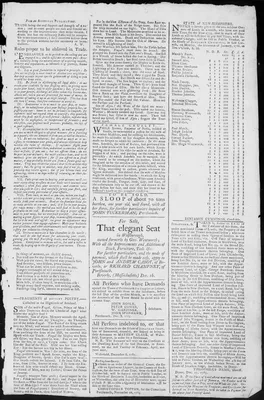
Fowle's New Hampshire Gazette And General Advertiser Literary December 23, 1785
Portsmouth, Rockingham, New Hampshire
What is this article about?
A didactic essay laying out nine rules for conducting trade honestly and prudently—mastery of one's calling, fair dealing, prompt payment, personal attention to customers, courtesy, careful bookkeeping, cautious credit, and a fair character—closing with verses on diligence and thrift.
Quality green show the numbers
Measured from the scan
— how cleanly the OCR engine read the characters
- Mean ink quality
- 98.0% The length-weighted average confidence across the OCR lines — the mean of exactly the per-line scores whose tails the two figures below report. Typical is 99%.
- Illegible ink
- 0.7% Text sitting in OCR-detected lines that scored below 80% confidence — very shaky reads. Weighted by line length, so one long bad line counts for more than a short one.
- Uncertain ink
- 0.0% Text in lines that scored 80–90% — somewhat shaky reads.
- Matches source
- 96.09% How closely the served text matches the raw OCR of the same boxes, letter by letter, after collapsing spacing and case. This measures agreement, not correctness: the OCR is often wrong and the extractor corrects it, so 100% does not mean perfect, and a low figure usually means poor scan text was rewritten rather than that text was lost (length vs source shows loss).
- Length vs source
- 98.95% Below 100% means text was dropped from the OCR; above means text was added to make it read.
Assembled by the extraction model
— whether the stitched-together text holds up; catches layout and segmentation errors, which the scores above cannot see
- Transcription confidence
- 97.0% (typical 96%) How cleanly the extractor could assemble what it was given. Low here with clean ink scores points at layout analysis — the characters were read correctly but grouped or ordered wrongly.
- Comprehension
- 90.0% Whether the piece reads coherently start to finish. Can stay high while transcription confidence drops, when only part of the component is affected.
Clipping
Full Text
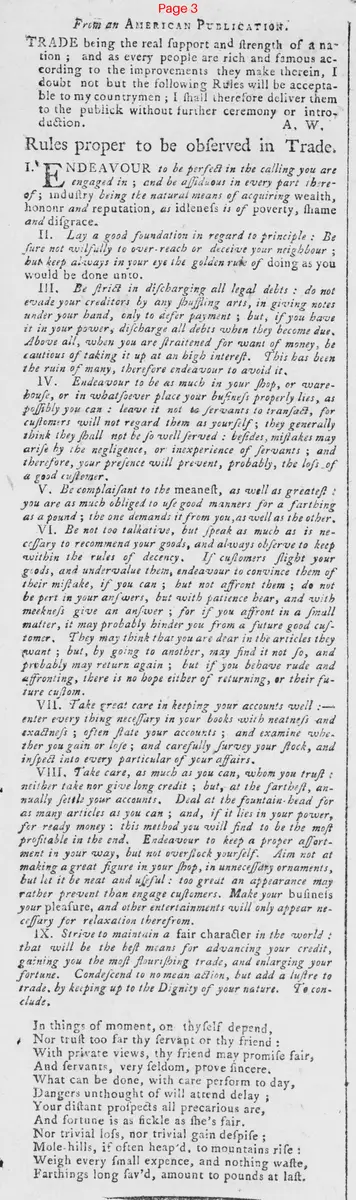
From an AMERICAN PUBLICATION.
TRADE being the real support and strength of a nation; and as every people are rich and famous according to the improvements they make therein, I doubt not but the following Rules will be acceptable to my countrymen; I shall therefore deliver them to the publick without further ceremony or introduction. A. W.
Rules proper to be observed in Trade.
I. ENDEAVOUR to be perfect in the calling you are engaged in; and be assiduous in every part thereof; industry being the natural means of acquiring wealth, honour and reputation, as idleness is of poverty, shame and disgrace.
II. Lay a good foundation in regard to principle: Be sure not wilfully to over-reach or deceive your neighbour; but keep always in your eye the golden rule of doing as you would be done unto.
III. Be strict in discharging all legal debts: do not evade your creditors by any shuffling arts, in giving notes under your hand, only to defer payment; but, if you have it in your power, discharge all debts when they become due. Above all, when you are straitened for want of money, be cautious of taking it up at a high interest. This has been the ruin of many, therefore endeavour to avoid it.
IV. Endeavour to be as much in your shop, or warehouse, or in whatsoever place your business properly lies, as possibly you can: leave it not to servants to transact, for customers will not regard them as yourself; they generally think they shall not be so well served: besides, mistakes may arise by the negligence, or inexperience of servants; and therefore, your presence will prevent, probably, the loss of a good customer.
V. Be complaisant to the meanest, as well as greatest: you are as much obliged to use good manners for a farthing as a pound; the one demands it from you, as well as the other.
VI. Be not too talkative, but speak as much as is necessary to recommend your goods, and always observe to keep within the rules of decency. If customers slight your goods, and undervalue them, endeavour to convince them of their mistake, if you can; but not affront them; do not be pert in your answers, but with patience bear, and with meekness give an answer; for if you affront in a small matter, it may probably hinder you from a future good customer. They may think that you are dear in the articles they want; but, by going to another, may find it not so, and probably may return again; but if you behave rude and affronting, there is no hope either of returning, or their future custom.
VII. Take great care in keeping your accounts well:— enter every thing necessary in your books with neatness and exactness; often state your accounts; and examine whether you gain or lose; and carefully survey your stock, and inspect into every particular of your affairs.
VIII. Take care, as much as you can, whom you trust: neither take nor give long credit; but, at the farthest, annually settle your accounts. Deal at the fountain-head for as many articles as you can; and, if it lies in your power, for ready money: this method you will find to be the most profitable in the end. Endeavour to keep a proper assortment in your way, but not overstock yourself. Aim not at making a great figure in your shop, in unnecessary ornaments, but let it be neat and useful: too great an appearance may rather prevent than engage customers. Make your business your pleasure, and other entertainments will only appear necessary for relaxation therefrom.
IX. Strive to maintain a fair character in the world: that will be the best means for advancing your credit, gaining you the most flourishing trade, and enlarging your fortune. Condescend to no mean action, but add a lustre to trade, by keeping up to the Dignity of your nature. To conclude,
In things of moment, on thyself depend,
Nor trust too far thy servant or thy friend:
With private views, thy friend may promise fair,
And servants, very seldom, prove sincere.
What can be done, with care perform to day,
Dangers unthought of will attend delay;
Your distant prospects all precarious are,
And fortune is as fickle as she's fair.
Nor trivial loss, nor trivial gain despise;
Mole-hills, if often heap'd, to mountains rise:
Weigh every small expense, and nothing waste,
Farthings long sav'd, amount to pounds at last.
What sub-type of article is it?
Essay
Instructional
What themes does it touch?
Commerce Trade
Moral Virtue
What keywords are associated?
Rules Of Trade
Mercantile Advice
Industry
Honesty In Business
Thrift
What entities or persons were involved?
A. W.
Literary Details
Title
Rules Proper To Be Observed In Trade.
Author
A. W.
Subject
Rules And Ethical Guidance For Merchants And Traders
Form / Style
Numbered Didactic Essay In Prose With A Concluding Verse Moral
Key Lines
Industry Being The Natural Means Of Acquiring Wealth, Honour And Reputation
Farthings Long Sav'd, Amount To Pounds At Last.