Thank you for visiting SNEWPapers!
Sign up free
Anti Slavery Bugle Filler May 22, 1852
New Lisbon, Columbiana, Ohio
What is this article about?
Census statistics from Maryland illustrate the chances of life: of 10,268 infants born on the same day, only a scattered few survive to 106, with mortality rising after 55.
Quality green show the numbers
Measured from the scan
— how cleanly the OCR engine read the characters
- Mean ink quality
- 99.0% The length-weighted average confidence across the OCR lines — the mean of exactly the per-line scores whose tails the two figures below report. Typical is 99%.
- Illegible ink
- 0.0% Text sitting in OCR-detected lines that scored below 80% confidence — very shaky reads. Weighted by line length, so one long bad line counts for more than a short one.
- Uncertain ink
- 0.0% Text in lines that scored 80–90% — somewhat shaky reads.
- Matches source
- 98.71% How closely the served text matches the raw OCR of the same boxes, letter by letter, after collapsing spacing and case. This measures agreement, not correctness: the OCR is often wrong and the extractor corrects it, so 100% does not mean perfect, and a low figure usually means poor scan text was rewritten rather than that text was lost (length vs source shows loss).
- Length vs source
- 99.01% Below 100% means text was dropped from the OCR; above means text was added to make it read.
Assembled by the extraction model
— whether the stitched-together text holds up; catches layout and segmentation errors, which the scores above cannot see
- Transcription confidence
- 95.0% (typical 96%) How cleanly the extractor could assemble what it was given. Low here with clean ink scores points at layout analysis — the characters were read correctly but grouped or ordered wrongly.
- Comprehension
- 95.0% Whether the piece reads coherently start to finish. Can stay high while transcription confidence drops, when only part of the component is affected.
Clipping
Full Text
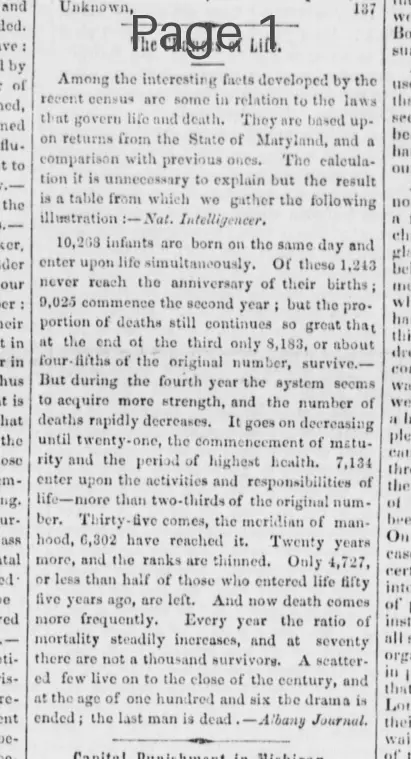
The Chances of Life.
Among the interesting facts developed by the recent census are some in relation to the laws that govern life and death. They are based upon returns from the State of Maryland, and a comparison with previous ones. The calculation it is unnecessary to explain but the result is a table from which we gather the following illustration:—Nat. Intelligencer.
10,268 infants are born on the same day and enter upon life simultaneously. Of these 1,243 never reach the anniversary of their births; 9,025 commence the second year; but the proportion of deaths still continues so great that at the end of the third only 8,183, or about four-fifths of the original number, survive.—But during the fourth year the system seems to acquire more strength, and the number of deaths rapidly decreases. It goes on decreasing until twenty-one, the commencement of maturity and the period of highest health. 7,134 enter upon the activities and responsibilities of life—more than two-thirds of the original number. Thirty-five comes, the meridian of manhood, 6,302 have reached it. Twenty years more, and the ranks are thinned. Only 4,727, or less than half of those who entered life fifty-five years ago, are left. And now death comes more frequently. Every year the ratio of mortality steadily increases, and at seventy there are not a thousand survivors. A scattered few live on to the close of the century, and at the age of one hundred and six the drama is ended; the last man is dead.—Albany Journal.
What sub-type of article is it?
Death Or Longevity
Curiosity
What keywords are associated?
Life Expectancy
Census
Mortality
Longevity
Where did it happen?
Maryland
Filler Details
Topic
Life Expectancy Statistics From The Maryland Census
Location
Maryland