Thanks for visiting SNEWPapers!
Sign up free today to connect your AI tools to the Library of Congress' newspaper collection.
The New Hampshire Gazette And Historical Chronicle Filler June 29, 1770
Portsmouth, Rockingham, New Hampshire
What is this article about?
A king tells nobles pleading for a condemned murderer an anecdote about an ancestor whose pardon of a favourite count led to a second murder, concluding that murder must not be pardoned, however great the offender.
Quality green show the numbers
Measured from the scan
— how cleanly the OCR engine read the characters
- Mean ink quality
- 98.0% The length-weighted average confidence across the OCR lines — the mean of exactly the per-line scores whose tails the two figures below report. Typical is 99%.
- Illegible ink
- 0.0% Text sitting in OCR-detected lines that scored below 80% confidence — very shaky reads. Weighted by line length, so one long bad line counts for more than a short one.
- Uncertain ink
- 0.0% Text in lines that scored 80–90% — somewhat shaky reads.
- Matches source
- 96.14% How closely the served text matches the raw OCR of the same boxes, letter by letter, after collapsing spacing and case. This measures agreement, not correctness: the OCR is often wrong and the extractor corrects it, so 100% does not mean perfect, and a low figure usually means poor scan text was rewritten rather than that text was lost (length vs source shows loss).
- Length vs source
- 98.63% Below 100% means text was dropped from the OCR; above means text was added to make it read.
Assembled by the extraction model
— whether the stitched-together text holds up; catches layout and segmentation errors, which the scores above cannot see
- Transcription confidence
- 95.0% (typical 96%) How cleanly the extractor could assemble what it was given. Low here with clean ink scores points at layout analysis — the characters were read correctly but grouped or ordered wrongly.
- Comprehension
- 100.0% Whether the piece reads coherently start to finish. Can stay high while transcription confidence drops, when only part of the component is affected.
Clipping
Full Text
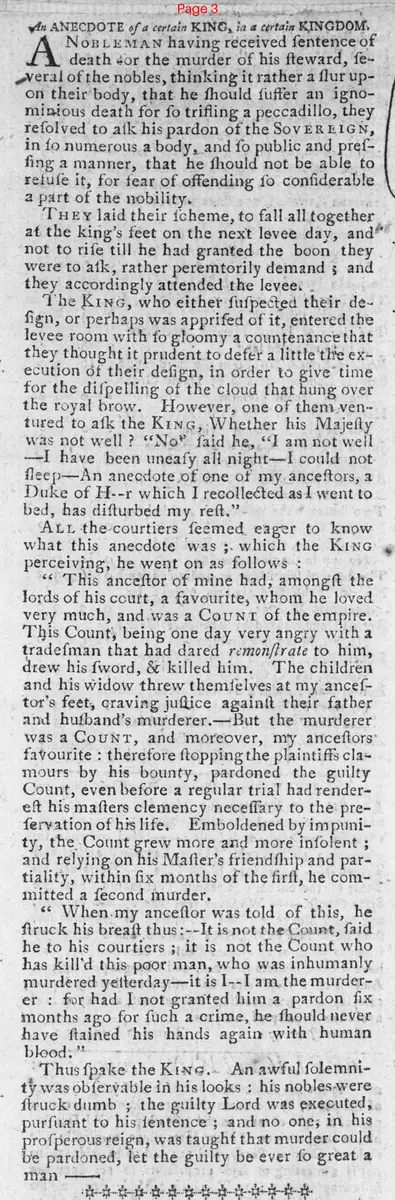
An ANECDOTE of a certain KING, in a certain KINGDOM.
A NOBLEMAN having received sentence of death for the murder of his steward, several of the nobles, thinking it rather a slur upon their body, that he should suffer an ignominious death for so trifling a peccadillo, they resolved to ask his pardon of the SOVEREIGN, in so numerous a body, and so public and pressing a manner, that he should not be able to refuse it, for fear of offending so considerable a part of the nobility.
They laid their scheme, to fall all together at the king's feet on the next levee day, and not to rise till he had granted the boon they were to ask, rather peremptorily demand; and they accordingly attended the levee.
The King, who either suspected their design, or perhaps was apprised of it, entered the levee room with so gloomy a countenance that they thought it prudent to defer a little the execution of their design, in order to give time for the dispelling of the cloud that hung over the royal brow. However, one of them ventured to ask the King, Whether his Majesty was not well? "No" said he, "I am not well—I have been uneasy all night—I could not sleep—An anecdote of one of my ancestors, a Duke of H--r which I recollected as I went to bed, has disturbed my rest."
All the courtiers seemed eager to know what this anecdote was; which the King perceiving, he went on as follows:
"This ancestor of mine had, amongst the lords of his court, a favourite, whom he loved very much, and was a Count of the empire. This Count, being one day very angry with a tradesman that had dared remonstrate to him, drew his sword, & killed him. The children and his widow threw themselves at my ancestor's feet, craving justice against their father and husband's murderer.—But the murderer was a Count, and moreover, my ancestors favourite: therefore stopping the plaintiffs clamours by his bounty, pardoned the guilty Count, even before a regular trial had rendered his master's clemency necessary to the preservation of his life. Emboldened by impunity, the Count grew more and more insolent; and relying on his Master's friendship and partiality, within six months of the first, he committed a second murder.
"When my ancestor was told of this, he struck his breast thus:--It is not the Count, said he to his courtiers; it is not the Count who has kill'd this poor man, who was inhumanly murdered yesterday—it is I—I am the murderer: for had I not granted him a pardon six months ago for such a crime, he should never have stained his hands again with human blood."
Thus spake the King. An awful solemnity was observable in his looks: his nobles were struck dumb; the guilty Lord was executed, pursuant to his sentence; and no one; in his prosperous reign, was taught that murder could be pardoned, let the guilty be ever so great a man
What sub-type of article is it?
Moral Observation
Human Interest
What keywords are associated?
King
Nobleman
Murder
Pardon
Anecdote
Filler Details
Topic
A King's Anecdote On The Danger Of Pardoning Murder