Thanks for visiting SNEWPapers!
Sign up free today to connect your AI tools to the Library of Congress' newspaper collection.
Edwardsville Spectator Domestic News July 3, 1819
Edwardsville, Madison, Illinois
What is this article about?
Col. Henry Atkinson fitted one of his Missouri River barges with tread-wheel propulsion; a trial run up the Missouri succeeded, promising faster transport of troops and stores.
Quality green show the numbers
Measured from the scan
— how cleanly the OCR engine read the characters
- Mean ink quality
- 99.0% The length-weighted average confidence across the OCR lines — the mean of exactly the per-line scores whose tails the two figures below report. Typical is 99%.
- Illegible ink
- 0.0% Text sitting in OCR-detected lines that scored below 80% confidence — very shaky reads. Weighted by line length, so one long bad line counts for more than a short one.
- Uncertain ink
- 3.1% Text in lines that scored 80–90% — somewhat shaky reads.
- Matches source
- 99.05% How closely the served text matches the raw OCR of the same boxes, letter by letter, after collapsing spacing and case. This measures agreement, not correctness: the OCR is often wrong and the extractor corrects it, so 100% does not mean perfect, and a low figure usually means poor scan text was rewritten rather than that text was lost (length vs source shows loss).
- Length vs source
- 98.86% Below 100% means text was dropped from the OCR; above means text was added to make it read.
Assembled by the extraction model
— whether the stitched-together text holds up; catches layout and segmentation errors, which the scores above cannot see
- Transcription confidence
- 95.0% (typical 96%) How cleanly the extractor could assemble what it was given. Low here with clean ink scores points at layout analysis — the characters were read correctly but grouped or ordered wrongly.
- Comprehension
- 95.0% Whether the piece reads coherently start to finish. Can stay high while transcription confidence drops, when only part of the component is affected.
Clipping
Full Text
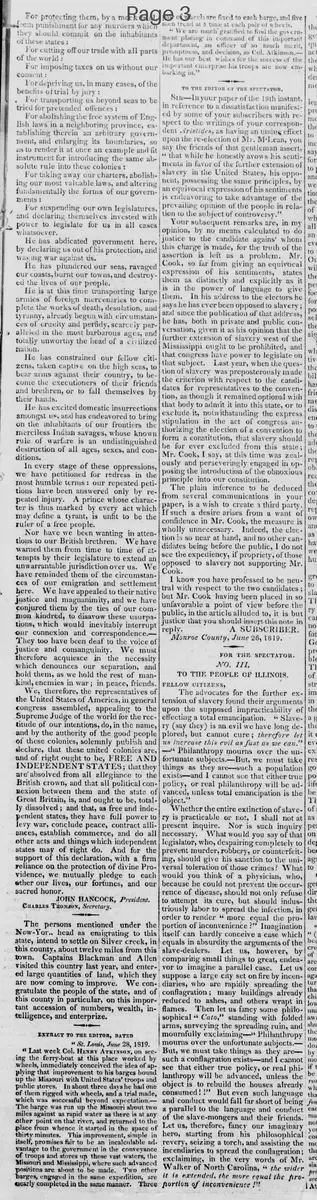
EXTRACT TO THE EDITOR, DATED
St. Louis, June 28, 1819.
Last week Col. Henry Atkinson, on seeing the ferry-boat at this place worked by wheels, immediately conceived the idea of applying that improvement to his barges bound up the Missouri with United States' troops and public stores. In about three days he had one of them rigged with wheels, and a trial made, which was successful beyond expectation.— The barge was run up the Missouri about two miles against as rapid water as there is at any other point on that river, and returned to the place from whence it started in the space of thirty minutes. This improvement, simple in itself, promises fair to be an incalculable advantage to the government in the conveyance of troops and stores up those vast waters, the Missouri and Mississippi, where such advanced positions are about to be made. Two other barges, engaged in the same expedition, are nearly completed in the same manner. Three pair of wheels are fixed to each barge, and five men tread at a time at each pair of wheels.
We are much gratified to find the government placing in command of this important department, an officer of so much merit, promptness, and decision, as Col. Atkinson.— He has our best wishes for the success of the important enterprise his troops are now embarking in.
What sub-type of article is it?
Invention Technology
Military
What keywords are associated?
Steam Barge
Tread Wheels
Missouri River
Colonel Atkinson
What entities or persons were involved?
Col. Henry Atkinson
Where did it happen?
St. Louis
Domestic News Details
Primary Location
St. Louis
Event Date
June 28, 1819
Key Persons
Col. Henry Atkinson
Outcome
trial successful; barge ran two miles upstream in thirty minutes; two more barges being fitted.