Thanks for visiting SNEWPapers!
Sign up free today to connect your AI tools to the Library of Congress' newspaper collection.
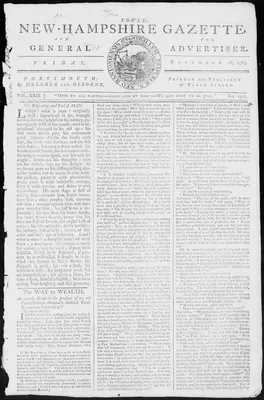
Fowle's New Hampshire Gazette And General Advertiser Literary November 18, 1785
Portsmouth, Rockingham, New Hampshire
What is this article about?
A moral essay framed as Father Abraham's speech at an auction, advising industry, frugality, and prudence to cope with hard times and heavy taxes, with proverbs attributed to Poor Richard.
Quality green show the numbers
Measured from the scan
— how cleanly the OCR engine read the characters
- Mean ink quality
- 99.0% The length-weighted average confidence across the OCR lines — the mean of exactly the per-line scores whose tails the two figures below report. Typical is 99%.
- Illegible ink
- 0.11% Text sitting in OCR-detected lines that scored below 80% confidence — very shaky reads. Weighted by line length, so one long bad line counts for more than a short one.
- Uncertain ink
- 0.11% Text in lines that scored 80–90% — somewhat shaky reads.
- Matches source
- 94.78% How closely the served text matches the raw OCR of the same boxes, letter by letter, after collapsing spacing and case. This measures agreement, not correctness: the OCR is often wrong and the extractor corrects it, so 100% does not mean perfect, and a low figure usually means poor scan text was rewritten rather than that text was lost (length vs source shows loss). Across pages, this is the worst fragment.
- Length vs source
- 98.71% Below 100% means text was dropped from the OCR; above means text was added to make it read.
Assembled by the extraction model
— whether the stitched-together text holds up; catches layout and segmentation errors, which the scores above cannot see
- Transcription confidence
- 93.0% (typical 96%) How cleanly the extractor could assemble what it was given. Low here with clean ink scores points at layout analysis — the characters were read correctly but grouped or ordered wrongly.
- Comprehension
- 95.0% Whether the piece reads coherently start to finish. Can stay high while transcription confidence drops, when only part of the component is affected.
Clippings
1 of 2
Full Text
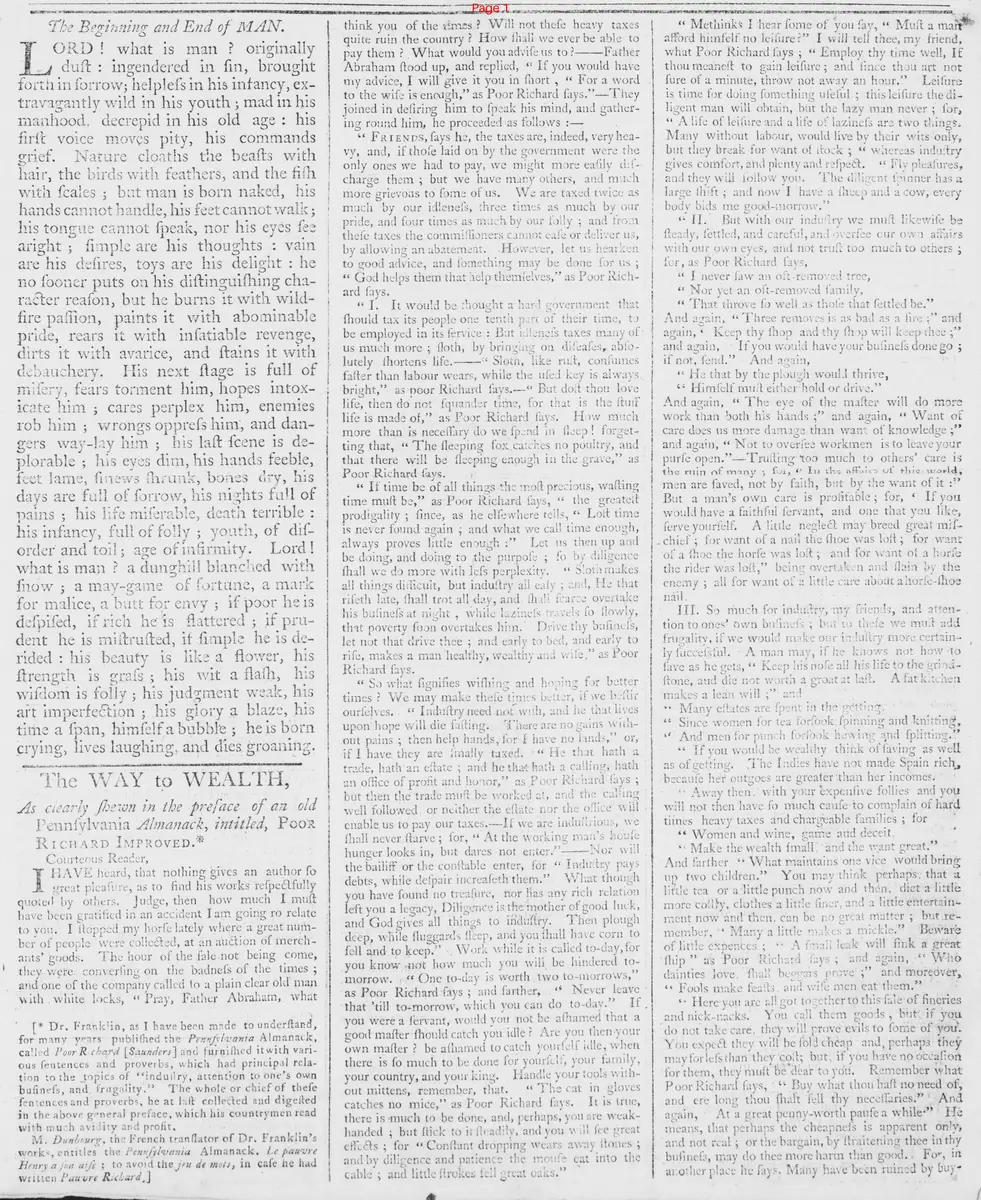
The WAY to WEALTH,
As clearly shewn in the preface of an old Pennsylvania Almanack, intitled, Poor Richard Improved.*
Courteous Reader,
I have heard, that nothing is more natural than for men to be guided by others. Judge, then, how much I must have been gratified in an accident I am going to relate to you. I stopped my horse lately where a great number of people were collected, at an auction of merchants' goods. The hour of the sale not being come, they were conversing on the badness of the times; and one of the company called to a plain clean old man with white locks, "Pray, Father Abraham, what think you of the times? Will not these heavy taxes quite ruin the country? How shall we ever be able to pay them? What would you advise us to?"
Father Abraham stood up, and replied, "If you would have my advice, I will give it you in short; for a word to the wise is enough," as Poor Richard says.—They joined in desiring him to speak his mind, and gathering round him, he proceeded as follows:—
"Friends," says he, "the taxes are, indeed, very heavy, and, if those laid on by the government were the only ones we had to pay, we might more easily discharge them; but we have many others, and much more grievous to some of us. We are taxed twice as much by our idleness, three times as much by our pride, and four times as much by our folly; and from these taxes the commissioners cannot ease or deliver us, by allowing an abatement. However, let us hearken to good advice, and something may be done for us; 'God helps them that help themselves,' as Poor Richard says.
I. It would be thought a hard government that should tax its people one tenth part of their time, to be employed in its service: But idleness taxes many of us much more; sloth, by bringing on diseases, absolutely shortens life.—'Sloth, like rust, consumes faster than labour wears, while the used key is always bright,' as Poor Richard says.—'But dost thou love life, then do not squander time, for that is the stuff life is made of,' as Poor Richard says. How much more than is necessary do we spend in sleep! forgetting that, 'The sleeping fox catches no poultry, and that there will be sleeping enough in the grave,' as Poor Richard says.
'If time be of all things the most precious, wasting time must be,' as Poor Richard says, 'the greatest prodigality; since, as he elsewhere tells us, Lost time is never found again; and what we call time enough, always proves little enough.' Let us then up and be doing, and doing to the purpose; so by diligence shall we do more with less perplexity. 'Sloth makes all things difficult, but industry all easy; and he that riseth late, shall trot all day, and shall scarce overtake his business at night, while laziness travels so slowly, that poverty soon overtakes him. Drive thy business, let not that drive thee; and early to bed, and early to rise, makes a man healthy, wealthy and wise,' as Poor Richard says.
So what signifies wishing and hoping for better times? We may make these times better, if we bestir ourselves. 'Industry need not wish, and he that lives upon hope will die fasting. There are no gains without pains; then help hands, for I have no lands; or, if I have, they are smartly taxed. He that hath a trade, hath an estate; and he that hath a calling, hath an office of profit and honor,' as Poor Richard says; but then the trade must be worked at, and the calling well followed, or neither the estate nor the office will enable us to pay our taxes.—If we are industrious, we shall never starve; for, 'At the working man's house hunger looks in, but dares not enter.'—Nor will the bailiff or the constable enter, for 'Industry pays debts, while despair increaseth them.' What though you have found no treasure, nor has any rich relation left you a legacy, Diligence is the mother of good luck, and God gives all things to industry. Then plough deep, while sluggards sleep, and you shall have corn to sell and to keep. Work while it is called to-day, for you know not how much you will be hindered to-morrow. 'One to-day is worth two to-morrows,' as Poor Richard says; and farther, 'Never leave that till to-morrow, which you can do to-day.' If you were a servant, would you not be ashamed that a good master should catch you idle? Are you then your own master? Be ashamed to catch yourself idle, when there is so much to be done for yourself, your family, your country, and your king. Handle your tools without mittens; remember, that 'The cat in gloves catches no mice,' as Poor Richard says. It is true, there is much to be done, and, perhaps, you are weak-handed; but stick to it steadily, and you will see great effects; for 'Constant dropping wears away stones; and by diligence and patience the mouse ate into the cable; and little strokes fell great oaks.'
Methinks I hear some of you say, 'Must a man afford himself no leisure?' I will tell thee, my friend, what Poor Richard says; 'Employ thy time well, if thou meanest to gain leisure; and since thou art not sure of a minute, throw not away an hour.' Leisure is time for doing something useful; this leisure the diligent man will obtain, but the lazy man never; for, 'A life of leisure and a life of laziness are two things. Many without labour, would live by their wits only, but they break for want of stock;' whereas industry gives comfort, and plenty and respect. 'Fly pleasures, and they will follow you. The diligent spinner has a large shift; and now I have a sheep and a cow, every body bids me good-morrow.'
II. But with our industry we must likewise be steady, settled, and careful, and oversee our own affairs with our own eyes, and not trust too much to others; for, as Poor Richard says,
'I never saw an oft-removed tree,
Nor yet an oft-removed family,
That throve so well as those that settled be.'
And again, 'Three removes is as bad as a fire;' and again, 'Keep thy shop, and thy shop will keep thee;' and again, 'If you would have your business done, go; if not, send.' And again,
'He that by the plough would thrive,
Himself must either hold or drive.'
And again, 'The eye of the master will do more work than both his hands;' and again, 'Want of care does us more damage than want of knowledge;' and again, 'Not to oversee workmen is to leave your purse open.'—Trusting too much to others' care is the ruin of many; for, as I have said before, in this world, men are saved, not by faith, but by the want of it: But a man's own care is profitable; for, 'If you would have a faithful servant, and one that you like, serve yourself.' A little neglect may breed great mischief; for want of a nail the shoe was lost; for want of a shoe the horse was lost; and for want of a horse the rider was lost, being overtaken and slain by the enemy; all for want of a little care about a horse-shoe nail.
III. So much for industry, my friends, and attention to one's own business; but to these we must add frugality, if we would make our industry more certainly successful.—A man may, if he knows not how to save as he gets, 'Keep his nose all his life to the grind-stone, and die not worth a groat at last. A fat kitchen makes a lean will;' and
'Many estates are spent in the getting,
Since women for tea forsook spinning and knitting,
And men for punch forsook hewing and splitting.'
'If you would be wealthy, think of saving as well as of getting. The Indies have not made Spain rich, because her outgoes are greater than her incomes.'
Away then, with your expensive follies and you will not then have so much cause to complain of hard times, heavy taxes and chargeable families; for
'Women and wine, game and deceit,
Make the wealth small, and the want great.'
And farther 'What maintains one vice would bring up two children.' You may think, perhaps, that a little tea or a little punch now and then, diet a little more costly, clothes a little finer, and a little entertainment now and then, can be no great matter; but remember, 'Many a little makes a mickle.' Beware of little expenses; 'A small leak will sink a great ship,' as Poor Richard says; and again, 'Who dainties love, shall beggars prove;' and moreover, 'Fools make feasts, and wise men eat them.'
'Here you are all got together to this sale of fineries and nick-nacks. You call them goods, but if you do not take care, they will prove evils to some of you. You expect they will be sold cheap, and, perhaps, they may for less than they cost; but, if you have no occasion for them, they must be dear to you. Remember what Poor Richard says, 'Buy what thou hast no need of, and ere long thou shalt sell thy necessaries.' And again, 'At a great penny-worth pause a while.' He means, that perhaps the cheapness is apparent only, and not real; or the bargain, by straitening thee in thy business, may do thee more harm than good. For, in another place he says, 'Many have been ruined by buy-
[* Dr. Franklin, as I have been made to understand, for many years published the Pennsylvania Almanack, called Poor Richard [Saunders] and furnished it with various sentences and proverbs, which had principal relation to the topics of 'industry, attention to one's own business, and frugality.' The whole or chief of these sentences and proverbs, he at last collected and digested in the above general preface, which his countrymen read with much avidity and profit.
M. Dubourg, the French translator of Dr. Franklin's works, entitles the Pennsylvania Almanack, Le pauvre Henri à son aise; to avoid the jeu de mots, in case he had written Pauvre Richard.]
“ing good pennyworths.” Again, “It is foolish to lay out money in a purchase of repentance;” and yet this folly is practised every day at auctions, for want of minding the Almanack. Many a one, for the sake of finery on the back, have gone with a hungry belly, and half-starved their families; “Silks and satins, scarlet and velvets, put out the kitchen fire,” as Poor Richard says. These are not the necessaries of life; they can scarcely be called the conveniences; and yet only because they look pretty, how many want to have them? By these, and other extravagancies, the genteel are reduced to poverty, and forced to borrow of those whom they formerly despised, but who, through industry and frugality, have maintained their standing; in which case it appears plainly, that “A ploughman on his legs is higher than a gentleman on his knees,” as Poor Richard says. Perhaps they have had a small estate left them, which they knew not the getting of; they think “It is day, and will never be night; that a little to be spent out of so much is not worth minding;” but “Always taking out of the meal tub, and never putting in, soon comes to the bottom,” as Poor Richard says; and then, “When the well is dry, they know the worth of water.” But this they might have known before, if they had taken his advice:—“If you would know the value of money, go and try to borrow some; for he that goes borrowing, goes a sorrowing,” as Poor Richard says; and, indeed, so does he that lends to such people, when he goes to get it again,—Poor Dick farther advises, and says,
“Fond pride of dress is sure a very curse;
E’er fancy you consult, consult your purse.”
And again, “Pride is as loud a beggar as want, and a great deal more saucy.” When you have bought one fine thing, you must buy ten more, that your appearance may be all of a piece; but poor Dick says “It is easier to suppress the first desire, than to satisfy all that follow it:” And it is as truly folly for the poor to ape the rich, as for the frog to swell, in order to equal the ox.
“Vessels large may venture more,
But little boats should keep near shore.”
It is, however, a folly soon punished; for, as Poor Richard says, “Pride that dines on vanity, sups on contempt; pride breakfasted with plenty, dined with poverty, and supped with infamy.” And, after all, of what use is this pride of appearance, for which so much is risked, so much is suffered? It cannot promote health, nor ease pain, it makes no increase of merit in the person, it creates envy it hastens misfortune.
But what madness must it be to run in debt for these superfluities? We are offered, by the terms of this sale, six months credit; and that, perhaps, has induced some of us to attend it, because we cannot spare the ready money, and hope now to be fine without it.—
But, ah! think what you do when you run in debt; you give to another power over your liberty.—If you cannot pay at the time, you will be ashamed to see your creditor; you will be in fear when you speak to him; you will make more poor pitiful sneaking excuses, and by degrees, come to lose your veracity, and sink into base, downright lying; for, “The second vice is lying, the first is running in debt,” as Poor Richard says;—and again, to the same purpose, “Lying rides upon debt’s back:” whereas a free-born Englishman ought not to be ashamed nor afraid to see or speak to any man living. But poverty often deprives a man of all spirit and virtue. “It is hard for an empty bag to stand upright.” What would you think of that prince, or of that government, who should issue an edict forbidding you to dress like a gentleman or gentlewoman, on pain of imprisonment or servitude? Would you not say that you were free, have a right to dress as you please, and that such an edict would be a breach of your privileges, and such a government tyrannical? And yet you are about to put yourself under that tyranny, when you run into debt for such a dress!—Your Creditor has authority, at his pleasure, to deprive you of your liberty, by confining you in gaol for life, or by selling you for a servant, if you should not be able to pay him. When you have got your bargain, you may, perhaps, think little of payment; but, as poor Richard says, “Creditors have better memories than debtors; creditors are a superstitious set, great observers of set-days and times.” The day comes round before you are aware, and the demand is made before you are prepared to satisfy it; or, if you bear your debt in mind the term, which at first seemed so long, will, as it lessens, appear extremely short: Time will seem to have added wings to his heels as well as his shoulders. “Those have a short Lent, who owe money to be paid at Easter.” At present, perhaps, you may think yourselves in thriving circumstances, and that you can bear a little extravagance without injury; but,
“For age and want save while you may,
No morning-sun lasts a whole day.”
Gain may be temporary and uncertain, but ever while you live, expence is constant and certain; and, “It is easier to build two chimnies, than to keep one in fuel,” as Poor Richard says: So, rather go to bed supperless, than rise in debt.”
“Get what you can, and what you get, hold:
’Tis the stone that will turn all your lead into gold.”
And when you have got the philosopher’s stone, sure you will no longer complain of bad times, or the difficulty of paying taxes.
“The doctrine my friend is reason and wisdom:
But after all do not depend too much upon your own industry, and frugality, and prudence, tho’ excellent things; for they may all be blasted without the blessing of heaven; and, therefore, ask that blessing humbly, and be not uncharitable to those that at present seem to want it, but comfort and help them. Remember, Job suffered, and afterwards prospered.
“And now, to conclude “Experience keeps a dear school, but fools will learn in no other.” as Poor Richard says) and scarce in that; for, it is true “We may give advice, but we cannot give conduct:” However, remember this, They that cannot be counselled, cannot be helped, and farther, that “If you will not hear Reason, she will surely rap your knuckles,” as Poor Richard says.”
Thus the old Gentleman ended his harangue. The people heard it and approved the doctrine; and immediately practised the contrary, just as if it had been a common sermon; for the auction opened and they began to buy extravagantly.——I found the good man had thoroughly studied my Almanacks, and digested all I had dropt on those topics during the course of twenty-five years. The frequent mention he made of me must have tired any one else; but my vanity was wonderfully delighted with it though I was conscious that not a tenth part of the wisdom was my own, which he ascribed to me, but rather the gleanings that I had made of the sense of all ages and nations. However, I resolved to be the better for the echo of it, and, tho’ I had at first determined to buy stuff for a new coat, I went away, resolved to wear my old one a little longer. Reader if thou wilt do the same, thy profit will be as great as mine.
I am, as ever,
Thine to serve thee,
RICHARD SAUNDERS.
What sub-type of article is it?
Essay
Instructional
What themes does it touch?
Moral Virtue
Commerce Trade
Temperance
What keywords are associated?
Industry
Frugality
Prudence
Proverbs
Hard Times
Debt
Poor Richard
What entities or persons were involved?
Benjamin Franklin (As Richard Saunders)
Literary Details
Title
The Way To Wealth
Author
Benjamin Franklin (As Richard Saunders)
Subject
Advice On Industry, Frugality, And Prudence In Hard Times, Delivered As Father Abraham's Speech At A Merchant's Auction
Form / Style
Didactic Moral Essay Framed As A Speech, Packed With Aphorisms Attributed To Poor Richard
Key Lines
God Helps Them That Help Themselves
Early To Bed, And Early To Rise, Makes A Man Healthy, Wealthy And Wise
A Small Leak Will Sink A Great Ship
Lying Rides Upon Debt's Back
Experience Keeps A Dear School, But Fools Will Learn In No Other