Thank you for visiting SNEWPapers!
Sign up free
The New Hampshire Gazette Domestic News September 24, 1793
Portsmouth, Rockingham, New Hampshire
What is this article about?
Detailed accounts of the yellow fever epidemic in Philadelphia in September 1793: nearly fifty buried daily, physicians dead, city depopulated, and Dr. Rush reports mercury and jalap treatment.
Quality green show the numbers
Measured from the scan
— how cleanly the OCR engine read the characters
- Mean ink quality
- 99.0% The length-weighted average confidence across the OCR lines — the mean of exactly the per-line scores whose tails the two figures below report. Typical is 99%.
- Illegible ink
- 0.0% Text sitting in OCR-detected lines that scored below 80% confidence — very shaky reads. Weighted by line length, so one long bad line counts for more than a short one.
- Uncertain ink
- 0.0% Text in lines that scored 80–90% — somewhat shaky reads.
- Matches source
- 95.68% How closely the served text matches the raw OCR of the same boxes, letter by letter, after collapsing spacing and case. This measures agreement, not correctness: the OCR is often wrong and the extractor corrects it, so 100% does not mean perfect, and a low figure usually means poor scan text was rewritten rather than that text was lost (length vs source shows loss).
- Length vs source
- 98.58% Below 100% means text was dropped from the OCR; above means text was added to make it read.
Assembled by the extraction model
— whether the stitched-together text holds up; catches layout and segmentation errors, which the scores above cannot see
- Transcription confidence
- 96.0% (typical 96%) How cleanly the extractor could assemble what it was given. Low here with clean ink scores points at layout analysis — the characters were read correctly but grouped or ordered wrongly.
- Comprehension
- 90.0% Whether the piece reads coherently start to finish. Can stay high while transcription confidence drops, when only part of the component is affected.
Clipping
Full Text
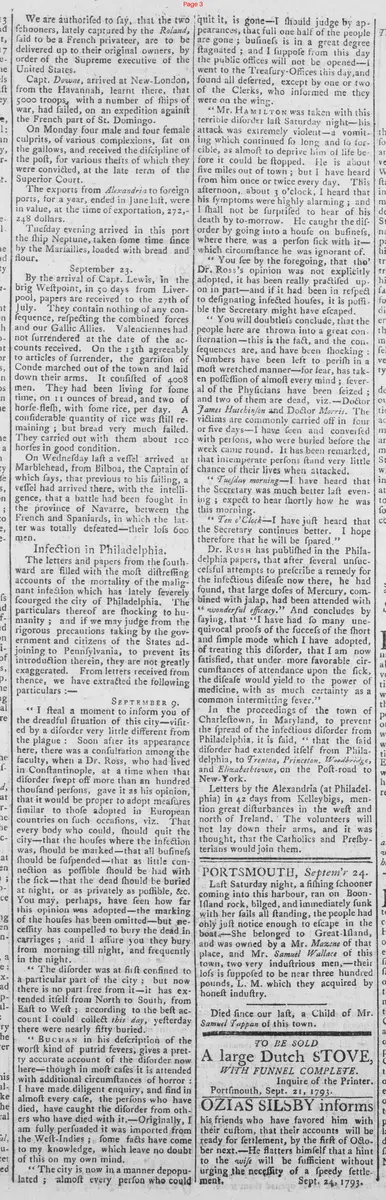
Infection in Philadelphia.
The letters and papers from the southward are filled with the most distressing accounts of the mortality of the malignant infection which has lately severely scourged the city of Philadelphia. The particulars thereof are shocking to humanity; and if we may judge from the rigorous precautions taking by the government and citizens of the States adjoining to Pennsylvania, to prevent its introduction therein, they are not greatly exaggerated. From letters received from thence, we have extracted the following particulars:—
SEPTEMBER 9.
“I steal a moment to inform you of the dreadful situation of this city—visited by a disorder very little different from the plague: Soon after its appearance here, there was a consultation among the faculty, when a Dr. Ross, who had lived in Constantinople, at a time when that disorder swept off more than an hundred thousand persons, gave it as his opinion, that it would be proper to adopt measures similar to those adopted in European countries on such occasions, viz. That every body who could, should quit the city—that the houses where the infection was, should be marked—that all business should be suspended—that as little connection as possible should be had with the sick—that the dead should be buried at night, or as privately as possible, &c. You may, perhaps, have seen how far this opinion was adopted—the marking of the houses has been omitted—but necessity has compelled to bury the dead in carriages; and I assure you they bury from morning till night, and frequently in the night.
“The disorder was at first confined to a particular part of the city; but now there is no part free from it—it has extended itself from North to South, from East to West; according to the best account I could collect this day, yesterday there were nearly fifty buried.
“Buchan in his description of the worst kind of putrid fevers, gives a pretty accurate account of the disorder now here—though in most cases it is attended with additional circumstances of horror: I have made diligent enquiry, and find in almost every case, the persons who have died, have caught the disorder from others who have died with it,—Originally, I am fully persuaded it was imported from the West-Indies; some facts have come to my knowledge, which leave no doubt of this on my own mind.
“The city is now in a manner depopulated; almost every person who could quit it, is gone—I should judge by appearances, that full one half of the people are gone; business is in a great degree stagnated; and I suppose from this day the public offices will not be opened—I went to the Treasury-Offices this day, and found all deserted, except by one or two of the Clerks, who informed me they were on the wing.
“Mr. Hamilton was taken with this terrible disorder last Saturday night—his attack was extremely violent—a vomiting which continued so long and so forcible, as almost to deprive him of life before it could be stopped. He is about five miles out of town; but I have heard from him once or twice every day. This afternoon, about 3 o'clock, I heard that his symptoms were highly alarming; and I shall not be surprised to hear of his death by to-morrow. He caught the disorder by going into a house on business where there was a person sick with it—which circumstance he was ignorant of.
“You see by the foregoing, that tho' Dr. Ross's opinion was not explicitly adopted, it has been really practised upon in part—and if it had been in respect to designating infected houses, it is possible the Secretary might have escaped.
“You will doubtless conclude, that the people here are thrown into a great consternation—this is the fact, and the consequences are, and have been shocking: Numbers have been left to perish in a most wretched manner—for fear, has taken possession of almost every mind; several of the Physicians have been seized; and two of them are dead, viz. Doctor James Hutchinson and Doctor Morris. The victims are commonly carried off in four or five days—I have seen and conversed with persons, who were buried before the week came round. It has been remarked, that intemperate persons stand very little chance of their lives when attacked.
“Tuesday morning—I have heard that the Secretary was much better last evening; expect to hear shortly how he was this morning.
“Ten o'Clock—I have just heard that the Secretary continues better. I hope therefore that he will be spared.”
Dr. Rush has published in the Philadelphia papers, that after several unsuccessful attempts to prescribe a remedy for the infectious disease now there, he had found, that large doses of Mercury, combined with jalap, had been attended with 'wonderful efficacy.' And concludes by saying, that 'I have had so many unequivocal proofs of the success of the short and simple mode which I have adopted, of treating this disorder, that I am now satisfied, that under more favorable circumstances of attendance upon the sick, the disease would yield to the power of medicine, with as much certainty as a common intermitting fever.'
In the proceedings of the town of Charlestown, in Maryland, to prevent the spread of the infectious disorder from Philadelphia, it is said, 'that the said disorder had extended itself from Philadelphia, to Trenton, Princeton, Woodbridge, and Elizabethtown, on the Post-road to New-York.'
What sub-type of article is it?
Disease Or Epidemic
What keywords are associated?
Yellow Fever
Philadelphia
Epidemic
Mortality
What entities or persons were involved?
Dr. Rush
Dr. James Hutchinson
Dr. Morris
Mr. Hamilton
Where did it happen?
Philadelphia
Domestic News Details
Primary Location
Philadelphia
Event Date
September 1793
Key Persons
Dr. Rush
Dr. James Hutchinson
Dr. Morris
Mr. Hamilton
Outcome
nearly fifty buried daily; physicians dead; city depopulated