Thank you for visiting SNEWPapers!
Sign up free
Los Angeles Daily Herald Editorial June 3, 1889
Los Angeles, Los Angeles, California
Cautionary note: graphic descriptions of death by fire and flood in a disaster
What is this article about?
Extended editorial commentary on the Johnstown, Pennsylvania flood disaster, describing the region, the waterspout and broken reservoir, the burning debris and appalling loss of life and property, and reflecting on recurring meteorological calamities.
Quality green show the numbers
Measured from the scan
— how cleanly the OCR engine read the characters
- Mean ink quality
- 99.0% The length-weighted average confidence across the OCR lines — the mean of exactly the per-line scores whose tails the two figures below report. Typical is 99%.
- Illegible ink
- 0.0% Text sitting in OCR-detected lines that scored below 80% confidence — very shaky reads. Weighted by line length, so one long bad line counts for more than a short one.
- Uncertain ink
- 0.0% Text in lines that scored 80–90% — somewhat shaky reads.
- Matches source
- 99.19% How closely the served text matches the raw OCR of the same boxes, letter by letter, after collapsing spacing and case. This measures agreement, not correctness: the OCR is often wrong and the extractor corrects it, so 100% does not mean perfect, and a low figure usually means poor scan text was rewritten rather than that text was lost (length vs source shows loss).
- Length vs source
- 99.36% Below 100% means text was dropped from the OCR; above means text was added to make it read.
Assembled by the extraction model
— whether the stitched-together text holds up; catches layout and segmentation errors, which the scores above cannot see
- Transcription confidence
- 95.0% (typical 96%) How cleanly the extractor could assemble what it was given. Low here with clean ink scores points at layout analysis — the characters were read correctly but grouped or ordered wrongly.
- Comprehension
- 94.0% Whether the piece reads coherently start to finish. Can stay high while transcription confidence drops, when only part of the component is affected.
Clipping
Full Text
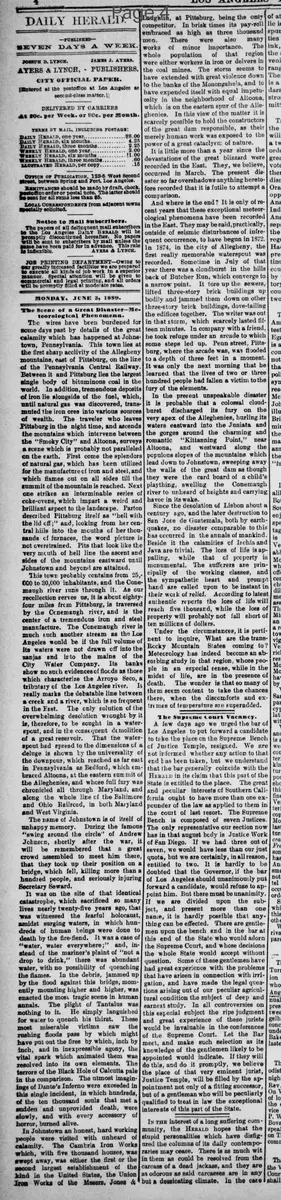
The Scene of a Great Disaster—Meteorological Phenomena.
The wires have been burdened for some days past by details of the great calamity which has happened at Johnstown, Pennsylvania. This town lies at the first sharp acclivity of the Allegheny mountains, east of Pittsburg, on the line of the Pennsylvania Central Railway. Between it and Pittsburg lies the largest single body of bituminous coal in the world. In addition, tremendous deposits of iron lie alongside of the fuel, which, until natural gas was discovered, transmuted the iron ores into various sources of wealth. The traveler who leaves Pittsburg in the night time, and ascends the mountains which intervene between the "Smoky City" and Altoona, surveys a scene which is probably not paralleled on the earth. First come the splendors of natural gas, which has been utilized for the manufacture of iron and steel, and which flames cut on all sides till the summit of the mountain is reached. Next one strikes an interminable series of coke-ovens, which impart a weird and brilliant aspect to the landscape. Parton described Pittsburg itself as "hell with the lid off;" and, looking from her central hills into the mouths of her thousands of furnaces, the word picture is not overstrained. Pits that look like the very mouth of hell line the ascent and sides of the mountains eastward until Johnstown and beyond are attained.
This town probably contains from 25,000 to 30,000 inhabitants, and the Conemaugh river runs through it. As our recollection serves us, it is about eighty-four miles from Pittsburg, is traversed by the Conemaugh river, and is the center of a tremendous iron and steel manufacture. The Conemaugh river is much such another stream as the Los Angeles would be if the full volume of its waters were not drawn off into the zanjas and into the mains of the City Water Company. Its banks show no such evidences of floods as those which characterize the Arroyo Seco, a tributary of the Los Angeles river. It really marks the debatable line between a creek and a river, which is so frequent in the East. The only solution of the overwhelming desolation wrought by it is, therefore, to be sought in a waterspout, and in the consequent demolition of a great reservoir. That the waterspout had spread to the dimensions of a deluge is shown by the universality of the downpour, which reached as far east in Pennsylvania as Bedford, which embraced Altoona, at the eastern summit of the Alleghenies, and whose full fury was chronicled all through Maryland, and along the whole line of the Baltimore and Ohio Railroad, in both Maryland and West Virginia.
The name of Johnstown is of itself of unhappy memory. During the famous "swing around the circle" of Andrew Johnson, shortly after the war, it will be remembered that a great crowd assembled to meet him there, that they took up their position on a bridge, which fell, killing more than a hundred people, and seriously injuring Secretary Seward.
It was on the site of that identical catastrophe, which sacrificed so many lives nearly twenty-five years ago, that was witnessed the fearful holocaust, amidst surging waters, in which hundreds of human beings were done to death by the fire-fiend. It was a case of "water, water everywhere;" and, instead of the mariner's plaint of "not a drop to drink," there was abundant water, with no possibility of quenching the flames. In the debris, jammed up by the flood against this bridge, momentarily mounting higher and higher, was enacted the most tragic scene in human annals. The plight of Tantalus was nothing to it. He simply languished for water to quench his thirst. These most miserable victims saw the rushing floods pass by which might have put out the fires by which, inch by inch, and in inexpressible agony, the vital spark which animated them was resolved into its own elements. The terrors of the Black Hole of Calcutta pale in the comparison. The utmost imaginings of Dante's Inferno were exceeded in this single incident, in which hundreds, of the ten thousand souls that met a sudden and unprovided death, were slowly, and with every accessory of horror, burned alive.
In Johnstown an honest, hard working people were visited with unheard of calamity. The Cambria Iron Works which, with five thousand houses, was swept away, was either the first or the second largest establishment of the kind in the United States, the Union Iron Works of the Messrs. Jones & Laughlin, at Pittsburg, being the only competitor. In brisk times its pay-roll embraced as high as three thousand men. There were also many works of minor importance. The whole population of that region were either workers in iron or delvers in the coal mines. The storm seems to have extended with great violence down to the banks of the Monongahela, and to have expended itself with equal impetuosity in the neighborhood of Altoona, which is on the eastern spur of the Alleghenies. In this view of the matter it is scarcely possible to hold the constructors of the great dam responsible, as their merely human work was exposed to the power of a great cataclysm of nature.
It is little more than a year since the devastations of the great blizzard were recorded in the East. They, we believe, occurred in March. The present disaster so far overshadows anything heretofore recorded that it is futile to attempt a comparison.
And where is the end? It is only of recent years that these exceptional meteorological phenomena have been recorded in the East. They may be said, practically, outside of seismic disturbances of infrequent occurrence, to have begun in 1872. In 1874, in the city of Allegheny, the first really memorable waterspout was recorded. Sometime in July of that year there was a cloudburst in the hills back of Butcher Run, which converge to a narrow point. It tore up the sewers, lifted three-story brick buildings up bodily and jammed them down on other three-story brick buildings, dove-tailing the edifices together. The writer was out in that storm, which scarcely lasted fifteen minutes. In company with a friend, he took refuge under an arcade to which some steps led up. Penn street, Pittsburg, where the arcade was, was flooded to a depth of three feet in a moment. It was only the next morning that he learned that the lives of two or three hundred people had fallen a victim to the fury of the elements.
In the present unspeakable disaster it is probable that a colossal cloud-burst discharged its fury on the very apex of the Alleghenies, hurling its waters eastward into the Juniata and the gorges around the charming and romantic "Kittanning Point," near Altoona, and westward along the populous slopes of the mountains which lead down to Johnstown, sweeping away the walls of the great dam as though they were the card board of a child's plaything, swelling the Conemaugh river to unheard of heights and carrying havoc in its wake.
Since the desolation of Lisbon about a century ago, and the later destruction to San Jose de Guatemala, both by earthquakes, no disaster comparable to this has occurred in the annals of mankind. Beside it the calamities of Ischia and Java are trivial. The loss of life is appalling, while that of property is monumental. The sufferers are principally of the working classes, and the sympathetic heart and prompt hand are called upon to be instant in their work of relief. According to latest authentic reports the loss of life will reach five thousand, while the loss of property will probably not fall short of ten millions of dollars.
Under the circumstances, it is pertinent to inquire, What are the trans-Rocky Mountain States coming to? Meteorology has indeed become an absorbing study in that region, whose people in an especial sense, while in the midst of life, are in the presence of death. The wonder is that so many of them seem content to take the chances there, when the discomforts and extremes of temperature are superadded.
What sub-type of article is it?
Science Or Medicine
Infrastructure
What keywords are associated?
Johnstown Flood
Conemaugh
Cloudburst
Dam Collapse
Meteorological Phenomena
Disaster Relief
Cambria Iron Works
What entities or persons were involved?
Johnstown
Conemaugh River
Cambria Iron Works
Altoona
Pittsburg
Andrew Johnson
Secretary Seward
Editorial Details
Primary Topic
The Johnstown Flood And Its Meteorological Causes
Stance / Tone
Awed, Sympathetic, Calls For Prompt Relief; Reflective On Recurring Disasters
Key Figures
Johnstown
Conemaugh River
Cambria Iron Works
Altoona
Pittsburg
Andrew Johnson
Secretary Seward
Key Arguments
- the disaster was caused by a colossal cloudburst and the bursting of the great dam
- the town and its iron works were swept away with thousands of working-class lives lost
- the horrors of the burning debris exceeded even the Black Hole of Calcutta and Dante's Inferno
- the dam's constructors are scarcely to blame for a cataclysm of nature
- such exceptional meteorological phenomena have multiplied in recent years, raising questions about settlement in the trans-Rocky Mountain states