Thanks for visiting SNEWPapers!
Sign up free today to connect your AI tools to the Library of Congress' newspaper collection.
The San Antonio Light Literary November 26, 1907
San Antonio, Bexar, Texas
What is this article about?
Newly qualified lady doctor Elizabeth Mapother, ignored in Burnham, is summoned by Sir Richard Delamere and cures his wife's imagined cancer by staging a bogus operation with a specimen and a trusted nurse, winning her friendship and a thriving practice.
Quality green show the numbers
Measured from the scan
— how cleanly the OCR engine read the characters
- Mean ink quality
- 99.0% The length-weighted average confidence across the OCR lines — the mean of exactly the per-line scores whose tails the two figures below report. Typical is 99%.
- Illegible ink
- 0.0% Text sitting in OCR-detected lines that scored below 80% confidence — very shaky reads. Weighted by line length, so one long bad line counts for more than a short one.
- Uncertain ink
- 0.0% Text in lines that scored 80–90% — somewhat shaky reads.
- Matches source
- 97.42% How closely the served text matches the raw OCR of the same boxes, letter by letter, after collapsing spacing and case. This measures agreement, not correctness: the OCR is often wrong and the extractor corrects it, so 100% does not mean perfect, and a low figure usually means poor scan text was rewritten rather than that text was lost (length vs source shows loss).
- Length vs source
- 100.1% Below 100% means text was dropped from the OCR; above means text was added to make it read.
Assembled by the extraction model
— whether the stitched-together text holds up; catches layout and segmentation errors, which the scores above cannot see
- Transcription confidence
- 95.0% (typical 96%) How cleanly the extractor could assemble what it was given. Low here with clean ink scores points at layout analysis — the characters were read correctly but grouped or ordered wrongly.
- Comprehension
- 95.0% Whether the piece reads coherently start to finish. Can stay high while transcription confidence drops, when only part of the component is affected.
Clipping
Full Text
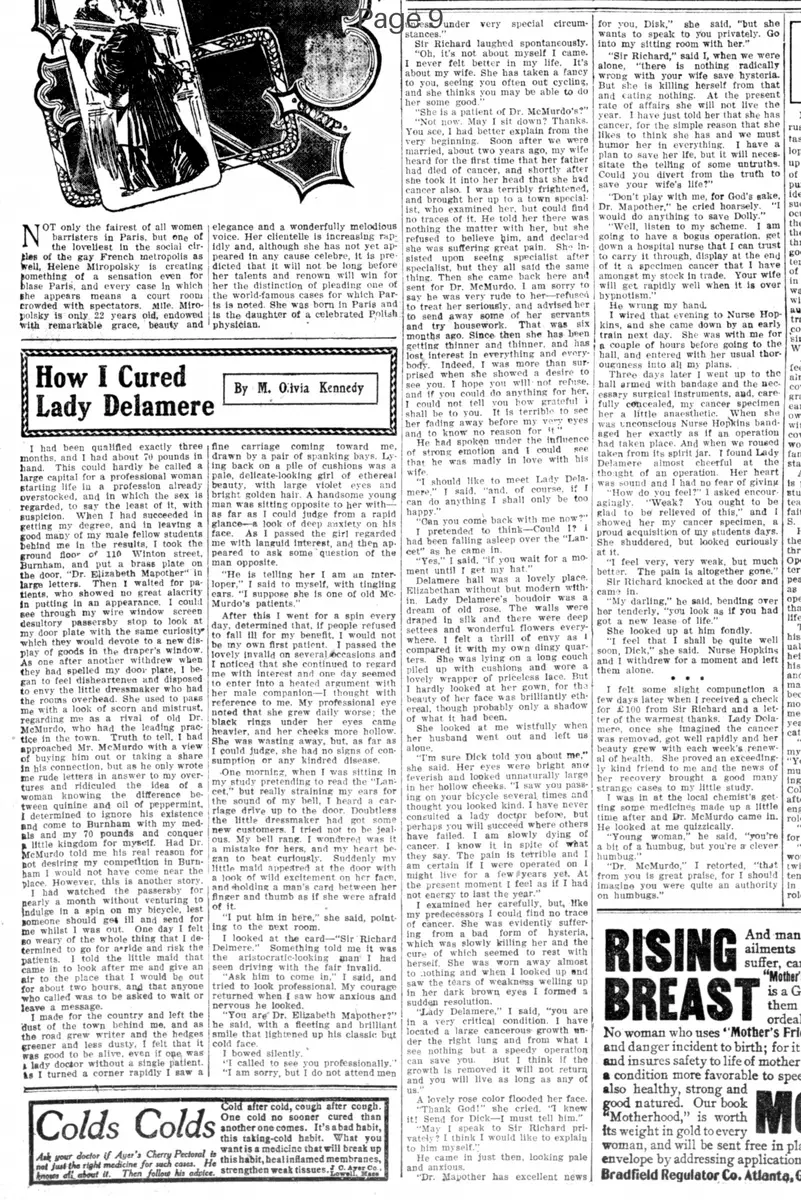
How I Cured Lady Delamere
By M. Olivia Kennedy
I had been qualified exactly three months, and I had about 70 pounds in hand. This could hardly be called a large capital for a professional woman starting life in a profession already overstocked, and in which the sex is regarded, to say the least of it, with suspicion. When I had succeeded in getting my degree, and in leaving a good many of my male fellow students behind me in the results, I took the ground floor of 110 Winton Street, Burnham, and put a brass plate on the door, "Dr. Elizabeth Mapother" in large letters. Then I waited for patients, who showed no great alacrity in putting in an appearance. I could see through my wire window screen desultory passers-by stop to look at my door plate with the same curiosity which they would devote to a new display of goods in the draper's window. As one after another withdrew when they had spelled my door plate, I began to feel disheartened and disposed to envy the little dressmaker who had the rooms overhead. She used to pass me with a look of scorn and mistrust, regarding me as a rival of old Dr. McMurdo, who had the leading practice in the town. Truth to tell, I had approached Mr. McMurdo with a view of buying him out or taking a share in his connection, but as he only wrote me rude letters in answer to my overtures and ridiculed the idea of a woman knowing the difference between quinine and oil of peppermint, I determined to ignore his existence and come to Burnham with my medals and my 70 pounds and conquer a little kingdom for myself. Had Dr. McMurdo told me his real reason for not desiring my competition in Burnham I would not have come near the place. However, this is another story.
I had watched the passers-by for nearly a month without venturing to indulge in a spin on my bicycle, lest someone should get ill and send for me whilst I was out. One day I felt so weary of the whole thing that I determined to go for a ride and risk the patients. I told the little maid that came in to look after me and give an air to the place that I would be out for about two hours, and that anyone who called was to be asked to wait or leave a message.
I made for the country and left the dust of the town behind me, and as the road grew wilder and the hedges greener and less dusty, I felt that it was good to be alive, even if one was a lady doctor without a single patient. As I turned a corner rapidly I saw a fine carriage coming toward me, drawn by a pair of spanking bays. Lying back on a pile of cushions was a pale, delicate-looking girl of ethereal beauty, with large violet eyes and bright golden hair. A handsome young man was sitting opposite to her with—as far as I could judge from a rapid glance—a look of deep anxiety on his face. As I passed the girl regarded me with languid interest, and then appeared to ask some question of the man opposite.
"He is telling her I am an intruder," I said to myself, with tingling ears. "I suppose she is one of old McMurdo's patients."
After this I went for a spin every day, determined that, if people refused to fall ill for my benefit, I would not be my own first patient. I passed the lovely invalid on several occasions and I noticed that she continued to regard me with interest and one day seemed to enter into a heated argument with her male companion—I thought with reference to me. My professional eye noted that she grew daily worse: the black rings under her eyes came heavier, and her cheeks more hollow. She was wasting away, but, as far as I could judge, she had no signs of consumption or any kindred disease.
One morning, when I was sitting in my study pretending to read the "Lancet," but really straining my ears for the sound of my bell, I heard a carriage drive up to the door. Doubtless the little dressmaker had got some new customers. I tried not to be jealous. My bell rang. I wondered was it a mistake for hers, and my heart began to beat curiously. Suddenly my little maid appeared at the door with a look of wild excitement on her face, and holding a man's card between her finger and thumb as if she were afraid of it.
"I put him in here," she said, pointing to the next room.
I looked at the card—"Sir Richard Delamere." Something told me it was the aristocratic-looking man I had seen driving with the fair invalid.
"Ask him to come in," I said, and tried to look professional. My courage returned when I saw how anxious and nervous he looked.
"You are Dr. Elizabeth Mapother?" he said, with a fleeting and brilliant smile that lightened up his classic but cold face.
I bowed silently.
"I called to see you professionally."
"I am sorry, but I do not attend men unless under very special circumstances."
Sir Richard laughed spontaneously. "Oh, it's not about myself I came. I never felt better in my life. It's about my wife. She has taken a fancy to you, seeing you often out cycling, and she thinks you may be able to do her some good."
"She is a patient of Dr. McMurdo's?"
"Not now. May I sit down? Thanks. You see, I had better explain from the very beginning. Soon after we were married, about two years ago, my wife heard for the first time that her father had died of cancer, and shortly after she took it into her head that she had cancer also. I was terribly frightened, and brought her up to a town specialist, who examined her, but could find no traces of it. He told her there was nothing the matter with her, but she refused to believe him, and declared she was suffering great pain. She insisted upon seeing specialist after specialist, but they all said the same thing. Then she came back here and sent for Dr. McMurdo. I am sorry to say he was very rude to her—refused to treat her seriously, and advised her to send away some of her servants and try housework. That was six months ago. Since then she has been getting thinner and thinner, and has lost interest in everything and everybody. Indeed, I was more than surprised when she showed a desire to see you. I hope you will not refuse, and if you could do anything for her, I could not tell you how grateful I shall be to you. It is terrible to see her fading away before my very eyes and to know no reason for it."
He had spoken under the influence of strong emotion and I could see that he was madly in love with his wife.
"I should like to meet Lady Delamere," I said. "And, of course, if I can do anything I shall only be too happy."
"Can you come back with me now?"
I pretended to think—Could I? I had been falling asleep over the "Lancet" as he came in.
"Yes," I said, "if you wait for a moment until I get my hat."
Delamere Hall was a lovely place, Elizabethan without but modern within. Lady Delamere's boudoir was a dream of old rose. The walls were draped in silk and there were deep settees and wonderful flowers everywhere. I felt a thrill of envy as I compared it with my own dingy quarters. She was lying on a long couch piled up with cushions and wore a lovely wrapper of priceless lace. But I hardly looked at her gown, for the beauty of her face was brilliantly ethereal, though probably only a shadow of what it had been.
She looked at me wistfully when her husband went out and left us alone.
"I'm sure Dick told you about me," she said. Her eyes were bright and feverish and looked unnaturally large in her hollow cheeks. "I saw you passing on your bicycle several times and thought you looked kind. I have never consulted a lady doctor before, but perhaps you will succeed where others have failed. I am slowly dying of cancer. I know it in spite of what they say. The pain is terrible and I am certain if I were operated on I might live for a few years yet. At the present moment I feel as if I had not energy to last the year."
I examined her carefully, but, like my predecessors, I could find no trace of cancer. She was evidently suffering from a bad form of hysteria, which was slowly killing her and the cure of which seemed to rest with herself. She was worn away almost to nothing, and when I looked up and saw the tears of weakness welling up in her dark brown eyes I formed a sudden resolution.
"Lady Delamere," I said, "you are in a very critical condition. I have located a large cancerous growth under the right lung and from what I see nothing but a speedy operation can save you. But I think if the growth is removed it will not return and you will live as long as any of us."
A lovely rose color flooded her face. "Thank God!" she cried. "I knew it! Send for Dick—I must tell him."
"May I speak to Sir Richard privately? I think I would like to explain to him myself."
He came in just then, looking pale and anxious.
"Dr. Mapother has excellent news for you, Dick," she said, "but she wants to speak to you privately. Go into my sitting room with her."
"Sir Richard," said I, when we were alone, "there is nothing radically wrong with your wife save hysteria. But she is killing herself from that and eating nothing. At the present rate of affairs she will not live the year. I have just told her that she has cancer, for the simple reason that she likes to think she has and we must humor her in everything. I have a plan to save her life, but it will necessitate the telling of some untruths. Could you divert from the truth to save your wife's life?"
"Don't play with me, for God's sake, Dr. Mapother," he cried hoarsely. "I would do anything to save Dolly."
"Well, listen to my scheme. I am going to have a bogus operation, get down a hospital nurse that I can trust to carry it through, display at the end of it a specimen cancer that I have amongst my stock in trade. Your wife will get rapidly well when it is over—hypnotism."
He wrung my hand.
I wired that evening to Nurse Hopkins, and she came down by an early train next day. She was with me for a couple of hours before going to the hall, and entered with her usual thoroughness into all my plans.
Three days later I went up to the hall armed with bandage and the necessary surgical instruments, and, carefully concealed, my cancer specimen taken from its spirit jar. I found Lady Delamere almost cheerful at the thought of an operation. Her heart was sound and I had no fear of giving her a little anaesthetic. When she was unconscious Nurse Hopkins bandaged her exactly as if an operation had taken place. And when we roused her, "How do you feel?" I asked encouragingly. "Weak? You ought to be glad to be relieved of this," and I showed her my cancer specimen, a proud acquisition of my student days. She shuddered, but looked curiously at it.
"I feel very, very weak, but much better. The pain is altogether gone."
Sir Richard knocked at the door and came in.
"My darling," he said, bending over her tenderly, "you look as if you had got a new lease of life."
She looked up at him fondly.
"I feel that I shall be quite well soon, Dick," she said. Nurse Hopkins and I withdrew for a moment and left them alone.
I felt some slight compunction a few days later when I received a check for £100 from Sir Richard and a letter of the warmest thanks. Lady Delamere, once she imagined the cancer was removed, got well rapidly and her beauty grew with each week's renewal of health. She proved an exceedingly kind friend to me and the news of her recovery brought a good many strange cases to my little study.
I was in at the local chemist's getting some medicines made up a little time after and Dr. McMurdo came in. He looked at me quizzically.
"Young woman," he said, "you're a bit of a humbug, but you're a clever humbug."
"Dr. McMurdo," I retorted, "that from you is great praise, for I should imagine you were quite an authority on humbugs."
What sub-type of article is it?
Prose Fiction
What themes does it touch?
Love Romance
Social Manners
What keywords are associated?
Lady Doctor
Hysteria
Bogus Operation
Medical Deception
Aristocratic Patient
Female Professional
What entities or persons were involved?
By M. Olivia Kennedy
Literary Details
Title
How I Cured Lady Delamere
Author
By M. Olivia Kennedy
Subject
A Lady Doctor's Ruse To Cure A Hypochondriac Aristocratic Patient
Form / Style
First Person Narrative Fiction In Prose
Key Lines
I Had Been Qualified Exactly Three Months, And I Had About 70 Pounds In Hand.
"Young Woman," He Said, "You're A Bit Of A Humbug, But You're A Clever Humbug."