Thanks for visiting SNEWPapers!
Sign up free today to connect your AI tools to the Library of Congress' newspaper collection.
Fowle's New Hampshire Gazette And General Advertiser Letter to Editor December 9, 1785
Portsmouth, Rockingham, New Hampshire
What is this article about?
A reader sends the editor an extract of a letter from Canada describing a strange midday darkness and violent storm with black, gunpowder-scented rain, and asks philosophic correspondents to explain it.
Quality green show the numbers
Measured from the scan
— how cleanly the OCR engine read the characters
- Mean ink quality
- 98.0% The length-weighted average confidence across the OCR lines — the mean of exactly the per-line scores whose tails the two figures below report. Typical is 99%.
- Illegible ink
- 0.8% Text sitting in OCR-detected lines that scored below 80% confidence — very shaky reads. Weighted by line length, so one long bad line counts for more than a short one.
- Uncertain ink
- 0.0% Text in lines that scored 80–90% — somewhat shaky reads.
- Matches source
- 95.43% How closely the served text matches the raw OCR of the same boxes, letter by letter, after collapsing spacing and case. This measures agreement, not correctness: the OCR is often wrong and the extractor corrects it, so 100% does not mean perfect, and a low figure usually means poor scan text was rewritten rather than that text was lost (length vs source shows loss).
- Length vs source
- 99.93% Below 100% means text was dropped from the OCR; above means text was added to make it read.
Assembled by the extraction model
— whether the stitched-together text holds up; catches layout and segmentation errors, which the scores above cannot see
- Transcription confidence
- 95.0% (typical 96%) How cleanly the extractor could assemble what it was given. Low here with clean ink scores points at layout analysis — the characters were read correctly but grouped or ordered wrongly.
- Comprehension
- 95.0% Whether the piece reads coherently start to finish. Can stay high while transcription confidence drops, when only part of the component is affected.
Clipping
Full Text
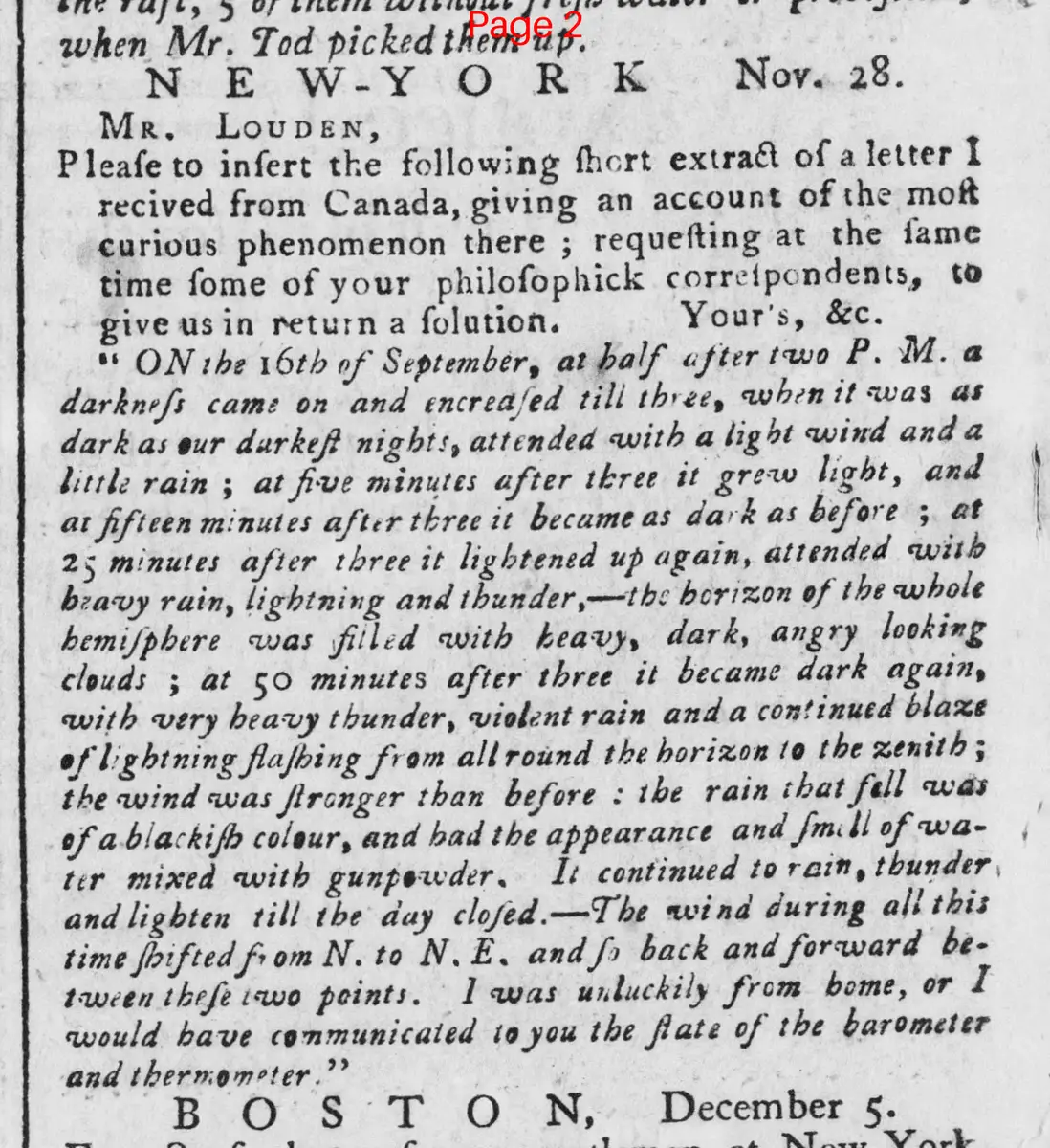
NEW-YORK, Nov. 28.
Mr. LOUDEN,
Please to insert the following short extract of a letter I received from Canada, giving an account of the most curious phenomenon there; requesting at the same time some of your philosophic correspondents, to give us in return a solution. Yours, &c.
"On the 16th of September, at half after two P.M., a darkness came on and increased till three, when it was as dark as our darkest nights, attended with a light wind and a little rain; at five minutes after three it grew light, and at fifteen minutes after three it became as dark as before; at 25 minutes after three it lightened up again, attended with heavy rain, lightning and thunder,—the horizon of the whole hemisphere was filled with heavy, dark, angry looking clouds; at 50 minutes after three it became dark again, with very heavy thunder, violent rain and a continued blaze of lightning flashing from all round the horizon to the zenith; the wind was stronger than before: the rain that fell was of a blackish colour, and had the appearance and smell of water mixed with gunpowder. It continued to rain, thunder and lighten till the day closed.—The wind during all this time shifted from N. to N.E., and back and forward between these two points. I was unluckily from home, or I would have communicated to you the state of the barometer and thermometer."
What sub-type of article is it?
Informative
What themes does it touch?
Science Nature
What keywords are associated?
Canada Weather Phenomenon
Midday Darkness
Black Rain
Thunderstorm
Letter To Editor
What entities or persons were involved?
Mr. Louden
Letter to Editor Details
Recipient
Mr. Louden
Main Argument
Requests publication of an account of a curious darkness and storm in Canada and asks philosophic correspondents to provide a solution.
Notable Details
- darkness came on September 16 at half past two P.M. and returned in waves
- rain was blackish and smelled like water mixed with gunpowder
- wind shifted between N and N.E.
- barometer and thermometer observations unavailable because the writer was away from home