Thanks for visiting SNEWPapers!
Sign up free today to connect your AI tools to the Library of Congress' newspaper collection.
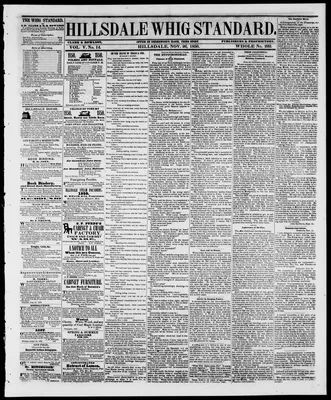
Hillsdale Whig Standard Poem November 26, 1850
Hillsdale, Hillsdale, Michigan
What is this article about?
An elegy mourning Edgar Allan Poe, evoking his imagery of Lenore, Nevermore and shadowy shores.
Quality green show the numbers
Measured from the scan
— how cleanly the OCR engine read the characters
- Mean ink quality
- 99.0% The length-weighted average confidence across the OCR lines — the mean of exactly the per-line scores whose tails the two figures below report. Typical is 99%.
- Illegible ink
- 0.0% Text sitting in OCR-detected lines that scored below 80% confidence — very shaky reads. Weighted by line length, so one long bad line counts for more than a short one.
- Uncertain ink
- 0.0% Text in lines that scored 80–90% — somewhat shaky reads.
- Matches source
- 99.25% How closely the served text matches the raw OCR of the same boxes, letter by letter, after collapsing spacing and case. This measures agreement, not correctness: the OCR is often wrong and the extractor corrects it, so 100% does not mean perfect, and a low figure usually means poor scan text was rewritten rather than that text was lost (length vs source shows loss).
- Length vs source
- 100.53% Below 100% means text was dropped from the OCR; above means text was added to make it read.
Assembled by the extraction model
— whether the stitched-together text holds up; catches layout and segmentation errors, which the scores above cannot see
- Transcription confidence
- 95.0% (typical 96%) How cleanly the extractor could assemble what it was given. Low here with clean ink scores points at layout analysis — the characters were read correctly but grouped or ordered wrongly.
- Comprehension
- 88.0% Whether the piece reads coherently start to finish. Can stay high while transcription confidence drops, when only part of the component is affected.
Clipping

Full Text
ON THE DEATH OF EDGAR A. POE.
BY SARAH T. BOLTON.
They have laid thee down to slumber, where the
sorrows that encumber,
Such a wild and wayward heart as thine, can never
reach thee more;
For the radiant light of gladness never alternates
with sadness,
Stinging gifted souls to madness on that bright and
blessed shore;
Safely moored from sorrow's tempest, on the "distant
Aidenn" shore.
Rest thee, lost one, ever more.
Thou wert like a meteor glancing through a starry
sky entracing.-
Thrilling, awing, wrapt beholders with the wondrous
light it wore;
But the meteor has descended, on the "Nightly" sha-
dows blended,
For the fever dream is ended, and the fearful crisis
o'er-
Yes, the wild, unresting fever-dream of human life
is o'er,
Thou art sleeping evermore.
Ocean, earth and air could utter, words that made
thy spirit flutter-
Words that stirred the hidden fountain swelling in
thy bosom's core,
Stirred it till its wavelets sighing, wakened to a wild
replying,
And in numbers never dying sung the heart's un-
written lore,
Now, unwritten nevermore.
There was something sad and lonely in thy mystic
songs that only
Could have trembled from a spirit weary of the life
it bore—
Something like the plaintive toning of a hidden stream-
let moaning,
In its prisoned darkness moaning for the light it knew
before-
For the fragrance and the sunlight that had gladden-
ed it before--
Sighing, sighing, evermore.
To thy soul, for ever, dreaming, came a strange efful-
gence beaming,
Beaming, flashing from a region mortals never may
explore,
Spirits led thee in thy trances through a realm of
gloomy fancies,
Giving spectres to thy glances man had never seen
before-
Were around the evermore.
Thou didst see the starlight quiver, over many a fa-
bled river-
Thou didst wander with the shadows of the mighty
dead of yore—
And thy songs to us came ringing like the wild, un-
earthly singing
Of the viewless spirits winging o'er "the night's Plu-
tonian shore."
Of the weary spirits wandering by the gloomy Styg-
ian shore,
Singing dirges evermore.
Thou didst seem like one benighted, one whose hopes
were crushed and blighted-
Mourning for the lost and lovely that the world could
not restore-
But an endless rest is given to thy heart so wrecked
and riven,
Thou hast met again in heaven with the "lost" and
loved "Lenore,"
With the "rare and radiant maiden whom the angels
call·Lenore.'"
She will leave thee nevermore.
From the earth a star has faded, and the shrine of
song is shaded,
And the muses veil their faces, weeping sorrowful and
sore-
But the harp, all rent and broken, left us many a
thrilling token;
We shall hear its numbers spoken, and repeated o'er
and o'er,
Sounding ever, evermore.
We shall hear them like a fountain tinkling down a
rugged mountain,
Like the wailing of the tempest mingling with the
ocean's roar;
Like the winds of autumn sighing, when the summer
flowers are dying;
Like a spirit voice replying, from a dim and distant
shore-
Like a wild, mysterious echo, from a distant shadowy
shore,
We shall hear them evermore.
Never more wilt thou, undaunted, wander through
"the Palace Haunted,"
Or the "cypress vales Titanic" which thy spirit did
explore-
Never heard the "Ghoul" king dwelling in the an-
cient steeple telling,
With a slow and solemn knelling, losses human
hearts deplore-
Telling "in a sort of Runic rhyme," the losses we de-
plore,
Tolling, tolling, evermore.
If a "living human being" ever had the gift of
"seeing"
The "grim and ghastly" countenance his "evil" Ge-
nius wore-
It was thee, "unhappy master, whom unmerciful
Disaster
Followed fast and followed faster, till "thy songs
one burden bore.
Till the dirges of "thy hope one melancholy bur-
den bore,
Of never-nevermore."
Indianapolis, Nov. 1, 1849. [Home Journal.
What sub-type of article is it?
Elegy
Lyric
What themes does it touch?
Death Mourning
Religious Faith
What keywords are associated?
Elegy Edgar Allan Poe
Lenore
Nevermore
Death Of Poe
What entities or persons were involved?
Sarah T. Bolton
Poem Details
Title
On The Death Of Edgar A. Poe.
Author
Sarah T. Bolton
Subject
On The Death Of Edgar Allan Poe
Form / Style
Rhymed Stanzas With A Refrain
Key Lines
They Have Laid Thee Down To Slumber, Where The Sorrows That Encumber,
Thou Art Sleeping Evermore.
She Will Leave Thee Nevermore.