Thanks for visiting SNEWPapers!
Sign up free today to connect your AI tools to the Library of Congress' newspaper collection.
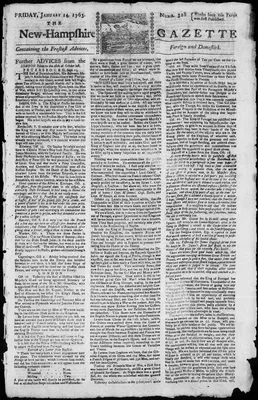
The New Hampshire Gazette Editorial January 14, 1763
Portsmouth, Rockingham, New Hampshire
What is this article about?
Complains of the present partiality to Scotsmen, citing the retaking of Newfoundland, where the commander, the officers bringing colours and news, and the only three wounded officers were all Scots.
Quality green show the numbers
Measured from the scan
— how cleanly the OCR engine read the characters
- Mean ink quality
- 96.0% The length-weighted average confidence across the OCR lines — the mean of exactly the per-line scores whose tails the two figures below report. Typical is 99%.
- Illegible ink
- 0.0% Text sitting in OCR-detected lines that scored below 80% confidence — very shaky reads. Weighted by line length, so one long bad line counts for more than a short one.
- Uncertain ink
- 0.0% Text in lines that scored 80–90% — somewhat shaky reads.
- Matches source
- 93.32% How closely the served text matches the raw OCR of the same boxes, letter by letter, after collapsing spacing and case. This measures agreement, not correctness: the OCR is often wrong and the extractor corrects it, so 100% does not mean perfect, and a low figure usually means poor scan text was rewritten rather than that text was lost (length vs source shows loss).
- Length vs source
- 98.02% Below 100% means text was dropped from the OCR; above means text was added to make it read.
Assembled by the extraction model
— whether the stitched-together text holds up; catches layout and segmentation errors, which the scores above cannot see
- Transcription confidence
- 92.0% (typical 96%) How cleanly the extractor could assemble what it was given. Low here with clean ink scores points at layout analysis — the characters were read correctly but grouped or ordered wrongly.
- Comprehension
- 90.0% Whether the piece reads coherently start to finish. Can stay high while transcription confidence drops, when only part of the component is affected.
Clipping
Full Text
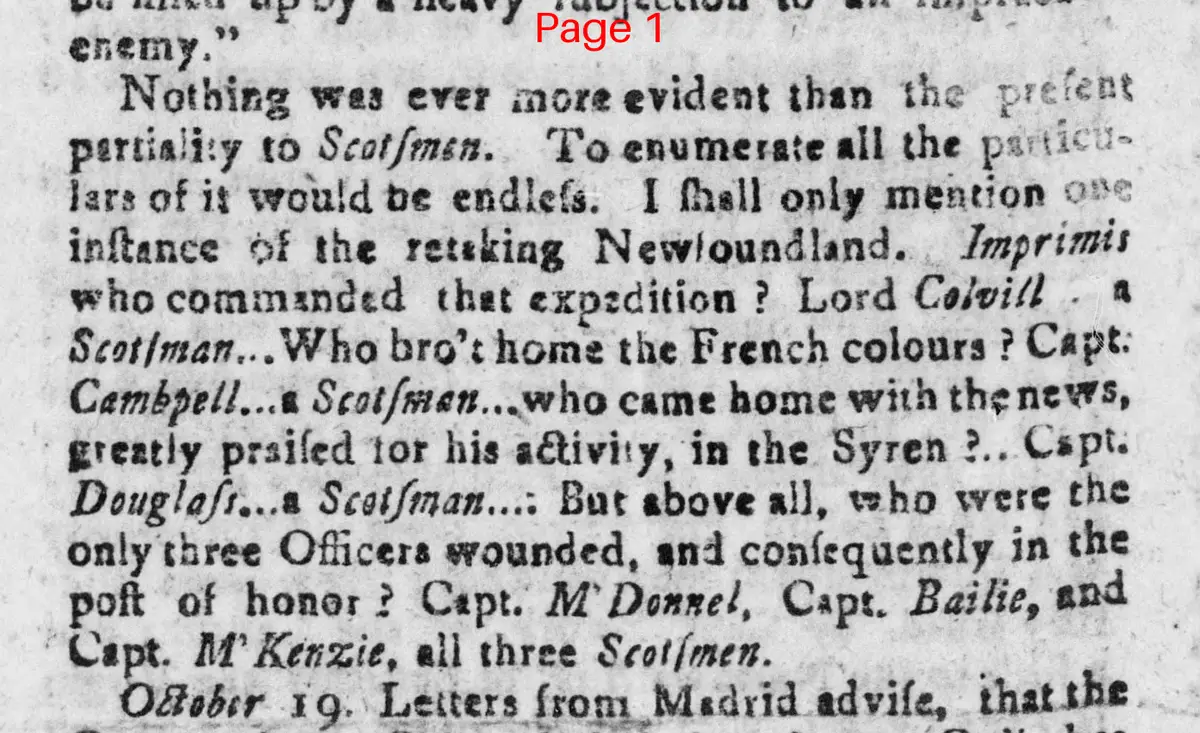
Nothing was ever more evident than the present partiality to Scotsmen. To enumerate all the particulars of it would be endless. I shall only mention one instance of the retaking Newfoundland. Imprimis, who commanded that expedition? Lord Colvill, a Scotsman. Who brought home the French colours? Capt. Campbell, a Scotsman, who came home with the news, greatly praised for his activity, in the Syren? Capt. Douglas, a Scotsman. But above all, who were the only three Officers wounded, and consequently in the post of honor? Capt. M'Donnel, Capt. Bailie, and Capt. M'Kenzie, all three Scotsmen.
What sub-type of article is it?
Partisan Politics
Military Affairs
What keywords are associated?
Scotsmen
Partiality
Newfoundland
Military Honors
Lord Colvill
What entities or persons were involved?
Lord Colvill
Capt. Campbell
Capt. Douglas
Capt. M'donnel
Capt. Bailie
Capt. M'kenzie
Editorial Details
Primary Topic
Alleged Favoritism Toward Scotsmen In Military Honors
Stance / Tone
Resentful, Critical Of Perceived Scottish Favoritism
Key Figures
Lord Colvill
Capt. Campbell
Capt. Douglas
Capt. M'donnel
Capt. Bailie
Capt. M'kenzie
Key Arguments
- The present partiality to Scotsmen is evident
- The retaking of Newfoundland was led and celebrated by Scotsmen at every stage
- The only three officers wounded, and in the post of honor, were all Scotsmen