Thanks for visiting SNEWPapers!
Sign up free today to connect your AI tools to the Library of Congress' newspaper collection.
The Virginia Gazette Literary July 1, 1773
Williamsburg, Virginia
What is this article about?
A detailed description of the King of Poland's appearance, education, languages, reading, and enlightened political sentiments.
Quality green show the numbers
Measured from the scan
— how cleanly the OCR engine read the characters
- Mean ink quality
- 99.0% The length-weighted average confidence across the OCR lines — the mean of exactly the per-line scores whose tails the two figures below report. Typical is 99%.
- Illegible ink
- 0.0% Text sitting in OCR-detected lines that scored below 80% confidence — very shaky reads. Weighted by line length, so one long bad line counts for more than a short one.
- Uncertain ink
- 0.0% Text in lines that scored 80–90% — somewhat shaky reads.
- Matches source
- 96.51% How closely the served text matches the raw OCR of the same boxes, letter by letter, after collapsing spacing and case. This measures agreement, not correctness: the OCR is often wrong and the extractor corrects it, so 100% does not mean perfect, and a low figure usually means poor scan text was rewritten rather than that text was lost (length vs source shows loss).
- Length vs source
- 99.69% Below 100% means text was dropped from the OCR; above means text was added to make it read.
Assembled by the extraction model
— whether the stitched-together text holds up; catches layout and segmentation errors, which the scores above cannot see
- Transcription confidence
- 96.0% (typical 96%) How cleanly the extractor could assemble what it was given. Low here with clean ink scores points at layout analysis — the characters were read correctly but grouped or ordered wrongly.
- Comprehension
- 90.0% Whether the piece reads coherently start to finish. Can stay high while transcription confidence drops, when only part of the component is affected.
Clipping
Full Text
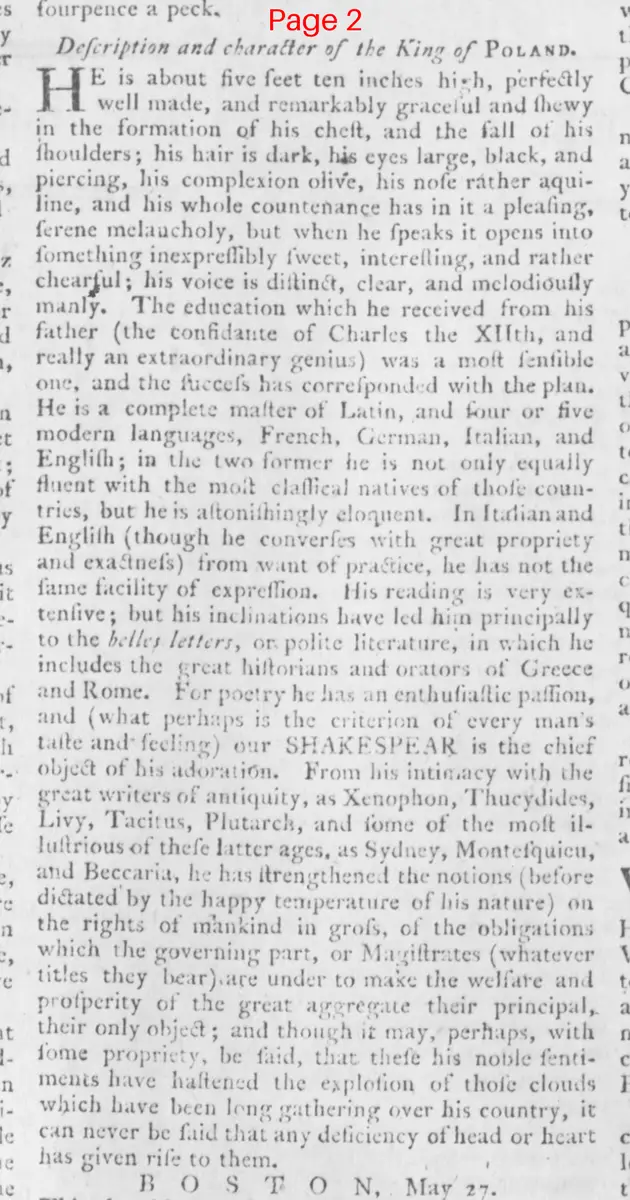
Description and character of the King of Poland.
He is about five feet ten inches high, perfectly well made, and remarkably graceful and showy in the formation of his chest, and the fall of his shoulders; his hair is dark, his eyes large, black, and piercing, his complexion olive, his nose rather aquiline, and his whole countenance has in it a pleasing, serene melancholy, but when he speaks it opens into something inexpressibly sweet, interesting, and rather cheerful; his voice is distinct, clear, and melodiously manly. The education which he received from his father (the confidant of Charles the XIIth, and really an extraordinary genius) was a most sensible one, and the success has corresponded with the plan. He is a complete master of Latin, and four or five modern languages, French, German, Italian, and English; in the two former he is not only equally fluent with the most classical natives of those countries, but he is astonishingly eloquent. In Italian and English (though he converses with great propriety and exactness) from want of practice, he has not the same facility of expression. His reading is very extensive; but his inclinations have led him principally to the belles lettres, or polite literature, in which he includes the great historians and orators of Greece and Rome. For poetry he has an enthusiastic passion, and (what perhaps is the criterion of every man's taste and feeling) our SHAKESPEAR is the chief object of his adoration. From his intimacy with the great writers of antiquity, as Xenophon, Thucydides, Livy, Tacitus, Plutarch, and some of the most illustrious of these latter ages, as Sydney, Montesquieu, and Beccaria, he has strengthened the notions (before dictated by the happy temperature of his nature) on the rights of mankind in gross, of the obligations which the governing part, or Magistrates (whatever titles they bear), are under to make the welfare and prosperity of the great aggregate their principal, their only object; and though it may, perhaps, with some propriety, be said, that these his noble sentiments have hastened the explosion of those clouds which have been long gathering over his country, it can never be said that any deficiency of head or heart has given rise to them.
What sub-type of article is it?
Essay
What themes does it touch?
Political
Liberty Freedom
Moral Virtue
What keywords are associated?
King Of Poland
Character Sketch
Royal Biography
Belles Lettres
Shakespeare
Literary Details
Title
Description And Character Of The King Of Poland.
Subject
Character Sketch Of The King Of Poland
Form / Style
Descriptive Prose Character Sketch
Key Lines
He Is A Complete Master Of Latin, And Four Or Five Modern Languages, French, German, Italian, And English.
Our Shakespear Is The Chief Object Of His Adoration.