Thanks for visiting SNEWPapers!
Sign up free today to connect your AI tools to the Library of Congress' newspaper collection.
Trainman News Editorial November 26, 1951
Indianapolis, Marion, Indiana
What is this article about?
Editorial by W. P. Kennedy argues the U.S. has mishandled Korean War armistice negotiations and the publication of a POW atrocities report, and urges that the undeclared war be ended promptly.
Quality green show the numbers
Measured from the scan
— how cleanly the OCR engine read the characters
- Mean ink quality
- 99.0% The length-weighted average confidence across the OCR lines — the mean of exactly the per-line scores whose tails the two figures below report. Typical is 99%.
- Illegible ink
- 0.0% Text sitting in OCR-detected lines that scored below 80% confidence — very shaky reads. Weighted by line length, so one long bad line counts for more than a short one.
- Uncertain ink
- 0.0% Text in lines that scored 80–90% — somewhat shaky reads.
- Matches source
- 99.65% How closely the served text matches the raw OCR of the same boxes, letter by letter, after collapsing spacing and case. This measures agreement, not correctness: the OCR is often wrong and the extractor corrects it, so 100% does not mean perfect, and a low figure usually means poor scan text was rewritten rather than that text was lost (length vs source shows loss).
- Length vs source
- 99.77% Below 100% means text was dropped from the OCR; above means text was added to make it read.
Assembled by the extraction model
— whether the stitched-together text holds up; catches layout and segmentation errors, which the scores above cannot see
- Transcription confidence
- 98.0% (typical 96%) How cleanly the extractor could assemble what it was given. Low here with clean ink scores points at layout analysis — the characters were read correctly but grouped or ordered wrongly.
- Comprehension
- 98.0% Whether the piece reads coherently start to finish. Can stay high while transcription confidence drops, when only part of the component is affected.
Clipping
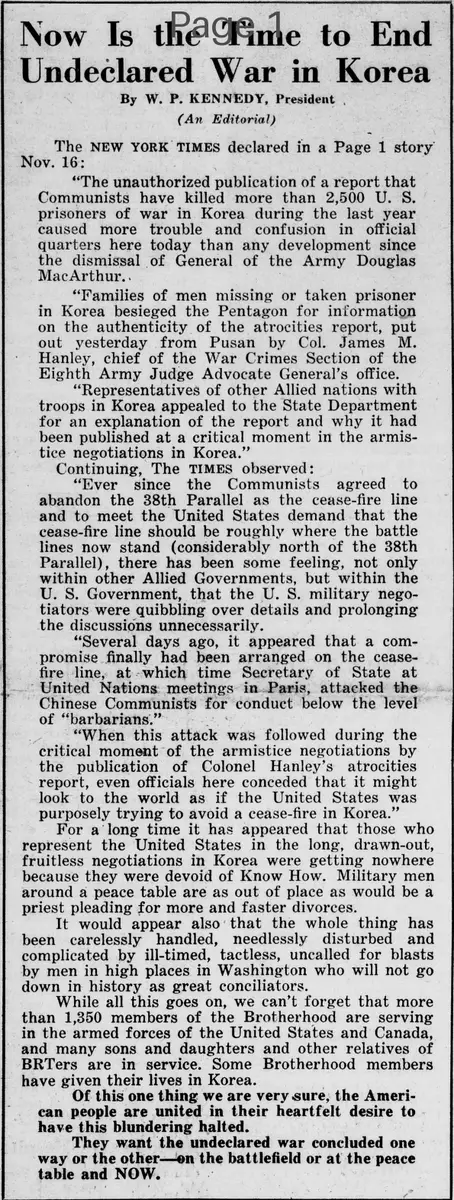
Full Text
Now Is the Time to End Undeclared War in Korea
By W. P. KENNEDY, President
(An Editorial)
The New York Times declared in a Page 1 story Nov. 16:
"The unauthorized publication of a report that Communists have killed more than 2,500 U. S. prisoners of war in Korea during the last year caused more trouble and confusion in official quarters here today than any development since the dismissal of General of the Army Douglas MacArthur.
"Families of men missing or taken prisoner in Korea besieged the Pentagon for information on the authenticity of the atrocities report, put out yesterday from Pusan by Col. James M. Hanley, chief of the War Crimes Section of the Eighth Army Judge Advocate General's office.
"Representatives of other Allied nations with troops in Korea appealed to the State Department for an explanation of the report and why it had been published at a critical moment in the armistice negotiations in Korea."
Continuing, The Times observed:
"Ever since the Communists agreed to abandon the 38th Parallel as the cease-fire line and to meet the United States demand that the cease-fire line should be roughly where the battle lines now stand (considerably north of the 38th Parallel), there has been some feeling, not only within other Allied Governments, but within the U. S. Government, that the U. S. military negotiators were quibbling over details and prolonging the discussions unnecessarily.
"Several days ago, it appeared that a compromise finally had been arranged on the cease-fire line, at which time Secretary of State at United Nations meetings in Paris, attacked the Chinese Communists for conduct below the level of 'barbarians.'
"When this attack was followed during the critical moment of the armistice negotiations by the publication of Colonel Hanley's atrocities report, even officials here conceded that it might look to the world as if the United States was purposely trying to avoid a cease-fire in Korea."
For a long time it has appeared that those who represent the United States in the long, drawn-out, fruitless negotiations in Korea were getting nowhere because they were devoid of know-how. Military men around a peace table are as out of place as would be a priest pleading for more and faster divorces.
It would appear also that the whole thing has been carelessly handled, needlessly disturbed and complicated by ill-timed, tactless, uncalled for blasts by men in high places in Washington who will not go down in history as great conciliators.
While all this goes on, we can't forget that more than 1,350 members of the Brotherhood are serving in the armed forces of the United States and Canada, and many sons and daughters and other relatives of BRTers are in service. Some Brotherhood members have given their lives in Korea.
Of this one thing we are very sure, the American people are united in their heartfelt desire to have this blundering halted.
They want the undeclared war concluded one way or the other—on the battlefield or at the peace table and NOW.
What sub-type of article is it?
War Or Peace
Foreign Affairs
Military Affairs
What keywords are associated?
Korean War
Armistice Negotiations
Prisoner Atrocities
Undeclared War
Peace Talks
What entities or persons were involved?
W. P. Kennedy
The New York Times
General Douglas Macarthur
Col. James M. Hanley
Brotherhood Of Railroad Trainmen
Editorial Details
Primary Topic
Ending Undeclared War In Korea
Stance / Tone
Critical Of U.S. Handling, Urges Conclusion
Key Figures
W. P. Kennedy
The New York Times
General Douglas Macarthur
Col. James M. Hanley
Brotherhood Of Railroad Trainmen
Key Arguments
- atrocities report caused confusion
- U.S. negotiators quibbling
- military men poor peace negotiators
- American people want war ended