Thank you for visiting SNEWPapers!
Sign up free
The Worthington Advance Filler September 8, 1887
Worthington, Nobles, Minnesota
What is this article about?
A historical account of wages in 1800: laborers earned roughly $65 a year with food and lodging, working sunrise to sunset, with regional variations.
Quality green show the numbers
Measured from the scan
— how cleanly the OCR engine read the characters
- Mean ink quality
- 99.0% The length-weighted average confidence across the OCR lines — the mean of exactly the per-line scores whose tails the two figures below report. Typical is 99%.
- Illegible ink
- 0.0% Text sitting in OCR-detected lines that scored below 80% confidence — very shaky reads. Weighted by line length, so one long bad line counts for more than a short one.
- Uncertain ink
- 0.0% Text in lines that scored 80–90% — somewhat shaky reads.
- Matches source
- 99.43% How closely the served text matches the raw OCR of the same boxes, letter by letter, after collapsing spacing and case. This measures agreement, not correctness: the OCR is often wrong and the extractor corrects it, so 100% does not mean perfect, and a low figure usually means poor scan text was rewritten rather than that text was lost (length vs source shows loss).
- Length vs source
- 99.22% Below 100% means text was dropped from the OCR; above means text was added to make it read.
Assembled by the extraction model
— whether the stitched-together text holds up; catches layout and segmentation errors, which the scores above cannot see
- Transcription confidence
- 95.0% (typical 96%) How cleanly the extractor could assemble what it was given. Low here with clean ink scores points at layout analysis — the characters were read correctly but grouped or ordered wrongly.
- Comprehension
- 95.0% Whether the piece reads coherently start to finish. Can stay high while transcription confidence drops, when only part of the component is affected.
Clipping
Full Text
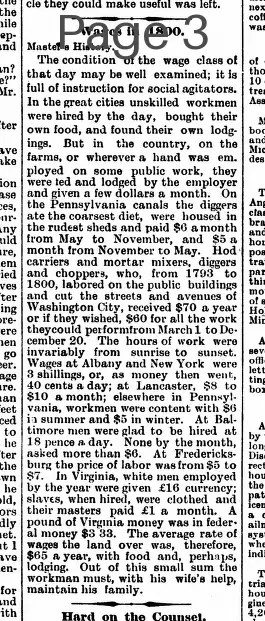
Wages in 1800.
Master's History.
The condition of the wage class of that day may be well examined; it is full of instruction for social agitators. In the great cities unskilled workmen were hired by the day, bought their own food, and found their own lodgings. But in the country, on the farms, or wherever a hand was employed on some public work, they were fed and lodged by the employer and given a few dollars a month. On the Pennsylvania canals the diggers ate the coarsest diet, were housed in the rudest sheds and paid $6 a month from May to November, and $5 a month from November to May. Hod carriers and mortar mixers, diggers and choppers, who, from 1793 to 1800, labored on the public buildings and cut the streets and avenues of Washington City, received $70 a year or if they wished, $60 for all the work they could perform from March 1 to December 20. The hours of work were invariably from sunrise to sunset.
Wages at Albany and New York were 3 shillings, or, as money then went, 40 cents a day; at Lancaster, $8 to $10 a month; elsewhere in Pennsylvania, workmen were content with $6 in summer and $5 in winter. At Baltimore men were glad to be hired at 18 pence a day. None by the month asked more than $6. At Fredericksburg the price of labor was from $5 to $7. In Virginia, white men employed by the year were given £16 currency; slaves, when hired, were clothed and their masters paid £1 a month. A pound of Virginia money was in federal money $3 33. The average rate of wages the land over was, therefore, $65 a year, with food and, perhaps, lodging. Out of this small sum the workman must, with his wife's help, maintain his family.
What sub-type of article is it?
Curiosity
What keywords are associated?
Wages 1800
Working Conditions
Pennsylvania Canals
Washington City
Laborers
Where did it happen?
United States
Filler Details
Topic
Wages And Working Conditions In 1800
Location
United States