Thank you for visiting SNEWPapers!
Sign up free
The New Hampshire Gazette Story May 27, 1794
Portsmouth, Rockingham, New Hampshire
Cautionary note: graphic descriptions of death and putrefaction; era-typical racial language
What is this article about?
Extracts from Carey's account of Philadelphia's malignant fever: a landlord evicts a sick widower, a New York woman adopts an orphan, a grave digger dies from a coffin's stench, and other scenes of suffering and death.
Quality green show the numbers
Measured from the scan
— how cleanly the OCR engine read the characters
- Mean ink quality
- 99.0% The length-weighted average confidence across the OCR lines — the mean of exactly the per-line scores whose tails the two figures below report. Typical is 99%.
- Illegible ink
- 0.0% Text sitting in OCR-detected lines that scored below 80% confidence — very shaky reads. Weighted by line length, so one long bad line counts for more than a short one.
- Uncertain ink
- 0.0% Text in lines that scored 80–90% — somewhat shaky reads.
- Matches source
- 96.55% How closely the served text matches the raw OCR of the same boxes, letter by letter, after collapsing spacing and case. This measures agreement, not correctness: the OCR is often wrong and the extractor corrects it, so 100% does not mean perfect, and a low figure usually means poor scan text was rewritten rather than that text was lost (length vs source shows loss).
- Length vs source
- 98.98% Below 100% means text was dropped from the OCR; above means text was added to make it read.
Assembled by the extraction model
— whether the stitched-together text holds up; catches layout and segmentation errors, which the scores above cannot see
- Transcription confidence
- 94.0% (typical 96%) How cleanly the extractor could assemble what it was given. Low here with clean ink scores points at layout analysis — the characters were read correctly but grouped or ordered wrongly.
- Comprehension
- 85.0% Whether the piece reads coherently start to finish. Can stay high while transcription confidence drops, when only part of the component is affected.
Clipping
Full Text
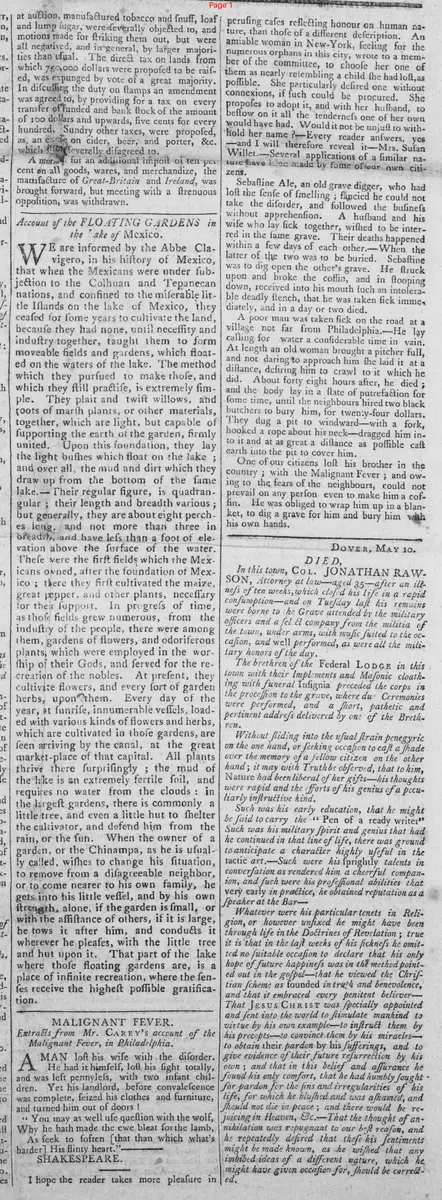
MALIGNANT FEVER.
Extracts from Mr. Carey's account of the Malignant Fever, in Philadelphia.
A man lost his wife with the disorder. He had it himself, lost his sight totally, and was left pennyless, with two infant children. Yet his landlord, before convalescence was complete, seized his clothes and furniture, and turned him out of doors!
"You may as well use question with the wolf, Why he hath made the ewe bleat for the lamb, As seek to soften that than which what's harder! His flinty heart."
SHAKESPEARE.
I hope the reader takes more pleasure in perusing cases reflecting honour on human nature, than those of a different description. An amiable woman in New-York, feeling for the numerous orphans in this city, wrote to a member of the committee, to choose her one of them as nearly resembling a child she had lost, as possible. She particularly desired one without connexions, if such could be procured. She proposes to adopt it, and with her husband, to bestow on it all the tenderness one of her own would have had. Would it not be unjust to withhold her name? Every reader answers, yes—and I will therefore reveal it—Mrs. Susan Willet.—Several applications of a similar nature have been made by some of our own citizens.
Sebastine Ale, an old grave digger, who had lost the sense of smelling; fancied he could not take the disorder, and followed the business without apprehension. A husband and his wife who lay sick together, wished to be interred in the same grave. Their deaths happened within a few days of each other.—When the latter of the two was to be buried, Sebastine was to dig open the other's grave. He struck upon and broke the coffin, and in stooping down, received into his mouth such an intolerable deadly stench, that he was taken sick immediately, and in a day or two died.
A poor man was taken sick on the road at a village not far from Philadelphia.—He lay calling for water a considerable time in vain. At length an old woman brought a pitcher full, and not daring to approach him she laid it at a distance, desiring him to crawl to it which he did. About forty eight hours after, he died; and the body lay in a state of putrefaction for some time, until the neighbours hired two black butchers to bury him, for twenty-four dollars. They dug a pit to windward—with a fork, hooked a rope about his neck—dragged him into it and at as great a distance as possible cast earth into the pit to cover him.
One of our citizens lost his brother in the country; with the Malignant Fever; and owing to the fears of the neighbours, could not prevail on any person even to make him a coffin. He was obliged to wrap him up in a blanket, to dig a grave for him and bury him with his own hands.
What sub-type of article is it?
Disaster
Tragedy
Medical Curiosity
What themes does it touch?
Catastrophe
Misfortune
Tragedy
What keywords are associated?
Malignant Fever
Philadelphia Epidemic
Yellow Fever
Grave Digger
Orphans
What entities or persons were involved?
Mrs. Susan Willet
Sebastine Ale
Where did it happen?
Philadelphia
Story Details
Key Persons
Mrs. Susan Willet
Sebastine Ale
Location
Philadelphia