Thank you for visiting SNEWPapers!
Sign up free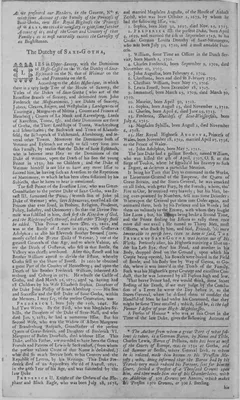
The Virginia Gazette Literary November 5, 1736
Richmond, Richmond, Virginia
What is this article about?
A continuation of an account of the family of the Princess of Saxe-Gotha (later Princess of Wales), describing the duchy's rulers, genealogy, court, government, and the towns of Gotha and Altenburg.
Quality green show the numbers
Measured from the scan
— how cleanly the OCR engine read the characters
- Mean ink quality
- 99.0% The length-weighted average confidence across the OCR lines — the mean of exactly the per-line scores whose tails the two figures below report. Typical is 99%.
- Illegible ink
- 0.0% Text sitting in OCR-detected lines that scored below 80% confidence — very shaky reads. Weighted by line length, so one long bad line counts for more than a short one.
- Uncertain ink
- 0.81% Text in lines that scored 80–90% — somewhat shaky reads.
- Matches source
- 96.56% How closely the served text matches the raw OCR of the same boxes, letter by letter, after collapsing spacing and case. This measures agreement, not correctness: the OCR is often wrong and the extractor corrects it, so 100% does not mean perfect, and a low figure usually means poor scan text was rewritten rather than that text was lost (length vs source shows loss). Across pages, this is the worst fragment.
- Length vs source
- 98.99% Below 100% means text was dropped from the OCR; above means text was added to make it read.
Assembled by the extraction model
— whether the stitched-together text holds up; catches layout and segmentation errors, which the scores above cannot see
- Transcription confidence
- 94.0% (typical 96%) How cleanly the extractor could assemble what it was given. Low here with clean ink scores points at layout analysis — the characters were read correctly but grouped or ordered wrongly.
- Comprehension
- 90.0% Whether the piece reads coherently start to finish. Can stay high while transcription confidence drops, when only part of the component is affected.
Clippings
1 of 2
Full Text
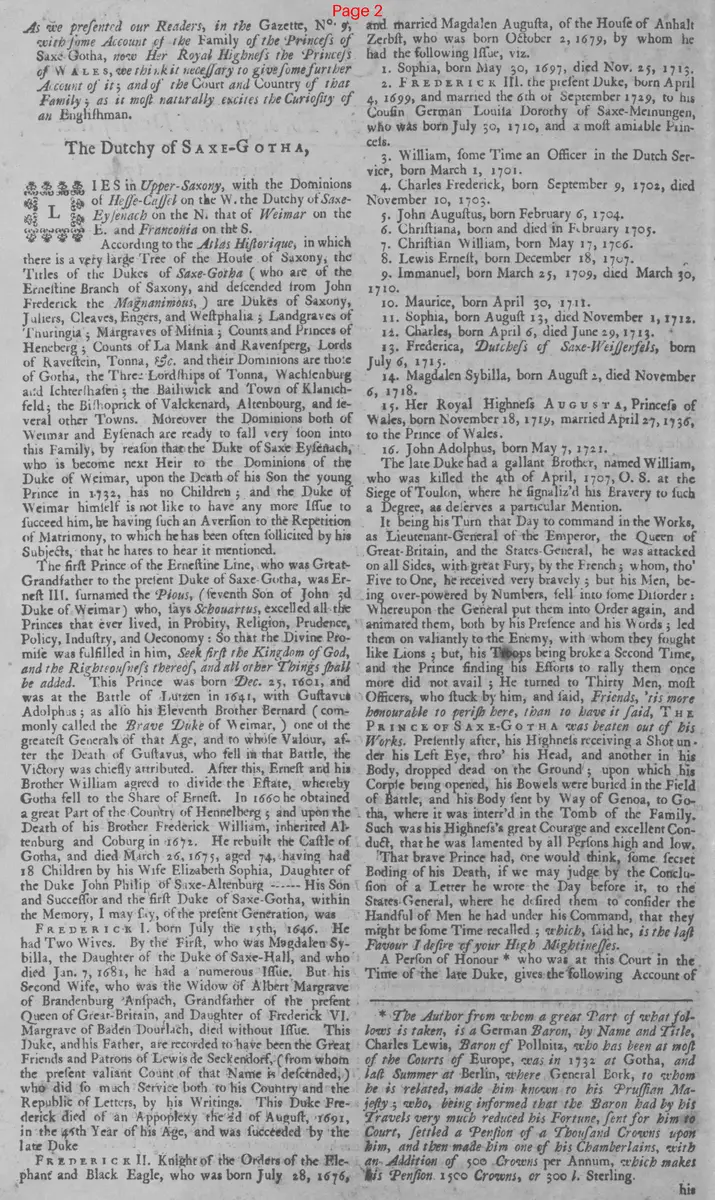
As we presented our Readers, in the Gazette, No. 9, with some Account of the Family of the Princess of Saxe-Gotha, now Her Royal Highness the Princess of Wales, we think it necessary to give some further Account of it; and of the Court and Country of that Family; as it most naturally excites the Curiosity of an Englishman.
The Dutchy of Saxe-Gotha,
LIES in Upper-Saxony, with the Dominions of Hesse-Cassel on the W. the Dutchy of Saxe-Eisenach on the N. that of Weimar on the E. and Franconia on the S.
According to the Atlas Historique, in which there is a very large Tree of the House of Saxony, the Titles of the Dukes of Saxe-Gotha (who are of the Ernestine Branch of Saxony, and descended from John Frederick the Magnanimous,) are Dukes of Saxony, Juliers, Cleves, Engers, and Westphalia; Landgraves of Thuringia; Margraves of Misnia; Counts and Princes of Henneberg; Counts of La Marck and Ravensperg, Lords of Ravestein, Tonna, &c. and their Dominions are those of Gotha, the Three Lordships of Tonna, Wachsenburg and Ichtershausen; the Bailiwick and Town of Kranichfeld; the Bishoprick of Valckenard, Altenburg, and several other Towns. Moreover the Dominions both of Weimar and Eisenach are ready to fall very soon into this Family, by reason that the Duke of Saxe-Eisenach, who is become next Heir to the Dominions of the Duke of Weimar, upon the Death of his Son the young Prince in 1732, has no Children; and the Duke of Weimar himself is not like to have any more Issue to succeed him, he having such an Aversion to the Repetition of Matrimony, to which he has been often solicited by his Subjects, that he hates to hear it mentioned.
The first Prince of the Ernestine Line, who was Great-Grandfather to the present Duke of Saxe-Gotha, was Ernest III. surnamed the Pious, (seventh Son of John III. Duke of Weimar) who, says Schouartus, excelled all the Princes that ever lived, in Probity, Religion, Prudence, Policy, Industry, and Oeconomy: So that the Divine Promise was fulfilled in him, Seek first the Kingdom of God, and the Righteousness thereof, and all other Things shall be added. This Prince was born Dec. 25, 1601, and was at the Battle of Lutzen in 1632, with Gustavus Adolphus; as also his Eleventh Brother Bernard (commonly called the Brave Duke of Weimar,) one of the greatest Generals of that Age, and to whose Valour, after the Death of Gustavus, who fell in that Battle, the Victory was chiefly attributed. After this, Ernest and his Brother William agreed to divide the Estate, whereby Gotha fell to the Share of Ernest. In 1660 he obtained a great Part of the Country of Henneberg; and upon the Death of his Brother Frederick William, inherited Altenburg and Coburg in 1672. He rebuilt the Castle of Gotha, and died March 26, 1675, aged 74, having had 18 Children by his Wife Elizabeth Sophia, Daughter of the Duke John Philip of Saxe-Altenburg ------ His Son and Successor and the first Duke of Saxe-Gotha, within the Memory, I may say, of the present Generation, was FREDERICK I. born July the 15th, 1646. He had Two Wives. By the First, who was Magdalen Sybilla, the Daughter of the Duke of Saxe-Hall, and who died Jan. 7, 1681, he had a numerous Issue. But his Second Wife, who was the Widow of Albert Margrave of Brandenburg-Anspach, Grandfather of the present Queen of Great-Britain, and Daughter of Frederick VI. Margrave of Baden-Durlach, died without Issue. This Duke, and his Father, are recorded to have been the Great Friends and Patrons of Lewis de Seckendorf, (from whom the present valiant Count of that Name is descended,) who did so much Service both to his Country and the Republic of Letters, by his Writings. This Duke Frederick died of an Appoplexy the 2d of August, 1691, in the 45th Year of his Age, and was succeeded by the late Duke.
FREDERICK II. Knight of the Orders of the Elephant and Black Eagle, who was born July 28, 1676, and married Magdalen Augusta, of the House of Anhalt-Zerbst, who was born October 2, 1679, by whom he had the following Issue, viz.
1. Sophia, born May 30, 1697, died Nov. 25, 1713.
2. Frederick III. the present Duke, born April 4, 1699, and married the 6th of September 1729, to his Cousin German Louisa Dorothea of Saxe-Meiningen, who was born July 30, 1710, and a most amiable Princess.
3. William, some Time an Officer in the Dutch Service, born March 1, 1701.
4. Charles Frederick, born September 9, 1702, died November 10, 1703.
5. John Augustus, born February 6, 1704.
6. Christiana, born and died in February 1705.
7. Christian William, born May 17, 1706.
8. Lewis Ernest, born December 18, 1707.
9. Immanuel, born March 25, 1709, died March 30, 1710.
10. Maurice, born April 30, 1711.
11. Sophia, born August 13, died November 1, 1712.
12. Charles, born April 6, died June 29, 1713.
13. Frederica, Dutchess of Saxe-Weissenfels, born July 6, 1715.
14. Magdalen Sybilla, born August 2, died November 6, 1718.
15. Her Royal Highness Augusta, Princess of Wales, born November 18, 1719, married April 27, 1736, to the Prince of Wales.
16. John Adolphus, born May 7, 1721.
The late Duke had a gallant Brother, named William, who was killed the 4th of April, 1707, O. S. at the Siege of Toulon, where he signaliz'd his Bravery to such a Degree, as deserves a particular Mention.
It being his Turn that Day to command in the Works, as Lieutenant-General of the Emperor, the Queen of Great-Britain, and the States-General, he was attacked on all Sides, with great Fury, by the French; whom, tho' Five to One, he received very bravely; but his Men, being over-powered by Numbers, fell into some Disorder: Whereupon the General put them into Order again, and animated them, both by his Presence and his Words; led them on valiantly to the Enemy, with whom they fought like Lions; but, his Troops being broke a Second Time, and the Prince finding his Efforts to rally them once more did not avail; He turned to Thirty Men, most Officers, who stuck by him, and said, Friends, 'tis more honourable to perish here, than to have it said, THE PRINCE OF SAXE-GOTHA was beaten out of his Works. Presently after, his Highness receiving a Shot under his Left Eye, thro' his Head, and another in his Body, dropped dead on the Ground; upon which his Corpse being opened, his Bowels were buried in the Field of Battle, and his Body sent by Way of Genoa, to Gotha, where it was interr'd in the Tomb of the Family. Such was his Highness's great Courage and excellent Conduct, that he was lamented by all Persons high and low.
That brave Prince had, one would think, some secret Boding of his Death, if we may judge by the Conclusion of a Letter he wrote the Day before it, to the States General, where he desired them to consider the Handful of Men he had under his Command, that they might be some Time recalled; which, said he, is the last Favour I desire of your High Mightinesses.
A Person of Honour * who was at this Court in the Time of the late Duke, gives the following Account of
* The Author from whom a great Part of what follows is taken, is a German Baron, by Name and Title, Charles Lewis, Baron de Pollnitz, who has been at most of the Courts of Europe, was in 1732 at Gotha, and last Summer at Berlin, where General Bork, to whom he is related, made him known to his Prussian Majesty; who, being informed that the Baron had by his Travels very much reduced his Fortune, sent for him to Court, settled a Pension of a Thousand Crowns upon him, and then made him one of his Chamberlains, with an Addition of 500 Crowns per Annum, which makes his Pension 1500 Crowns, or 300 l. Sterling.
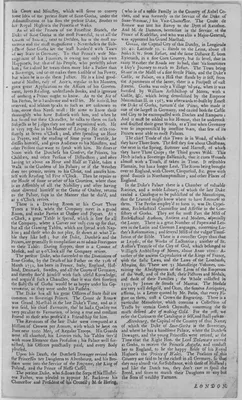
his Court and Ministry, which will serve to convey some Idea of the present State of Saxe-Gotha, under the Administration of his Son the present Duke, Brother to her Royal Highness the Princess of Wales.
As of all the Princes of the Ernestine Branch, the Duke of Saxe-Gotha is the most Powerful, so of all the Courts of Saxony, next to Dresden, his is the most numerous and the most magnificent: Nevertheless the Subjects of Saxe-Gotha are the least burden'd with Taxes of any State in Germany. To that Prince's wise Management of his Finances, is owing not only his own Happiness, but that of his People, who perfectly adore him; for indeed he treats them more like a Father than a Sovereign, and never makes them sensible of his Power, but when he is to do them Justice. He is a kind good-natur'd Master, easy of Access, regular in his Manners, gives great Application to the Affairs of his Government, loves Reading, understands Books, and is ignorant of nothing a Prince ought to know. As to the Air of his Person, he is handsome and well set. He is civil, but reserved, and seldom speaks to such as are unknown to him, more than Needs must: He aims to know those thoroughly who have Business with him, and when he has found out their Character, he talks to them on such Subjects as he judges they are most acquainted with. He is very regular in his Manner of Living: He rises constantly at Seven o'Clock; and, after spending an Hour in Prayer, and the reading of some pious Treatise, he dresses himself, and gives Audience to his Ministers, and other Persons that want to speak with him. He dines at Noon with the Duchess his Consort, the Princes, his Children, and other Persons of Distinction; and after having sat about an Hour and Half at Table, takes a Walk in the Gardens of his Palace; or if the Weather does not permit, retires to his Closet, and amuses himself with Reading 'til Five o'Clock. Then he repairs to the House of some or other of his Courtiers, where there is an Assembly of all the Nobility; and after having there diverted himself at the Game of Ombre, returns to the Palace, sups in the Manner that he din'd, and at 9 o'Clock retires.
There is a Drawing Room at his Court Three Times a Week, when the Company meet in a grand Room, and make Parties at Ombre and Piquet. At 7 o'Clock, a great Table is spread, which is free for all the Company, where a Carver not only cuts up for that, but all the Gaming Tables, which are spread with Napkins; and those who do not play, sit down at what Table they like best; but the Duke, Duchess and the Princes, are generally so complaisant as to admit Foreigners to their Table: During Supper, there is a Concert of Musick, and at 9 o'Clock all the Company retires.
The present Duke, who succeeded to the Dominions of Saxe-Gotha, by the Death of his Father on the 12th of March 1732, has been in France, Italy, England, Holland, Denmark, Sweden, and all the Courts of Germany, and thereby stor'd himself with such useful Knowledge, and acquir'd such a Character, that it was then foreseen the Subjects of Gotha would be as happy under his Government, as they were under his Father's.
The Duke has all his great Officers of State that are common to Sovereign Princes. The Count de Ronaw was Grand Marshal in the late Duke's Time, and as it was said, his chief Favourite, tho' he had a Quality not very peculiar to Favourites, of being a true and constant Friend to those who profess'd a Friendship for him.
The Revenues of the late Duke were computed at a Million of Crowns per Annum, with which he kept on Foot near 2000 Men, of Regular Troops. His Guards were all cloathed, his Liveries rich, his Tables serv'd with more Elegance than Profusion; his Palace well furnished, his Officers punctually paid, and every Body pleased.
Upon his Death, the Duchess Dowager retired with the Princesses her Daughters to Altenbourg, and his Brothers went into the Service of the Emperor, the King of Poland, and the Prince of Hesse Cassel.
The present Duke, who follows the Steps of his Illustrious Father, was pleased to appoint M. Backover his Chancellor and President of his Council, M. de Hering, (who is of a noble Family in the Country of Anhalt Cothen, and was formerly in the Service of the Duke of Saxe-Weimar,) his Vice-Chancellor. The Count de Ronaw was sent his Envoy to the Diet of Ratisbon. And M. de Damnits, heretofore in the Service of the Prince of Rudolstadt, and who was also a Major-General, was appointed his Grand Marshal.
Gotha, the Capital City of this Dutchy, in Longitude 30. 40. Latitude 51. 2. stands on the Leina, about 18 Miles S: W. from Erfurt, and the same Distance E. from Eisenach, in a fine Corn Country, but so level, that in rainy Weather the Roads are so bad, that 'tis sometimes a Day's Journey to reach to Erfurt. The Town being situate in the Midst of a fine fertile Plain, and the Duke's Castle, or Palace, on a Hill that stands by it self, from the Apartments of the latter, there is a Prospect of vast Extent. Gotha was only a Village 'til 964, when it was fortified by William Archbishop of Mentz, with a Castle, &c. which being demolished by the Emperor Maximilian II. in 1567, was afterwards re-built by Ernest the Duke of Gotha, surnam'd the Pious, who made it one of the largest in Germany, and caused both the Castle and City to be encompassed with Ditches and Ramparts: And it must be added to his Honour, that he undertook and finished those great Works, at a Time when Germany was so impoverish'd by intestine Wars, that few of its Princes were able to erect Palaces.
The chief Trade of this Town is in Woad, of which they have Three Sorts. The first they sow about Christmas, the next in the Spring, Summer and Harvest, of which they have Three Crops; the Third grows Wild. This Herb is such a Sovereign Balsamick, that it cures Wounds almost with a Touch, if taken in Time. It resembles Plantain, but has a longer Leaf. The Roots being brought over to England, with Clover, Cinquefoil, &c. grow with good Success in Northamptonshire; and other Places of England.
In the Duke's Palace there is a Chamber of valuable Rarities, and a noble Library, of which the late Duke caused a Catalogue to be published of the Manuscripts, that the Learned might know where to have Recourse to them. The Person employ'd to form it, was Dr. Cyprianus, Ecclesiastical Councellor and Assessor in the Consistory of Gotha. They are for most Part the MSS of Ecclesiastical Authors, Ancient and Modern, especially the Latter. There is a great Number of Papers and Letters in the Latin and German Languages, concerning Luther's Reformation; and several MSS of the vulgar Translation of the Bible. There is a correcter Copy than that at Leipsic, of the Works of Lactantius; another of St. Austin's Treatise of the City of God, which belonged to Willigis Archbishop of Mentz, about Anno 1000: Another of the ancient Capitularies of the Kings of France, with the Salic Laws, and the Laws of the Lombards, Almains, &c. There are 31 Manuscript Volumes, containing the Abridgments of the Lives of the Emperors of the West, and of the East, their Pictures and Medals, and those of their Families; the Whole collected in 1550, by James de Strada of Mantua. The Medals are very well design'd, and Occo, the famous Antiquary, affirms, in a Letter quoted by Mr. Patin, that every Figure on them, cost a Crown the Engraving. There is a particular Manuscript, which contains a Collection of Tracts by certain Greek Chymists, concerning the so much desired Art of making Gold. For the rest, we refer the Curious to the Catalogue it self, and shall pass to
Altenbourg, the Capital of the Country of that Name of which the Duke of Saxe-Gotha is the Sovereign, and where he has a handsome Palace, where the Duchess Dowager, and the young Princesses were retired, at the Time that the Right Hon. the Lord Delaware arrived at Gotha, to receive the Princess Augusta, and conduct her to England, to be the happy Bride of his Royal Highness the Prince of Wales. The Peasants of this Country are said to be the richest in all Germany, so that they may almost vie, for Substance, with those of Holland, and like the Dutch too, they don't care to spoil the Breed, and scorn to match their Daughters to any but the Sons of wealthy Farmers.
What sub-type of article is it?
Essay
What themes does it touch?
Political
Social Manners
Moral Virtue
What keywords are associated?
Saxe Gotha
Princess Of Wales
Ducal Genealogy
German Court
Gotha
Altenburg
Literary Details
Title
The Dutchy Of Saxe Gotha
Subject
Further Account Of The Family And Dominions Of The Princess Of Saxe Gotha, Now Princess Of Wales, Including Ducal Genealogy, Court Life, And Descriptions Of Gotha And Altenburg
Form / Style
Historical And Topographical Prose Essay With Genealogical Lists And A Quoted Court Memoir
Key Lines
Friends, 'Tis More Honourable To Perish Here, Than To Have It Said, The Prince Of Saxe Gotha Was Beaten Out Of His Works.
Seek First The Kingdom Of God, And The Righteousness Thereof, And All Other Things Shall Be Added.
He Treats Them More Like A Father Than A Sovereign, And Never Makes Them Sensible Of His Power, But When He Is To Do Them Justice.