Thank you for visiting SNEWPapers!
Sign up free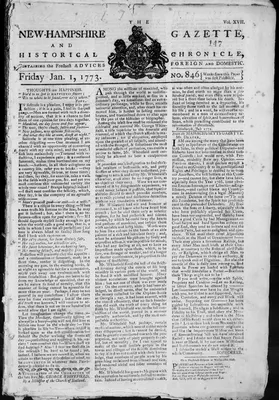
The New Hampshire Gazette And Historical Chronicle Literary January 1, 1773
Portsmouth, Rockingham, New Hampshire
What is this article about?
A Church of Scotland minister's vindication of the late Rev. George Whitefield, defending his eloquence, sincerity, and reforming influence against groundless detraction.
Quality green show the numbers
Measured from the scan
— how cleanly the OCR engine read the characters
- Mean ink quality
- 99.0% The length-weighted average confidence across the OCR lines — the mean of exactly the per-line scores whose tails the two figures below report. Typical is 99%.
- Illegible ink
- 0.0% Text sitting in OCR-detected lines that scored below 80% confidence — very shaky reads. Weighted by line length, so one long bad line counts for more than a short one.
- Uncertain ink
- 0.0% Text in lines that scored 80–90% — somewhat shaky reads.
- Matches source
- 96.22% How closely the served text matches the raw OCR of the same boxes, letter by letter, after collapsing spacing and case. This measures agreement, not correctness: the OCR is often wrong and the extractor corrects it, so 100% does not mean perfect, and a low figure usually means poor scan text was rewritten rather than that text was lost (length vs source shows loss).
- Length vs source
- 98.6% Below 100% means text was dropped from the OCR; above means text was added to make it read.
Assembled by the extraction model
— whether the stitched-together text holds up; catches layout and segmentation errors, which the scores above cannot see
- Transcription confidence
- 98.0% (typical 96%) How cleanly the extractor could assemble what it was given. Low here with clean ink scores points at layout analysis — the characters were read correctly but grouped or ordered wrongly.
- Comprehension
- 95.0% Whether the piece reads coherently start to finish. Can stay high while transcription confidence drops, when only part of the component is affected.
Clipping
Full Text
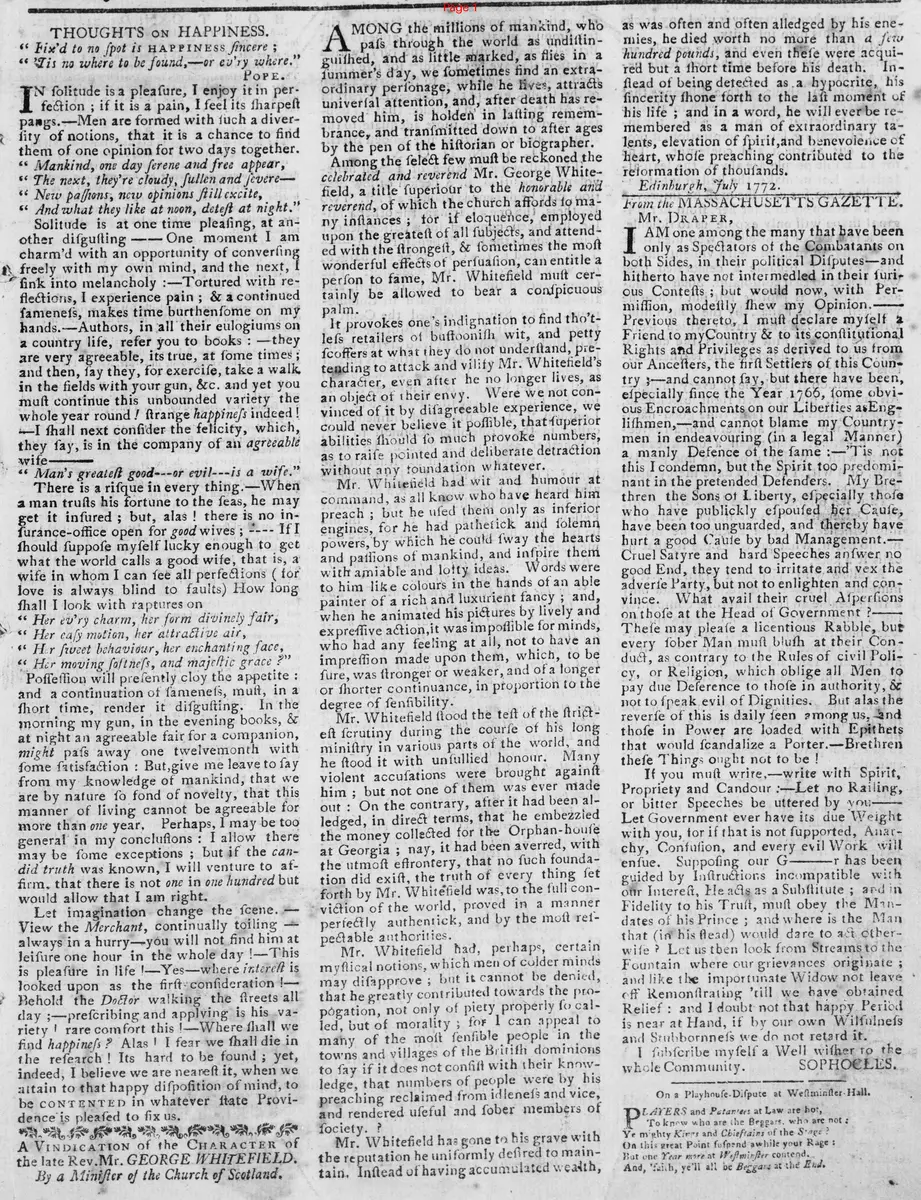
A VINDICATION of the CHARACTER of the late Rev. Mr. GEORGE WHITEFIELD.
By a Minister of the Church of Scotland.
Among the millions of mankind, who pass through the world as undistinguished, and as little marked, as flies in a summer's day, we sometimes find an extraordinary personage, while he lives, attracts universal attention, and, after death has removed him, is holden in lasting remembrance, and transmitted down to after ages by the pen of the historian or biographer.
Among the select few must be reckoned the celebrated and reverend Mr. George Whitefield, a title superior to the honorable and reverend, of which the church affords to many instances; for if eloquence, employed upon the greatest of all subjects, and attended with the strongest, & sometimes the most wonderful effects of persuasion, can entitle a person to fame, Mr. Whitefield must certainly be allowed to bear a conspicuous palm.
It provokes one's indignation to find thoughtless retailers of buffoonish wit, and petty scoffers at what they do not understand, pretending to attack and vilify Mr. Whitefield's character, even after he no longer lives, as an object of their envy. Were we not convinced of it by disagreeable experience, we could never believe it possible, that superior abilities should so much provoke numbers, as to raise pointed and deliberate detraction without any foundation whatever.
Mr. Whitefield had wit and humour at command, as all know who have heard him preach; but he used them only as inferior engines, for he had pathetick and solemn powers, by which he could sway the hearts and passions of mankind, and inspire them with amiable and lofty ideas. Words were to him like colours in the hands of an able painter of a rich and luxuriant fancy; and, when he animated his pictures by lively and expressive action, it was impossible for minds, who had any feeling at all, not to have an impression made upon them, which, to be sure, was stronger or weaker, and of a longer or shorter continuance, in proportion to the degree of sensibility.
Mr. Whitefield stood the test of the strictest scrutiny during the course of his long ministry in various parts of the world, and he stood it with unsullied honour. Many violent accusations were brought against him; but not one of them was ever made out: On the contrary, after it had been alleged, in direct terms, that he embezzled the money collected for the Orphan-house at Georgia; nay, it had been averred, with the utmost effrontery, that no such foundation did exist, the truth of every thing set forth by Mr. Whitefield was, to the full conviction of the world, proved in a manner perfectly authentick, and by the most respectable authorities.
Mr. Whitefield had, perhaps, certain mystical notions, which men of colder minds may disapprove; but it cannot be denied, that he greatly contributed towards the propagation, not only of piety properly so called, but of morality; for I can appeal to many of the most sensible people in the towns and villages of the British dominions to say if it does not consist with their knowledge, that numbers of people were by his preaching reclaimed from idleness and vice, and rendered useful and sober members of society.
Mr. Whitefield has gone to his grave with the reputation he uniformly desired to maintain, Instead of having accumulated wealth, as was often and often alleged by his enemies, he died worth no more than a few hundred pounds, and even these were acquired but a short time before his death. Instead of being detected as a hypocrite, his sincerity shone forth to the last moment of his life; and in a word, he will ever be remembered as a man of extraordinary talents, elevation of spirit, and benevolence of heart, whose preaching contributed to the reformation of thousands.
Edinburgh, July 1772.
What sub-type of article is it?
Essay
What themes does it touch?
Religious
Moral Virtue
What keywords are associated?
George Whitefield
Vindication
Character Defense
Evangelical Preaching
Church Of Scotland
What entities or persons were involved?
By A Minister Of The Church Of Scotland
Literary Details
Title
A Vindication Of The Character Of The Late Rev. Mr. George Whitefield.
Author
By A Minister Of The Church Of Scotland
Subject
Vindication Of George Whitefield's Character After His Death
Form / Style
Argumentative Vindication In Formal Prose
Key Lines
Words Were To Him Like Colours In The Hands Of An Able Painter Of A Rich And Luxuriant Fancy;
Instead Of Being Detected As A Hypocrite, His Sincerity Shone Forth To The Last Moment Of His Life