Thank you for visiting SNEWPapers!
Sign up free
Alexandria Advertiser And Commercial Intelligencer Editorial November 4, 1802
Alexandria, Virginia
What is this article about?
Pro-Federalist editorial defending the Washington and Adams administrations against Jeffersonian slander, citing Wolcott's pamphlet and the Giles-Bayard judiciary debate, and predicting the people will return Federalists to power.
Quality green show the numbers
Measured from the scan
— how cleanly the OCR engine read the characters
- Mean ink quality
- 99.0% The length-weighted average confidence across the OCR lines — the mean of exactly the per-line scores whose tails the two figures below report. Typical is 99%.
- Illegible ink
- 0.0% Text sitting in OCR-detected lines that scored below 80% confidence — very shaky reads. Weighted by line length, so one long bad line counts for more than a short one.
- Uncertain ink
- 0.0% Text in lines that scored 80–90% — somewhat shaky reads.
- Matches source
- 96.26% How closely the served text matches the raw OCR of the same boxes, letter by letter, after collapsing spacing and case. This measures agreement, not correctness: the OCR is often wrong and the extractor corrects it, so 100% does not mean perfect, and a low figure usually means poor scan text was rewritten rather than that text was lost (length vs source shows loss).
- Length vs source
- 99.13% Below 100% means text was dropped from the OCR; above means text was added to make it read.
Assembled by the extraction model
— whether the stitched-together text holds up; catches layout and segmentation errors, which the scores above cannot see
- Transcription confidence
- 92.0% (typical 96%) How cleanly the extractor could assemble what it was given. Low here with clean ink scores points at layout analysis — the characters were read correctly but grouped or ordered wrongly.
- Comprehension
- 95.0% Whether the piece reads coherently start to finish. Can stay high while transcription confidence drops, when only part of the component is affected.
Clipping
Full Text
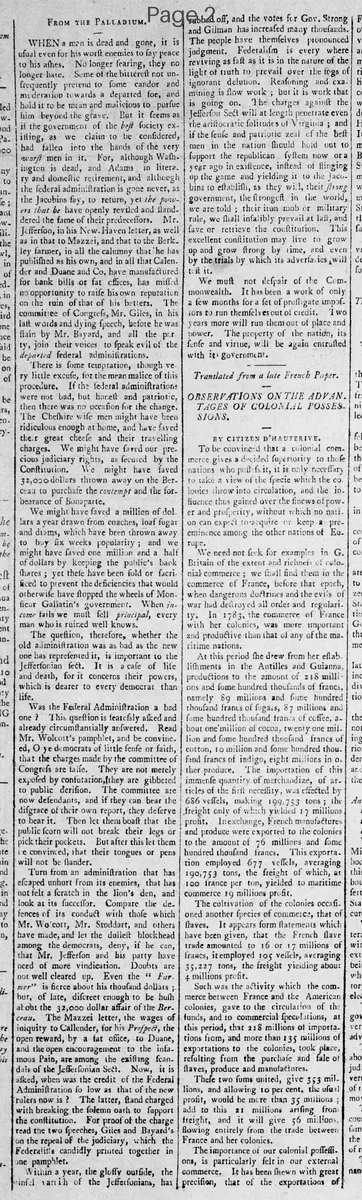
FROM THE PALLADIUM
When a man is dead and gone, it is usual even for his worst enemies to say peace to his ashes. No longer fearing, they no longer hate. Some of the bitterest not unfrequently pretend to some candor and moderation towards a departed foe, and hold it to be mean and malicious to pursue him beyond the grave. But it seems as if the government of the best society existing, as we claim to be considered, had fallen into the hands of the very worst men in it. For, although Washington is dead, and Adams in literary and domestic retirement, and although the federal administration is gone never, as the Jacobins say, to return, yet the powers that be have openly reviled and slandered the fame of their predecessors. Mr. Jefferson, in his New-Haven letter, as well as in that to Mazzei, and that to the Berkeley farmer, in all the calumny that he has published as his own, and in all that Callender and Duane and Co. have manufactured for bank bills or fat offices, has missed no opportunity to raise his own reputation on the ruin of that of his betters. The committee of Congress, Mr. Giles, in his last words and dying speech, before he was slain by Mr. Bayard, and all the party, join their voices to speak evil of the departed federal administrations.
There is some temptation, though very little excuse, for the mean malice of this procedure. If the federal administrations were not bad, but honest and patriotic, then there was no occasion for the change. The Cheshire wise men might have been ridiculous enough at home, and have saved their great cheese and their travelling charges. We might have saved our precious judiciary rights, as secured by the Constitution. We might have saved 32,000 dollars thrown away on the Berceau to purchase the contempt and the forbearance of Bonaparte.
We might have saved a million of dollars a year drawn from coaches, loaf sugar and diamonds, which have been thrown away to buy six weeks popularity; and we might have saved one million and a half of dollars by keeping the public's bank shares; yet these have been sold or sacrificed to prevent the deficiencies that would otherwise have stopped the wheels of Monsieur Gallatin's government. When income fails we must sell principal, every man who is ruined well knows.
The question, therefore, whether the old administration was as bad as the new one has represented it, is important to the Jeffersonian sect. It is a case of life and death, for it concerns their powers, which is dearer to every democrat than life.
Was the Federal Administration a bad one? This question is scarcely asked and already circumstantially answered. Read Mr. Wolcott's pamphlet, and be convinced, O ye democrats of little sense or faith, that the charges made by the committee of Congress are false. They are not merely exposed by confutation; they are gibbeted to public derision. The committee are now defendants, and if they can bear the disgrace of their own report, they deserve to bear it. Then let them boast that the public scorn will not break their legs or pick their pockets. But after this let them be convinced, that their tongues or pens will not be slander.
Turn from an administration that has escaped unhurt from its enemies, that has not felt a scratch in the lion's den, and look at its successor. Compare the defences of its conduct with those which Mr. Wolcott, Mr. Stoddart, and others have made, and let the dullest blockhead among the democrats, deny, if he can, that Mr. Jefferson and his party have need of more vindication. Doubts are not well cleared up. Even the "Farmer" is fierce about his thousand dollars; but, of late, discreet enough to be hush about the 32,000 dollar affair of the Berceau. The Mazzei letter, the wages of iniquity to Callender, for his Prospect, the open reward, by a fat office, to Duane, and the open encouragement to the infamous Paine, are among the existing scandals of the Jeffersonian Sect. Now, it is asked, when was the credit of the Federal Administration so low as that of the new rulers now is? The latter, stand charged with breaking the solemn oath to support the constitution. For proof of the charge read the two speeches, Giles and Bayard's on the repeal of the judiciary, which the Federalists candidly printed together in one pamphlet.
Within a year, the glossy outside, the vile varnish of the Jeffersonians, has rubbed off, and the votes for Gov. Strong and Gilman has increased many thousands. The people have themselves pronounced judgment. Federalism is everywhere reviving as fast as it is in the nature of the light of truth to prevail over the fogs of ignorant delusion. Reasoning and examining is slow work; but it is work that is going on. The charges against the Jefferson Sect will at length penetrate even the aristocratic solitudes of Virginia; and if the sense and patriotic zeal of the best men in the nation should hold out to support the republican system now or a year ago in existence, instead of flinging up the game and yielding it to the Jacobins to establish, as they will, their strong government, the strongest in the world, we are told; their iron mob or military rule, we shall infallibly prevail at last, and save or retrieve the constitution. This excellent constitution may live to grow up and grow strong by time, and even by the trials by which its adversaries will test it.
We must not despair of the Commonwealth. It has been a work of only a few months for a set of profligate impostors to run themselves out of credit. Two years more will run them out of place and power. The property of the nation, its sense and virtue, will be again entrusted with its government.
What sub-type of article is it?
Partisan Politics
Constitutional
What keywords are associated?
Federalist Vindication
Jeffersonian Calumny
Wolcott Pamphlet
Judiciary Repeal
Anti Jefferson
What entities or persons were involved?
George Washington
John Adams
Thomas Jefferson
Oliver Wolcott
Giles
Bayard
Callender
Duane
Paine
Gallatin
Editorial Details
Primary Topic
Vindication Of The Federalist Administrations Against Jeffersonian Slander
Stance / Tone
Strongly Pro Federalist, Exhortatory, Anti Jeffersonian
Key Figures
George Washington
John Adams
Thomas Jefferson
Oliver Wolcott
Giles
Bayard
Callender
Duane
Paine
Gallatin
Key Arguments
- The Federalist administrations were honest and patriotic, not bad
- The committee of Congress charges are false and exposed by Wolcott's pamphlet
- Jeffersonians slandered predecessors to justify the change of government
- The Jeffersonians broke their oath to support the constitution by repealing the judiciary
- Public opinion is already turning back to Federalism
- Federalists will prevail and retrieve the constitution