Thanks for visiting SNEWPapers!
Sign up free today to connect your AI tools to the Library of Congress' newspaper collection.
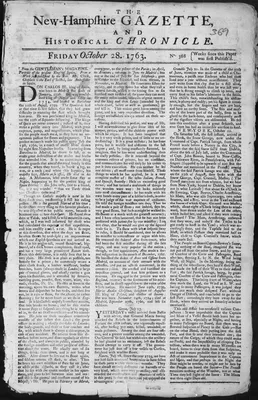
The New Hampshire Gazette And Historical Chronicle Domestic News October 28, 1763
Portsmouth, Rockingham, New Hampshire
What is this article about?
The snow George arrived at the Hook under Capt. Patrick Savage after Capt. John Bowen, mate Charles Armstrong, two seamen and a boy disappeared while boarding another snow at sea; Savage was chosen captain by crew and passengers.
Quality green show the numbers
Measured from the scan
— how cleanly the OCR engine read the characters
- Mean ink quality
- 99.0% The length-weighted average confidence across the OCR lines — the mean of exactly the per-line scores whose tails the two figures below report. Typical is 99%.
- Illegible ink
- 0.0% Text sitting in OCR-detected lines that scored below 80% confidence — very shaky reads. Weighted by line length, so one long bad line counts for more than a short one.
- Uncertain ink
- 0.9% Text in lines that scored 80–90% — somewhat shaky reads.
- Matches source
- 96.03% How closely the served text matches the raw OCR of the same boxes, letter by letter, after collapsing spacing and case. This measures agreement, not correctness: the OCR is often wrong and the extractor corrects it, so 100% does not mean perfect, and a low figure usually means poor scan text was rewritten rather than that text was lost (length vs source shows loss).
- Length vs source
- 99.14% Below 100% means text was dropped from the OCR; above means text was added to make it read.
Assembled by the extraction model
— whether the stitched-together text holds up; catches layout and segmentation errors, which the scores above cannot see
- Transcription confidence
- 95.0% (typical 96%) How cleanly the extractor could assemble what it was given. Low here with clean ink scores points at layout analysis — the characters were read correctly but grouped or ordered wrongly.
- Comprehension
- 92.0% Whether the piece reads coherently start to finish. Can stay high while transcription confidence drops, when only part of the component is affected.
Clipping
Full Text
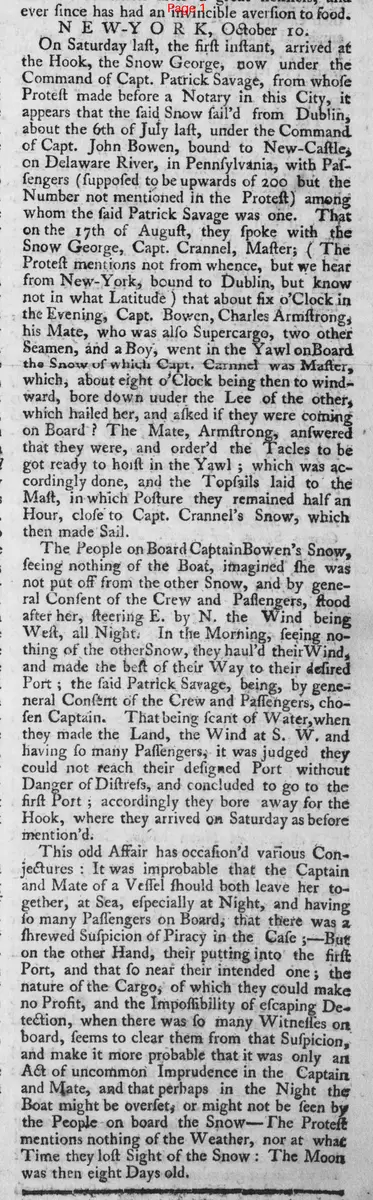
NEW-YORK, October 10.
On Saturday last, the first instant, arrived at the Hook, the Snow George, now under the Command of Capt. Patrick Savage, from whose Protest made before a Notary in this City, it appears that the said Snow sailed from Dublin, about the 6th of July last, under the Command of Capt. John Bowen, bound to New-Castle on Delaware River, in Pennsylvania, with Passengers (supposed to be upwards of 200 but the Number not mentioned in the Protest) among whom the said Patrick Savage was one. That on the 17th of August, they spoke with the Snow George, Capt. Crannel, Master; (The Protest mentions not from whence, but we hear from New-York, bound to Dublin, but know not in what Latitude) that about six o'Clock in the Evening, Capt. Bowen, Charles Armstrong, his Mate, who was also Supercargo, two other Seamen, and a Boy, went in the Yawl on Board the Snow of which Capt. Crannel was Master, which, about eight o'Clock being then to windward, bore down under the Lee of the other, which hailed her, and asked if they were coming on Board? The Mate, Armstrong, answered that they were, and ordered the Tackles to be got ready to hoist in the Yawl; which was accordingly done, and the Topsails laid to the Mast, in which Posture they remained half an Hour, close to Capt. Crannel's Snow, which then made Sail.
The People on Board Captain Bowen's Snow, seeing nothing of the Boat, imagined she was not put off from the other Snow, and by general Consent of the Crew and Passengers, stood after her, steering E. by N. the Wind being West, all Night: In the Morning, seeing nothing of the other Snow, they hauled their Wind, and made the best of their Way to their desired Port; the said Patrick Savage, being, by general Consent of the Crew and Passengers, chosen Captain. That being scant of Water, when they made the Land, the Wind at S. W. and having so many Passengers, it was judged they could not reach their designed Port without Danger of Distress, and concluded to go to the first Port; accordingly they bore away for the Hook, where they arrived on Saturday as before mentioned.
This odd Affair has occasioned various Conjectures: It was improbable that the Captain and Mate of a Vessel should both leave her together, at Sea, especially at Night, and having so many Passengers on Board, that there was a shrewd Suspicion of Piracy in the Case;—But on the other Hand, their putting into the first Port, and that so near their intended one; the nature of the Cargo, of which they could make no Profit, and the Impossibility of escaping Detection, when there was so many Witnesses on board, seems to clear them from that Suspicion, and make it more probable that it was only an Act of uncommon Imprudence in the Captain and Mate, and that perhaps in the Night the Boat might be overset, or might not be seen by the People on board the Snow—The Protest mentions nothing of the Weather, nor at what Time they lost Sight of the Snow: The Moon was then eight Days old.
What sub-type of article is it?
Shipping
Missing Person
What keywords are associated?
Snow George
Captain And Mate Missing
Arrival At The Hook
Patrick Savage
Sea Disappearance
What entities or persons were involved?
Capt. Patrick Savage
Capt. John Bowen
Charles Armstrong
Capt. Crannel
Where did it happen?
New York
Domestic News Details
Primary Location
New York
Event Date
Saturday Last, The First Instant
Key Persons
Capt. Patrick Savage
Capt. John Bowen
Charles Armstrong
Capt. Crannel
Outcome
capt. bowen, mate armstrong, two seamen and a boy disappeared after boarding capt. crannel's snow; the george arrived safely at the hook.