Thank you for visiting SNEWPapers!
Sign up free
Fowle's New Hampshire Gazette And General Advertiser Foreign News January 21, 1785
Portsmouth, Rockingham, New Hampshire
What is this article about?
A commentary on Mr. Pitt's Reform proposals discusses opposition to triennial parliaments and the expected Scotch fisheries bill to be brought in by Mr. Dundas.
Quality green show the numbers
Measured from the scan
— how cleanly the OCR engine read the characters
- Mean ink quality
- 99.0% The length-weighted average confidence across the OCR lines — the mean of exactly the per-line scores whose tails the two figures below report. Typical is 99%.
- Illegible ink
- 0.0% Text sitting in OCR-detected lines that scored below 80% confidence — very shaky reads. Weighted by line length, so one long bad line counts for more than a short one.
- Uncertain ink
- 0.0% Text in lines that scored 80–90% — somewhat shaky reads.
- Matches source
- 96.34% How closely the served text matches the raw OCR of the same boxes, letter by letter, after collapsing spacing and case. This measures agreement, not correctness: the OCR is often wrong and the extractor corrects it, so 100% does not mean perfect, and a low figure usually means poor scan text was rewritten rather than that text was lost (length vs source shows loss).
- Length vs source
- 99.56% Below 100% means text was dropped from the OCR; above means text was added to make it read.
Assembled by the extraction model
— whether the stitched-together text holds up; catches layout and segmentation errors, which the scores above cannot see
- Transcription confidence
- 97.0% (typical 96%) How cleanly the extractor could assemble what it was given. Low here with clean ink scores points at layout analysis — the characters were read correctly but grouped or ordered wrongly.
- Comprehension
- 90.0% Whether the piece reads coherently start to finish. Can stay high while transcription confidence drops, when only part of the component is affected.
Clipping
Full Text
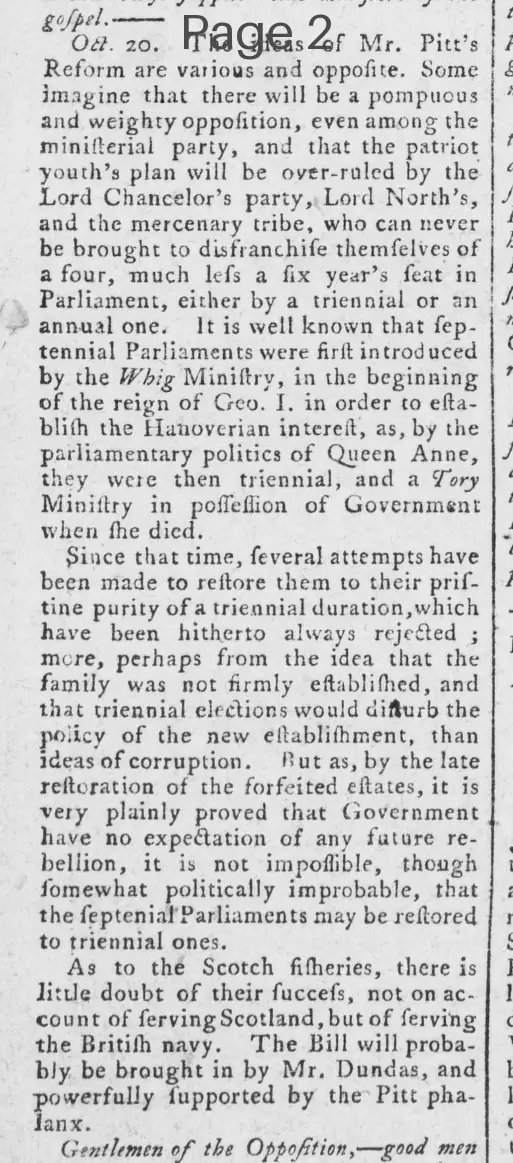
Oct. 20. The ideas of Mr. Pitt's Reform are various and opposite. Some imagine that there will be a pompous and weighty opposition, even among the ministerial party, and that the patriot youth's plan will be over-ruled by the Lord Chancellor's party, Lord North's, and the mercenary tribe, who can never be brought to disfranchise themselves of a four, much less a six year's seat in Parliament, either by a triennial or an annual one. It is well known that septennial Parliaments were first introduced by the Whig Ministry, in the beginning of the reign of Geo. I. in order to establish the Hanoverian interest, as, by the parliamentary politics of Queen Anne, they were then triennial, and a Tory Ministry in possession of Government when she died.
Since that time, several attempts have been made to restore them to their pristine purity of a triennial duration, which have been hitherto always rejected; more, perhaps from the idea that the family was not firmly established, and that triennial elections would disturb the policy of the new establishment, than ideas of corruption. But as, by the late restoration of the forfeited estates, it is very plainly proved that Government have no expectation of any future rebellion, it is not impossible, though somewhat politically improbable, that the septennial Parliaments may be restored to triennial ones.
As to the Scotch fisheries, there is little doubt of their success, not on account of serving Scotland, but of serving the British navy. The Bill will probably be brought in by Mr. Dundas, and powerfully supported by the Pitt phalanx.
What sub-type of article is it?
Political
What keywords are associated?
Pitt Reform
Triennial Parliaments
Scotch Fisheries Bill
What entities or persons were involved?
Mr. Pitt
Lord Chancellor
Lord North
Mr. Dundas
Where did it happen?
Great Britain
Foreign News Details
Primary Location
Great Britain
Event Date
Oct. 20
Key Persons
Mr. Pitt
Lord Chancellor
Lord North
Mr. Dundas