Thank you for visiting SNEWPapers!
Sign up free
The New Hampshire Gazette Foreign News September 10, 1762
Portsmouth, Rockingham, New Hampshire
What is this article about?
Letter from a British officer off Havana describing the landing, siege, and capture of Moro Castle from the Spanish, including naval attack, Spanish sorties, mining, and storming of the fortress.
Quality green show the numbers
Measured from the scan
— how cleanly the OCR engine read the characters
- Mean ink quality
- 96.0% The length-weighted average confidence across the OCR lines — the mean of exactly the per-line scores whose tails the two figures below report. Typical is 99%.
- Illegible ink
- 0.0% Text sitting in OCR-detected lines that scored below 80% confidence — very shaky reads. Weighted by line length, so one long bad line counts for more than a short one.
- Uncertain ink
- 0.5% Text in lines that scored 80–90% — somewhat shaky reads.
- Matches source
- 94.16% How closely the served text matches the raw OCR of the same boxes, letter by letter, after collapsing spacing and case. This measures agreement, not correctness: the OCR is often wrong and the extractor corrects it, so 100% does not mean perfect, and a low figure usually means poor scan text was rewritten rather than that text was lost (length vs source shows loss).
- Length vs source
- 99.45% Below 100% means text was dropped from the OCR; above means text was added to make it read.
Assembled by the extraction model
— whether the stitched-together text holds up; catches layout and segmentation errors, which the scores above cannot see
- Transcription confidence
- 93.0% (typical 96%) How cleanly the extractor could assemble what it was given. Low here with clean ink scores points at layout analysis — the characters were read correctly but grouped or ordered wrongly.
- Comprehension
- 95.0% Whether the piece reads coherently start to finish. Can stay high while transcription confidence drops, when only part of the component is affected.
Clipping
Full Text
NEW-YORK, August 30.
[The following Letter, we believe, will be thought to give the best general Account of Affairs from the Havannah,]
On board the Briton, off the Havannah in Cuba, July 28, 1762.
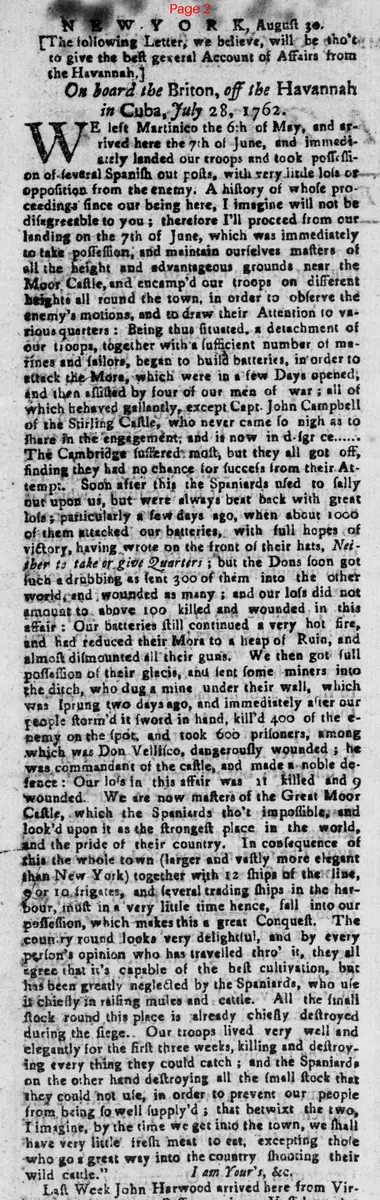
Arrived here the 7th of June, and immediately landed our troops and took possession of several Spanish out-posts, with very little loss or opposition from the enemy: A history of whose proceedings since our being here, I imagine will not be disagreeable to you; therefore I'll proceed from our landing on the 7th of June, which was immediately to take possession, and maintain ourselves masters of all the heights and advantageous grounds near the Moro Castle, and encamped our troops on different heights all round the town, in order to observe the enemy's motions, and to draw their attention to various quarters: Being thus situated, a detachment of our troops, together with a sufficient number of marines and sailors, began to build batteries, in order to attack the Moro, which were in a few days opened; and then assailed by four of our men of war; all of which behaved gallantly, except Capt. John Campbell of the Stirling Castle, who never came so nigh as to share in the engagement; and is now in disgrace...... The Cambridge suffered most, but they all got off, finding they had no chance for success from their attempt. Soon after this the Spaniards used to sally out upon us, but were always beat back with great loss; particularly a few days ago, when about 500 of them attacked our batteries, with full hopes of victory, having wrote on the front of their hats, Neither to take or give Quarters; but the Dons soon got such a drubbing as sent 200 of them into the other world, and wounded as many; and our loss did not amount to above 100 killed and wounded, in this affair: Our batteries still continued a very hot fire, and had reduced their Moro to a heap of ruin, and almost dismounted all their guns. We then got full possession of their glacis, and sent some miners into the ditch, who dug a mine under their wall, which was sprung two days ago, and immediately after our people stormed it sword in hand, killed 400 of the enemy on the spot, and took 600 prisoners, among which was Don Velasco, dangerously wounded; he was commandant of the castle, and made a noble defence: Our loss in this affair was 8 killed and 9 wounded. We are now masters of the Great Moro Castle, which the Spaniards thought impossible, and looked upon it as the strongest place in the world, and the pride of their country. In consequence of this the whole town (larger and vastly more elegant than New York) together with 12 ships of the line, or 10 frigates, and several trading ships in the harbour, must in a very little time hence fall into our possession, which makes this a great conquest. The country round looks very delightful, and by every person's opinion who has travelled through it, they all agree that it's capable of the best cultivation, but has been greatly neglected by the Spaniards, who use it chiefly in raising mules and cattle. All the small stock round this place is already chiefly destroyed during the siege. Our troops lived very well and elegantly for the first three weeks, killing and destroying every thing they could catch; and the Spaniards on the other hand destroying all the small stock they could not use, in order to prevent our people from being so well supplied; that betwixt the two, I imagine, by the time we get into the town, we shall have very little fresh meat to eat, excepting those who go great way into the country shooting their wild cattle.
I am, Yours, &c.
What sub-type of article is it?
Military Campaign
Naval Affairs
What keywords are associated?
Havana Siege
Moro Castle
British Expedition
Spanish Prisoners
What entities or persons were involved?
Capt. John Campbell
Don Velasco
Where did it happen?
Havannah (Havana), Cuba
Foreign News Details
Primary Location
Havannah (Havana), Cuba
Event Date
July 28, 1762
Key Persons
Capt. John Campbell
Don Velasco
Outcome
spanish losses: about 200 killed in a sortie; 400 killed and 600 prisoners at the storming of moro. british losses: about 100 killed/wounded in the sortie; 8 killed and 9 wounded in the storming. moro castle captured.