Thank you for visiting SNEWPapers!
Sign up free
Fowle's New Hampshire Gazette And General Advertiser Story September 16, 1785
Portsmouth, Rockingham, New Hampshire
What is this article about?
A satirical Dublin dispatch describes the vast crowds that turned out to see Crosbie's balloon ascend at Ranelagh, only to be disappointed when it failed; the piece mockingly counts fainting ladies, accidents, and general chaos.
Quality green show the numbers
Measured from the scan
— how cleanly the OCR engine read the characters
- Mean ink quality
- 99.0% The length-weighted average confidence across the OCR lines — the mean of exactly the per-line scores whose tails the two figures below report. Typical is 99%.
- Illegible ink
- 0.0% Text sitting in OCR-detected lines that scored below 80% confidence — very shaky reads. Weighted by line length, so one long bad line counts for more than a short one.
- Uncertain ink
- 0.8% Text in lines that scored 80–90% — somewhat shaky reads.
- Matches source
- 95.59% How closely the served text matches the raw OCR of the same boxes, letter by letter, after collapsing spacing and case. This measures agreement, not correctness: the OCR is often wrong and the extractor corrects it, so 100% does not mean perfect, and a low figure usually means poor scan text was rewritten rather than that text was lost (length vs source shows loss).
- Length vs source
- 98.74% Below 100% means text was dropped from the OCR; above means text was added to make it read.
Assembled by the extraction model
— whether the stitched-together text holds up; catches layout and segmentation errors, which the scores above cannot see
- Transcription confidence
- 97.0% (typical 96%) How cleanly the extractor could assemble what it was given. Low here with clean ink scores points at layout analysis — the characters were read correctly but grouped or ordered wrongly.
- Comprehension
- 85.0% Whether the piece reads coherently start to finish. Can stay high while transcription confidence drops, when only part of the component is affected.
Clipping
Full Text
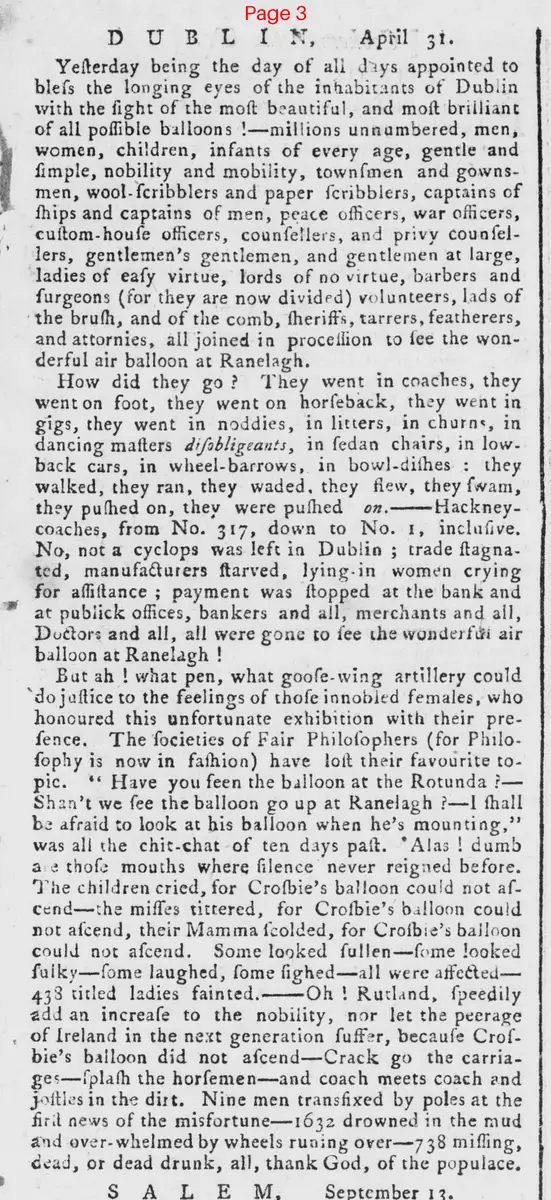
DUBLIN, April 31.
Yesterday being the day of all days appointed to bless the longing eyes of the inhabitants of Dublin with the sight of the most beautiful, and most brilliant of all possible balloons!—millions unnumbered, men, women, children, infants of every age, gentle and simple, nobility and mobility, townsmen and gownsmen, wool-scribblers and paper scribblers, captains of ships and captains of men, peace officers, war officers, custom-house officers, counsellers, and privy counsellors, gentlemen's gentlemen, and gentlemen at large, ladies of easy virtue, lords of no virtue, barbers and surgeons (for they are now divided) volunteers, lads of the brush, and of the comb, sheriffs, tarrers, featherers, and attornies, all joined in procession to see the wonderful air balloon at Ranelagh.
How did they go? They went in coaches, they went on foot, they went on horseback, they went in gigs, they went in noddies, in litters, in churns, in dancing masters disobligeants, in sedan chairs, in low-back cars, in wheel-barrows, in bowl-dishes: they walked, they ran, they waded, they flew, they swam, they pushed on, they were pushed on.—Hackney-coaches, from No. 317, down to No. 1, inclusive. No, not a cyclops was left in Dublin; trade stagnated, manufacturers starved, lying-in women crying for assistance; payment was stopped at the bank and at publick offices, bankers and all, merchants and all, Doctors and all, all were gone to see the wonderful air balloon at Ranelagh!
But ah! what pen, what goose-wing artillery could do justice to the feelings of those innobled females, who honoured this unfortunate exhibition with their presence. The societies of Fair Philosophers (for Philosophy is now in fashion) have lost their favourite topic. "Have you seen the balloon at the Rotunda? Shan't we see the balloon go up at Ranelagh?—I shall be afraid to look at his balloon when he's mounting," was all the chit-chat of ten days past. Alas! dumb are those mouths where silence never reigned before. The children cried, for Crosbie's balloon could not ascend—the misses tittered, for Crosbie's balloon could not ascend, their Mamma scolded, for Crosbie's balloon could not ascend. Some looked sullen—some looked sulky—some laughed, some sighed—all were affected—438 titled ladies fainted.—Oh! Rutland, speedily add an increase to the nobility, nor let the peerage of Ireland in the next generation suffer, because Crosbie's balloon did not ascend—Crack go the carriages—splash the horsemen—and coach meets coach and jostles in the dirt. Nine men transfixed by poles at the first news of the misfortune—1632 drowned in the mud and overwhelmed by wheels running over—738 missing, dead, or dead drunk, all, thank God, of the populace.
What sub-type of article is it?
Extraordinary Event
Curiosity
What themes does it touch?
Misfortune
Social Manners
What keywords are associated?
Balloon Ascent Failure
Dublin Crowds
Ranelagh
Satirical Report
What entities or persons were involved?
Crosbie (Balloonist)
Where did it happen?
Dublin (Ranelagh)
Story Details
Key Persons
Crosbie (Balloonist)
Location
Dublin (Ranelagh)
Event Date
April 31