Thank you for visiting SNEWPapers!
Sign up free
The Virginia Gazette Foreign News December 2, 1773
Williamsburg, Virginia
What is this article about?
A Petersburg-published account of the Russian army's operations beyond the Danube describes the hardships of the retreat, an attack by Spahis and Janissaries, and the capture of Osman's retrenchments by Col. Klitschka.
Quality green show the numbers
Measured from the scan
— how cleanly the OCR engine read the characters
- Mean ink quality
- 99.0% The length-weighted average confidence across the OCR lines — the mean of exactly the per-line scores whose tails the two figures below report. Typical is 99%.
- Illegible ink
- 0.0% Text sitting in OCR-detected lines that scored below 80% confidence — very shaky reads. Weighted by line length, so one long bad line counts for more than a short one.
- Uncertain ink
- 0.0% Text in lines that scored 80–90% — somewhat shaky reads.
- Matches source
- 96.41% How closely the served text matches the raw OCR of the same boxes, letter by letter, after collapsing spacing and case. This measures agreement, not correctness: the OCR is often wrong and the extractor corrects it, so 100% does not mean perfect, and a low figure usually means poor scan text was rewritten rather than that text was lost (length vs source shows loss).
- Length vs source
- 99.57% Below 100% means text was dropped from the OCR; above means text was added to make it read.
Assembled by the extraction model
— whether the stitched-together text holds up; catches layout and segmentation errors, which the scores above cannot see
- Transcription confidence
- 97.0% (typical 96%) How cleanly the extractor could assemble what it was given. Low here with clean ink scores points at layout analysis — the characters were read correctly but grouped or ordered wrongly.
- Comprehension
- 95.0% Whether the piece reads coherently start to finish. Can stay high while transcription confidence drops, when only part of the component is affected.
Clipping
Full Text
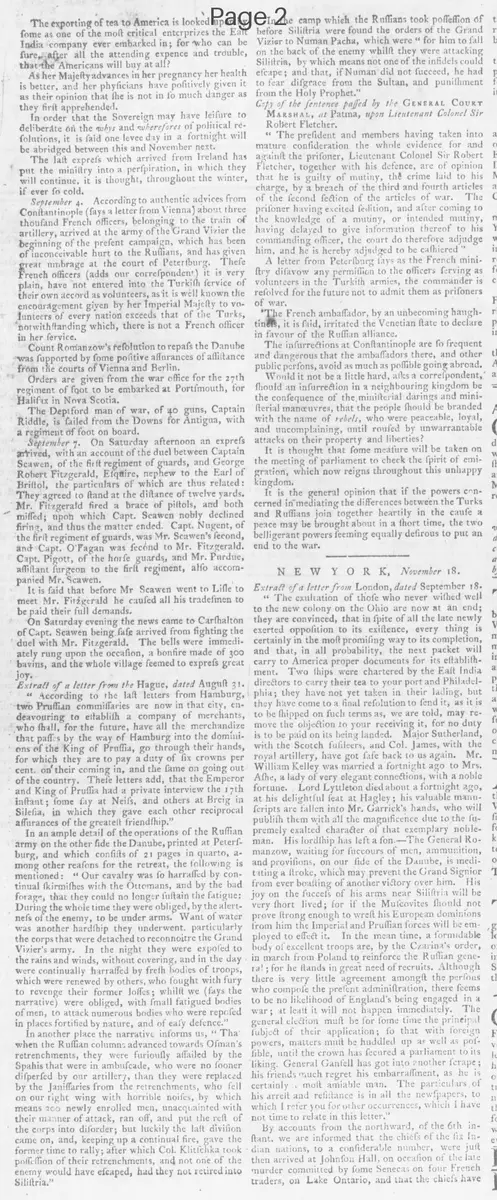
In an ample detail of the operations of the Russian army on the other side the Danube, printed at Petersburg, and which consists of 21 pages in quarto, among other reasons for the retreat, the following is mentioned: "Our cavalry was so harassed by continual skirmishes with the Ottomans, and by the bad forage, that they could no longer sustain the fatigue; During the whole time they were obliged, by the alertness of the enemy, to be under arms. Want of water was another hardship they underwent, particularly the corps that were detached to reconnoitre the Grand Vizier's army. In the night they were exposed to the rains and winds, without covering, and in the day were continually harassed by fresh bodies of troops, which were renewed by others, who fought with fury to revenge their former losses; whilst we (says the narrative) were obliged, with small fatigued bodies of men, to attack numerous bodies who were reposed in places fortified by nature, and of easy defence."
In another place the narrative informs us, "That when the Russian columns advanced towards Osman's retrenchments, they were furiously assailed by the Spahis that were in ambuscade, who were no sooner dispersed by our artillery, than they were replaced by the Janissaries from the retrenchments, who fell on our right wing with horrible noises, by which means 200 newly enrolled men, unacquainted with their manner of attack, ran off, and put the rest of the corps into disorder; but luckily the last division came on, and, keeping up a continual fire, gave the former time to rally; after which Col. Klitschka took possession of their retrenchments, and not one of the enemy would have escaped, had they not retired into Silistria."
In the camp which the Russians took possession of before Silistria were found the orders of the Grand Vizier to Numan Pacha, which were "for him to fall on the back of the enemy whilst they were attacking Silistria, by which means not one of the infidels could escape; and that, if Numan did not succeed, he had to fear disgrace from the Sultan, and punishment from the Holy Prophet."
What sub-type of article is it?
Military Campaign
War Report
What keywords are associated?
Russian Army
Danube Retreat
Silistria
Spahis
Janissaries
What entities or persons were involved?
Col. Klitschka
Grand Vizier
Numan Pacha
Where did it happen?
Danube / Silistria
Foreign News Details
Primary Location
Danube / Silistria
Key Persons
Col. Klitschka
Grand Vizier
Numan Pacha
Outcome
200 newly enrolled men ran off but rallied; col. klitschka took the retrenchments; enemy retired into silistria.