Thank you for visiting SNEWPapers!
Sign up free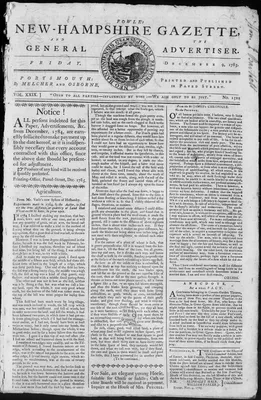
Fowle's New Hampshire Gazette And General Advertiser Letter to Editor December 9, 1785
Portsmouth, Rockingham, New Hampshire
What is this article about?
A philosophical letter to the printer reflecting on matrimony, contrasting marriages for beauty or fortune with unions based on mutual affection, and advocating a happy medium.
Quality green show the numbers
Measured from the scan
— how cleanly the OCR engine read the characters
- Mean ink quality
- 99.0% The length-weighted average confidence across the OCR lines — the mean of exactly the per-line scores whose tails the two figures below report. Typical is 99%.
- Illegible ink
- 0.5% Text sitting in OCR-detected lines that scored below 80% confidence — very shaky reads. Weighted by line length, so one long bad line counts for more than a short one.
- Uncertain ink
- 0.0% Text in lines that scored 80–90% — somewhat shaky reads.
- Matches source
- 95.96% How closely the served text matches the raw OCR of the same boxes, letter by letter, after collapsing spacing and case. This measures agreement, not correctness: the OCR is often wrong and the extractor corrects it, so 100% does not mean perfect, and a low figure usually means poor scan text was rewritten rather than that text was lost (length vs source shows loss).
- Length vs source
- 98.93% Below 100% means text was dropped from the OCR; above means text was added to make it read.
Assembled by the extraction model
— whether the stitched-together text holds up; catches layout and segmentation errors, which the scores above cannot see
- Transcription confidence
- 96.0% (typical 96%) How cleanly the extractor could assemble what it was given. Low here with clean ink scores points at layout analysis — the characters were read correctly but grouped or ordered wrongly.
- Comprehension
- 95.0% Whether the piece reads coherently start to finish. Can stay high while transcription confidence drops, when only part of the component is affected.
Clipping
Full Text
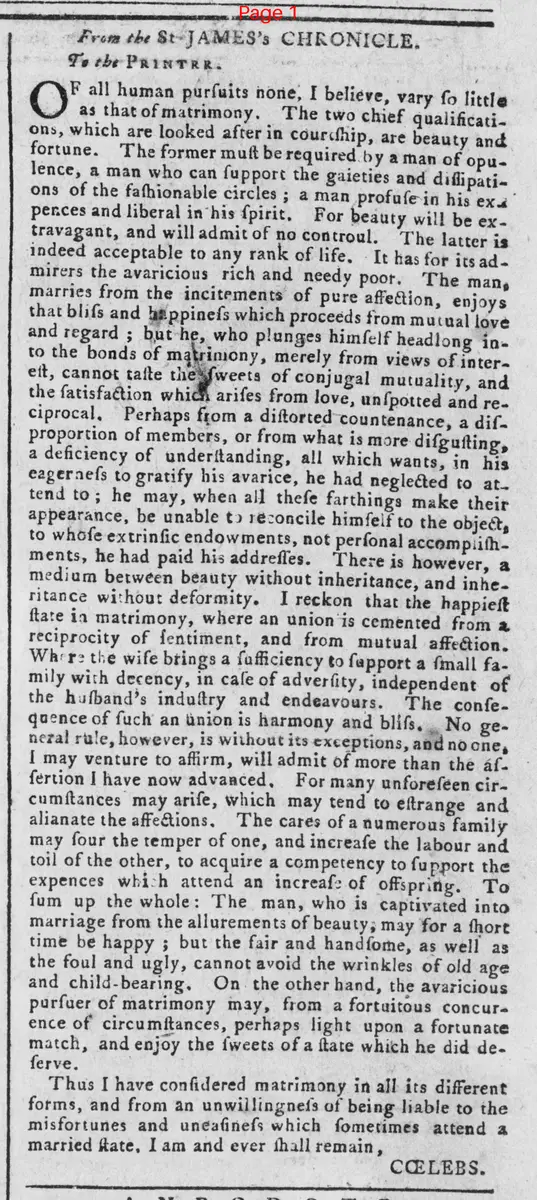
From the St. James's Chronicle.
To the PRINTER.
Of all human pursuits none, I believe, vary so little as that of matrimony. The two chief qualifications, which are looked after in courtship, are beauty and fortune. The former must be required by a man of opulence, a man who can support the gaieties and dissipations of the fashionable circles; a man profuse in his expenses and liberal in his spirit. For beauty will be extravagant, and will admit of no control. The latter is indeed acceptable to any rank of life. It has for its admirers the avaricious rich and needy poor. The man, who marries from the incitements of pure affection, enjoys that bliss and happiness which proceeds from mutual love and regard; but he, who plunges himself headlong into the bonds of matrimony, merely from views of interest, cannot taste the sweets of conjugal mutuality, and the satisfaction which arises from love, unspotted and reciprocal. Perhaps from a distorted countenance, a disproportion of members, or from what is more disgusting, a deficiency of understanding, all which wants, in his eagerness to gratify his avarice, he had neglected to attend to; he may, when all these farthings make their appearance, be unable to reconcile himself to the object, to whose extrinsic endowments, not personal accomplishments, he had paid his addresses.
There is however, a medium between beauty without inheritance, and inheritance without deformity. I reckon that the happiest state in matrimony, where an union is cemented from a reciprocity of sentiment, and from mutual affection. Where the wife brings a sufficiency to support a small family with decency, in case of adversity, independent of the husband's industry and endeavours. The consequence of such an union is harmony and bliss.
No general rule, however, is without its exceptions, and no one, I may venture to affirm, will admit of more than the assertion I have now advanced. For many unforeseen circumstances may arise, which may tend to estrange and alienate the affections. The cares of a numerous family may sour the temper of one, and increase the labour and toil of the other, to acquire a competency to support the expenses which attend an increase of offspring. To sum up the whole: The man, who is captivated into marriage from the allurements of beauty; may for a short time be happy; but the fair and handsome, as well as the foul and ugly, cannot avoid the wrinkles of old age and child-bearing. On the other hand, the avaricious pursuer of matrimony may, from a fortuitous concurrence of circumstances, perhaps light upon a fortunate match, and enjoy the sweets of a state which he did deserve.
Thus I have considered matrimony in all its different forms, and from an unwillingness of being liable to the misfortunes and uneasiness which sometimes attend a married state, I am and ever shall remain,
CŒLEBS.
What sub-type of article is it?
Social Critique
Philosophical
What themes does it touch?
Morality
Social Issues
What keywords are associated?
Matrimony
Marriage For Love Vs Money
Beauty And Fortune
Conjugal Happiness
Cœlebs
What entities or persons were involved?
The Printer
Cœlebs
Letter to Editor Details
Author
Cœlebs
Recipient
The Printer
Main Argument
Argues that marriages motivated by beauty or fortune are unlikely to be happy, while unions based on mutual affection and a sufficient competency bring harmony and bliss.
Notable Details
- identifies beauty and fortune as the two chief qualifications sought in courtship
- notes beauty fades with old age and child-bearing
- cautions that unforeseen circumstances can estrange affections even in good marriages
- signed CŒLEBS, meaning bachelor