Thanks for visiting SNEWPapers!
Sign up free today to connect your AI tools to the Library of Congress' newspaper collection.
Fowle's New Hampshire Gazette And General Advertiser Letter to Editor March 18, 1785
What is this article about?
A reader's letter to the New-Hampshire Gazette accusing the state Council of corrupt, self-serving judicial appointments—removing able judges, appointing relatives and unqualified outsiders from Massachusetts—and calling on the public to judge their conduct under the state constitution.
Quality green show the numbers
- Mean ink quality
- 98.0% The length-weighted average confidence across the OCR lines — the mean of exactly the per-line scores whose tails the two figures below report. Typical is 99%.
- Illegible ink
- 0.0% Text sitting in OCR-detected lines that scored below 80% confidence — very shaky reads. Weighted by line length, so one long bad line counts for more than a short one.
- Uncertain ink
- 0.0% Text in lines that scored 80–90% — somewhat shaky reads.
- Matches source
- 95.69% How closely the served text matches the raw OCR of the same boxes, letter by letter, after collapsing spacing and case. This measures agreement, not correctness: the OCR is often wrong and the extractor corrects it, so 100% does not mean perfect, and a low figure usually means poor scan text was rewritten rather than that text was lost (length vs source shows loss).
- Length vs source
- 99.7% Below 100% means text was dropped from the OCR; above means text was added to make it read.
- Transcription confidence
- 94.0% (typical 96%) How cleanly the extractor could assemble what it was given. Low here with clean ink scores points at layout analysis — the characters were read correctly but grouped or ordered wrongly.
- Comprehension
- 90.0% Whether the piece reads coherently start to finish. Can stay high while transcription confidence drops, when only part of the component is affected.
Clipping
Full Text
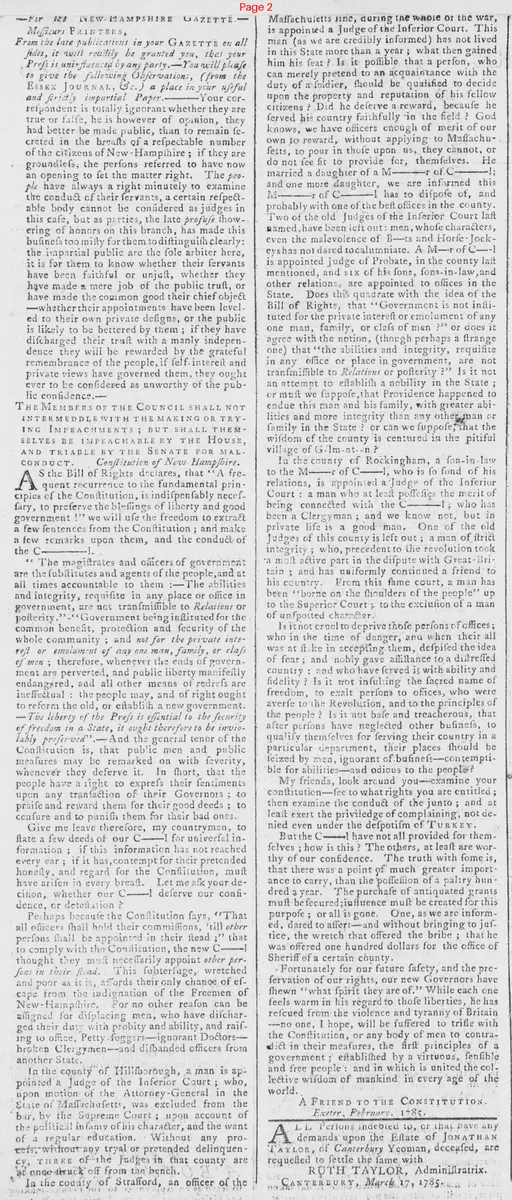
Messieurs PRINTERS,
From the late publications in your Gazette on all sides, it will readily be granted you, that your Press is uninfluenced by any party,—You will please to give the following Observations, (from the Essex Journal, &c.) a place in your useful and strictly impartial Paper.—Your correspondent is totally ignorant whether they are true or false, he is however of opinion, they had better be made public, than to remain secreted in the breasts of a respectable number of the citizens of New-Hampshire; if they are groundless, the persons referred to have now an opening to set the matter right. The people have always a right minutely to examine the conduct of their servants, a certain respectable body cannot be considered as judges in this case, but as parties, the late profuse showering of honors on this branch, has made this business too misty for them to distinguish clearly: the impartial public are the sole arbiter here, it is for them to know whether their servants have been faithful or unjust, whether they have made a mere job of the public trust, or have made the common good their chief object —whether their appointments have been leveled to their own private designs, or the public is likely to be bettered by them; if they have discharged their trust with a manly independence they will be rewarded by the grateful remembrance of the people, if self-interest and private views have governed them, they ought ever to be considered as unworthy of the public confidence.—
THE MEMBERS OF THE COUNCIL SHALL NOT INTERMEDDLE WITH THE MAKING OR TRYING IMPEACHMENTS; BUT SHALL THEMSELVES BE IMPEACHABLE BY THE HOUSE, AND TRIABLE BY THE SENATE FOR MALCONDUCT. Constitution of New-Hampshire.
As the Bill of Rights declares, that "A frequent recurrence to the fundamental principles of the Constitution, is indispensably necessary to preserve the blessings of liberty and good government!" we will use the freedom to extract a few sentences from the Constitution; and make a few remarks upon them, and the conduct of the C--l.
"The magistrates and officers of government are the substitutes and agents of the people, and at all times accountable to them:—The abilities and integrity, requisite in any place or office in government, are not transmissible to Relations or posterity."—"Government being instituted for the common benefit, protection and security of the whole community; and not for the private interest or emolument of any one man, family, or class of men; therefore, whenever the ends of government are perverted, and public liberty manifestly endangered, and all other means of redress are ineffectual: the people may, and of right ought to reform the old, or establish a new government.—The liberty of the Press is essential to the security of freedom in a State, it ought therefore to be inviolably preserved."—And the general tenor of the Constitution is, that public men and public measures may be remarked on with severity, whenever they deserve it. In short, that the people have a right to express their sentiments upon any transaction of their Governors; to praise and reward them for their good deeds; to censure and to punish them for their bad ones.
Give me leave therefore, my countrymen, to state a few deeds of our C--l for universal information; if this information has not reached every ear; if it has, contempt for their pretended honesty, and regard for the Constitution, must have arisen in every breast. Let me ask your decision, whether our C--l deserve our confidence, or detestation?
Perhaps because the Constitution says, "That all officers shall hold their commissions, 'till other persons shall be appointed in their stead;" that to comply with the Constitution, the new C—l thought they must necessarily appoint other persons in their stead. This subterfuge, wretched and poor as it is, affords their only chance of escape from the indignation of the Freemen of New-Hampshire, For no other reason can be assigned for displacing men, who have discharged their duty with probity and ability, and raising to office, Petty-foggers—ignorant Doctors—broken Clergymen—and disbanded officers from another State.
In the county of Hillsborough, a man is appointed a Judge of the Inferior Court; who, upon motion of the Attorney-General in the State of Massachusetts, was excluded from the bar, by the Supreme Court; upon account of the political infamy of his character, and the want of a regular education.· Without any process, without any tryal or pretended delinquency, THREE of the Judges in that county are at once struck off from the bench.
In the county of Strafford, an officer of the Massachusetts line, during the whole of the war, is appointed a Judge of the Inferior Court. This man (as we are credibly informed) has not lived in this State more than a year; what then gained him his seat? Is it possible that a person, who can merely pretend to an acquaintance with the duty of a soldier, should be qualified to decide upon the property and reputation of his fellow citizens? Did he deserve a reward, because he served his country faithfully in the field? God knows, we have officers enough of merit of our own to reward, without applying to Massachusetts, to pour in those upon us, they cannot, or do not see fit to provide for, themselves. He married a daughter of a Member of C--l; and one more daughter, we are informed this Member of C--l has to dispose of, and probably with one of the best offices in the county. Two of the old Judges of the Inferior Court last named, have been left out: men, whose characters, even the malevolence of B--ts and Horse-Jockeys has not dared to calumniate. A Member of C--l is appointed Judge of Probate, in the county last mentioned, and six of his sons, sons-in-law, and other relations, are appointed to offices in the State. Does this quadrate with the idea of the Bill of Rights, that "Government is not instituted for the private interest or emolument of any one man, family, or class of men?" or does it agree with the notion, (though perhaps a strange one) that "the abilities and integrity, requisite in any office or place in government, are not transmissible to Relations or posterity?" Is it not an attempt to establish a nobility in the State; or must we suppose, that Providence happened to endue this man and his family, with greater abilities and more integrity than any other man or family in the State? or can we suppose, that the wisdom of the county is centered in the pitiful village of G-lm-nt--n?
In the county of Rockingham, a son-in-law to the Member of C——l, who is so fond of his relations, is appointed a Judge of the Inferior Court: a man who at least possesses the merit of being connected with the C--l; has been a Clergyman; and we know not, but in private life is a good man. One of the old Judges of this county is left out; a man of strict integrity; who, precedent to the revolution took a most active part in the dispute with Great-Britain; and has uniformly continued a friend to his country. From this same court, a man has been "borne on the shoulders of the people" up to the Superior Court; to the exclusion of a man of unspotted character
Is it not cruel to deprive those persons of offices; who in the time of danger, and when their all was at stake in accepting them, despised the idea of fear; and nobly gave assistance to a distressed country; and who have served it with ability and fidelity? Is it not insulting the sacred name of freedom, to exalt persons to offices, who were averse to the Revolution, and to the principles of the people? Is it not base and treacherous, that after persons have neglected other business, to qualify themselves for serving their country in a particular department, their places should be seized by men, ignorant of business—contemptible for abilities—and odious to the people?
My friends, look around you—examine your constitution—see to what rights you are entitled; then examine the conduct of the junto; and at least exert the privilege of complaining, not denied even under the despotism of Turkey.
But the C-l have not all provided for themselves; how is this? The others, at least are worthy of our confidence. The truth with some is, that there was a point of much greater importance to carry, than the possession of a paltry hundred a year. The purchase of antiquated grants must be secured; influence must be created for this purpose; or all is gone. One, as we are informed, dared to assert—and without bringing to justice, the wretch that offered the bribe; that he was offered one hundred dollars for the office of Sheriff of a certain county.
-Fortunately for our future safety, and the preservation of our rights, our new Governors have shewn "what spirit they are of." While each one feels warm in his regard to those liberties, he has rescued from the violence and tyranny of Britain—no one, I hope, will be suffered to trifle with the Constitution, or any body of men to contradict in their measures, the first principles of a government; established by a virtuous, sensible and free people': and in which is united the collective wisdom of mankind in every age of the world.
A FRIEND TO THE CONSTITUTION.
Exeter, February, 1785,
What sub-type of article is it?
What themes does it touch?
What keywords are associated?
What entities or persons were involved?
Letter to Editor Details
Author
A Friend To The Constitution
Recipient
Messieurs Printers
Main Argument
The New Hampshire Council has abused its appointment power by removing capable judges and rewarding relatives, partisans, and unqualified outsiders, in violation of the state constitution; the public has a right to examine and condemn such conduct.
Notable Details
- Quotes the New Hampshire Bill of Rights on accountability of magistrates and freedom of the press
- Cites specific appointments in Hillsborough, Strafford, and Rockingham counties
- Accuses a council member of nepotism and of placing six relatives in office
- Alleges a bribe was offered for a sheriff's office
- Argues the council's actions contradict the constitutional principle that government is not for private emolument